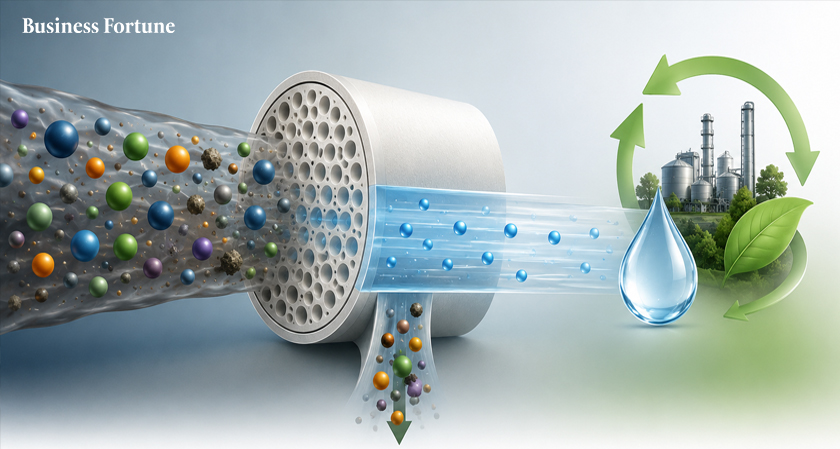
Business Fortune examines how POMbranes Separate Molecules with exceptional precision, helping industries reduce manufacturing waste, save energy, and support sustainable production.
Researchers have developed ultra-thin crystalline membranes, called POMbranes, that can separate molecules with remarkable precision while using significantly less energy than conventional industrial methods. POMbranes separate molecules and the separation processes are a hidden but essential part of many industries.
Traditional techniques such as distillation and evaporation have long been the industry standard. While effective, they require high temperatures and substantial energy input, leading to increased costs and carbon emissions. Scientists have been searching for better alternatives, and the newly developed POMbranes may offer a promising solution.
A One-Nanometer Pore Makes a Big Difference
Researchers from the CSIR-Central Salt and Marine Chemicals Research Institute (CSMCRI) and Indian Institute of Technology Gandhinagar (IITGN) designed membranes with pores measuring just one nanometer across. To put that into perspective, these openings are thousands of times thinner than a human hair. The design takes inspiration from aquaporins, natural channels found in living organisms that carefully control the movement of water and other molecules.
Instead of using traditional plastic-based filters, the team employed polyoxometalate (POM) clusters, tiny crown-shaped metal structures that naturally contain perfectly sized and permanently stable openings. According to the researchers, one of the biggest challenges with conventional polymer membranes is that their pores can change shape over time, reducing performance. The POM-based design avoids this problem by maintaining a consistent pore size.
How Did Scientists Build Such a Precise Filter?
Creating a usable membrane required arranging billions of these microscopic structures into a flawless ultra-thin layer. To achieve this, researchers attached flexible chemical chains to the POM clusters. When placed on water, the modified clusters naturally spread out and assembled themselves into a continuous film.
By carefully adjusting the chain lengths, the team controlled how tightly the clusters packed together. As a result, molecules were forced to pass through the one-nanometer openings, turning the membrane into a highly selective molecular sieve. Computer simulations performed by the research team further revealed how molecules travel through the membrane and how the filtration process works at the atomic scale.
Nearly Ten Times Better Performance
Testing delivered impressive results. The membranes successfully distinguished between molecules differing by only 100 to 200 Daltons, a level of precision that is difficult for conventional filtration technologies to achieve.
Key advantages include:
- Almost ten times higher separation performance than many existing membrane technologies
- Excellent flexibility and durability
- Stability across a wide range of acidity levels
- Potential for large-scale manufacturing
This combination makes the technology attractive for real-world industrial use.
Can It Help Solve Water and Waste Challenges?
One of the most promising applications lies in India's textile sector. Textile dyeing processes generate large volumes of wastewater that are difficult to treat. The new membranes can selectively remove dye molecules while allowing water to pass through, enabling water recycling and reducing waste. This could help manufacturers lower freshwater consumption while reducing environmental impact.
A Boost for Pharmaceutical Production
The pharmaceutical industry could also benefit significantly. Drug purification and solvent recovery require extremely accurate separations and consume large amounts of energy. The new membranes could improve efficiency while maintaining the strict quality standards required for medicine production. Researchers believe this could lower manufacturing costs and reduce the environmental footprint of pharmaceutical facilities.
A New Platform for Sustainable Industry
Scientists describe POMbranes as more than a single invention. They see them as a flexible platform technology that can be adapted for wastewater treatment, chemical manufacturing, and other industrial processes.
As Business Fortune observes, the development of POMbranes highlights how advanced nanomaterials may reshape industrial separation technologies in the coming years. If successfully adopted on a large scale, these membranes could reduce energy consumption, lower carbon emissions, improve water recycling, and make manufacturing more sustainable.
FAQs
1. What are POMbranes?
POMbranes are ultra-thin crystalline membranes made using polyoxometalate (POM) clusters. They contain highly precise one-nanometer pores that allow selective separation of molecules.
2. Why are these membranes important?
They can perform industrial separations with much higher efficiency while using less energy than traditional methods such as distillation and evaporation.
3. How small is a one-nanometer pore?
A nanometer is one-billionth of a meter. The pores in POMbranes are thousands of times thinner than a human hair.
4. Which industries could benefit from this technology?
Textile manufacturing, pharmaceutical production, wastewater treatment, food processing, and chemical manufacturing could all benefit from these membranes.
5. How do POMbranes support sustainability?
They can reduce industrial energy use, lower carbon emissions, improve water recycling, and decrease chemical waste generation.


.webp)