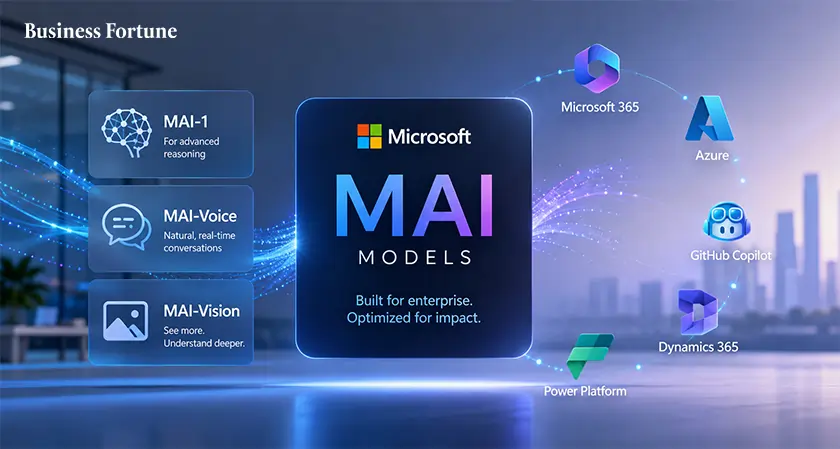
Microsoft introduces seven MAI models at Build 2026, strengthening reasoning, coding, healthcare, and enterprise AI capabilities globally across platforms.
Microsoft launches new MAI models at its Build 2026 developer conference, marking a major expansion of its artificial intelligence portfolio and a clearer move toward building its own full-scale AI ecosystem.
MAI-Thinking-1, the company's first proprietary thinking model intended for long-context reasoning, coding activities, and complicated problem-solving, led the announcement. The model, which was created completely from scratch using commercially licensed data, is positioned as a rival to top enterprise-focused systems and is currently accessible in private preview via Microsoft's Foundry AI development platform. According to Microsoft, the approach is optimized for efficiency, managing multi-step instructions and extended context windows targeted for real-world software engineering and enterprise workflows.
Microsoft also unveiled MAI-Code-1-Flash, a lightweight coding paradigm that is immediately integrated into Visual Studio Code and GitHub Copilot. The concept supports Microsoft's larger move toward "intent-based" software development by helping developers with agent-based programming workflows and quicker, more economical code production.
The remaining models cover a variety of AI fields. While MAI-Transcribe-1.5 offers high-accuracy speech-to-text capabilities in dozens of languages, MAI-picture-2.5 concentrates on picture creation and modification. With the addition of sophisticated speech synthesis and multilingual capabilities, MAI-speech-2 represents Microsoft's move toward more natural human-computer interface solutions. These models work together to provide a single MAI family that addresses all of the fundamental business AI requirements, including automation, communication and media production.
Microsoft's growing focus on lowering reliance on outside AI vendors by developing its own fundamental models is a major strategic highlight of the release. With the aim to better integrate its AI stack with Azure and developer tools, the company has been making consistent investments in internal model creation and training infrastructure.
Additionally, Microsoft increased its emphasis on industry-specific AI, such as healthcare. The company disclosed ongoing partnership efforts to create advanced clinical AI systems that will assist with diagnosis and treatment planning, initially in controlled hospital settings before being widely used.
With these releases, Microsoft is establishing itself as a full-stack AI supplier that includes developer platforms, cloud infrastructure, hardware, and now an expanding collection of proprietary AI models. The announcements for Build 2026 are part of a larger trend in the industry toward integrated AI ecosystems, in which enterprises are in charge of both the platforms and the models.
Thus, Business Fortune is of the view that Microsoft’s AI expansion strengthens its leadership in shaping enterprise-focused AI ecosystems.


.webp)