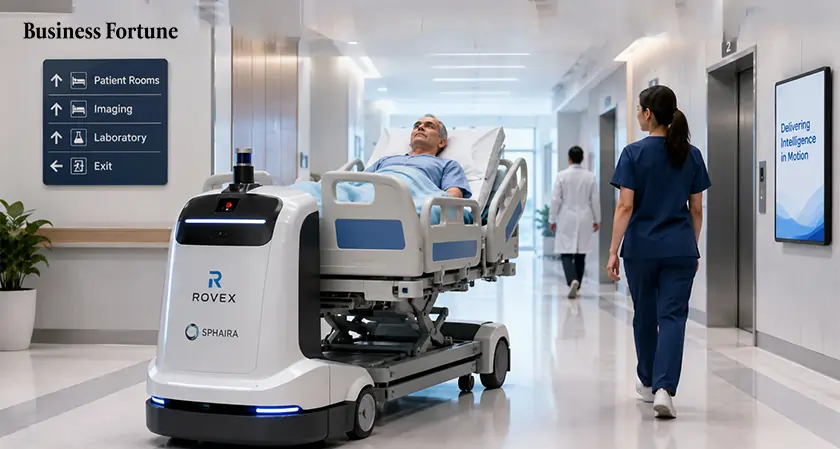
Rovex and Sphaira are bringing autonomous robotics into healthcare with a new patient transport system designed for hospitals, highlighting how robotics is expanding complex healthcare environments where safety, navigation, and workflow integration are critical.
Autonomous robotics has already transformed warehouses and factory floors. Now, companies are beginning to take that technology into one of the most complex indoor environments of hospitals.
Rovex and Sphaira are working together on a robotic system that can help transport patients inside hospitals without human assistance. The companies have not yet shared when the autonomous patient transport will be launched, where it will be used, or the technical details behind it. Still, the project shows that robotics is slowly expanding into healthcare operations.
The system is built to move patients using existing hospital beds, wheelchairs, stretchers, and gurneys. Unlike warehouse robots that work in controlled spaces, hospital robots have to safely move through busy hallways, shared elevators, and constantly changing environments filled with staff, patients, and visitors.
Can robots safely transport patients
According to Dr. Crabb of Rovex, the company’s key innovation lies in its towing technology, which allows robots to securely attach to free-spinning caster wheels commonly found on medical beds and transport equipment.
“One of the core pieces that we’ve developed in-house is around how we grab and integrate with caster wheels,” Crabb explained. He added that the company went through multiple design iterations to safely control stretchers, beds, and wheelchairs during movement. Safety remains their top concern.
“The No. 1 consideration when you’re moving around is that this is a vulnerable population,” said Crabb. He stressed that patients must feel safe and remain in control throughout transport.
To support that goal, Rovex has equipped its robots with:
-
Obstacle avoidance systems
-
Emergency stop buttons
-
Emergency release mechanisms
-
Slow and controlled movement settings
Crabb also highlighted the importance of data in improving robotic navigation inside hospitals.
“Social interaction with people can be chaotic,” he said, noting that healthcare workers, visitors, and patients create highly dynamic traffic patterns. The company is continuing to refine its algorithms using operational data collected during testing.
Robotics expands deeper into healthcare
Other innovators entering the space include OGGMA, which introduced an autonomous driving hospital bed at CES 2025, along with companies such as Able Innovations and Diligent Robotics.
As Business Fortune observes, hospitals continue searching for ways to improve efficiency and reduce staff workload, autonomous transport systems could become a larger part of healthcare operations. The success of projects like Rovex and Sphaira may ultimately determine how quickly robotics expands beyond warehouses into complex human-centered environments.


.webp)