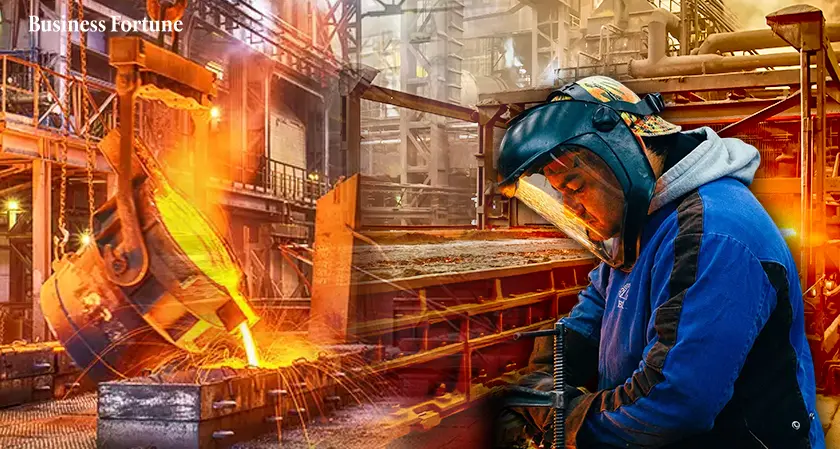
China Baowu leads the world's metal manufacturing companies at 124.76 million tonnes, while Tata Steel tops India. A ranked table and analysis.
China Baowu Group is the largest of the world's metal manufacturing companies, with 124.76 million tonnes of crude steel in 2025, according to the World Steel Association. That is nearly double the output of the runner up, ArcelorMittal, at 63.43 million tonnes. In India, Tata Steel and JSW Steel sit less than 0.2 million tonnes apart on the global list, so the answer to "who is biggest" depends on the yardstick!
This guide ranks the ten largest metal manufacturing companies using Worldsteel's 2025 list, the latest full year ranking available heading into 2027. It then explains what the numbers reveal about Chinese dominance, India's contenders and the manufacturing industries that depend on these mills.
Which are the top 10 metal manufacturing companies?
Crude steel output is the one measure every producer reports on the same basis, so worldsteel ranks on it. The 2025 order:
|
Rank |
Company |
Headquarters |
2025 crude steel (million tonnes) |
Share of world output |
|
1 |
China Baowu Group |
China |
124.76 |
6.7% |
|
2 |
ArcelorMittal |
Luxembourg |
63.43 |
3.4% |
|
3 |
Japan |
57.78 |
3.1% |
|
|
4 |
China |
57.61 |
3.1% |
|
|
5 |
China |
42.49 |
2.3% |
|
|
6 |
China |
39.10 |
2.1% |
|
|
7 |
Jianlong Group |
China |
38.02 |
2.1% |
|
8 |
South Korea |
37.36 |
2.0% |
|
|
9 |
China |
32.03 |
1.7% |
|
|
10 |
Tata Steel Group |
India |
30.46 |
1.6% |
Shares are calculated against world output of 1,849.4 million tonnes.
Add the column up and the ten firms produced 523.04 million tonnes, roughly 28% of the world's steel. Six Chinese groups account for 334.01 million tonnes of that. Concentration exists, but it is thinner than the headlines suggest: the largest single producer makes under 7% of the global total.
Why do Chinese groups dominate the list?
Scale at home
China produced 960.8 million tonnes in 2025, more than half the world total, even after a 4.4% decline. Of the 77 companies that cleared worldsteel's 3 million tonne threshold, 33 are headquartered in China.
Dominance does not mean growth
Baowu's output fell from 130.09 million tonnes in 2024 to 124.76 million, a drop of about 4% and Ansteel slipped from 59.55 million to 57.61 million. The real movement came from deal making. Nippon Steel completed its US$14.9 billion purchase of U.S. Steel in June 2025, and its reported output jumped 32.4% to 57.78 million tonnes, enough to leapfrog Ansteel into third place. The gap between them is 0.17 million tonnes.
Consolidation is also shrinking the field
Only 77 companies qualified for the 2025 ranking, down from 104 a year earlier. Delong Steel rose from 29.33 million to 32.03 million tonnes and moved ahead of Tata Steel, which edged down from 31.02 million to 30.46 million.
Which is the largest metal manufacturing company in India?
Tata Steel, on nearly every measure that matters
Worldsteel places Tata Steel Group tenth globally at 30.46 million tonnes, ahead of JSW Steel at 30.28 million (eleventh) and the state-owned Steel Authority of India Limited (SAIL) at 19.44 million (eighteenth).
The Indian operations alone tell a sharper story. Tata Steel India produced a record 23.48 million tonnes of crude steel in the financial year to March 2026, up 8%, after its Kalinganagar plant grew from 3 to 8 million tonnes a year. Record deliveries reached 22.53 million tonnes. Consolidated revenue from operations came to ₹2,32,140 crore, with profit after tax of ₹10,886 crore. Industry tracker BigMint also puts Tata Steel ahead of JSW Steel on standalone volumes for the year.
JSW Steel is the closest rival. It reported combined crude steel production of 30.14 million tonnes for FY26, up 8% from 27.79 million. Measured over the 2025 calendar year, its output rose about 12%, from 26.95 million to 30.28 million tonnes, a faster climb than Tata Steel managed. Tata Steel's consolidated production for FY26 was 31.67 million tonnes.
One detail changes how to read Tata's lead. India supplied 23.48 million of those 31.67 million tonnes, about three quarters, while overseas output slid from 9.3 million to 8.2 million tonnes. The company that tops India's metal manufacturing industry is becoming, in effect, an Indian company with a European side business.
SAIL holds the title of the largest steel-making public sector company. Its crude steel output rose 1% to 19.4 million tonnes in FY26 and sales climbed 11.5% to 20.14 million tonnes.
How do these mills connect to sheet metal fabrication?
Every sheet metal fabrication shop starts with a coil or plate that a mill rolled first. Cutting, bending and welding turn that flat steel into enclosures, vehicle panels and appliance housings. When the mills at the top of this table change output, pricing and lead times, the shops downstream feel it within weeks. Construction, automotive and appliance makers, three of the manufacturing industries most tied to steel, sit one step further along the same chain.
India's mid-sized metal formers cluster differently from its giants. RevenueBase's directory of 25 Indian metal manufacturing firms lists six headquartered in Bangalore, five in Pune and four in Coimbatore. That is 15 of 25 in three cities better known for car making and engineering than for blast furnaces. The names tell the story: Kalyani Technoforge, Pitti Engineering, Ramakrishna Forging, Madras Radiators & Pressings. These are shapers of metal, not melters.
The distinction matters for anyone sorting manufacturing companies by size or comparing manufacturing industry companies that look alike on a directory page but sit at opposite ends of the supply chain. A forging house with a few hundred staff and a steelmaker with tens of thousands compete for different customers, buy at different points in the chain and respond to different cycles.
What should buyers and investors watch heading into 2027?
India's pace is cooling. Crude steel output rose 11% across FY26, but April to July 2026 growth slowed to 2.6%, reaching 56.3 million tonnes. The seven largest producers made 31.2 million tonnes of that, just over 55%.
The policy target is distant. India's National Steel Policy aims for 300 million tonnes of capacity and 255 million tonnes of production by 2030-31. Calendar-year 2025 output was 164.9 million tonnes, up 10.4%, so roughly 90 million tonnes of additional production must arrive in five years.
Overseas operations remain the drag. Tata Steel's own results show profits driven by India while its overseas volumes shrink.
Ownership is shifting inside the metal manufacturing industry. Worldsteel counts Nippon Steel's 40% stake in AM/NS India toward Nippon's own tonnage, so part of India's output sits on a Japanese line in the table above. Joint ventures deserve as much scrutiny as headline tonnage.
More deals are likely. The Nippon Steel and U.S. Steel transaction reshuffled the global top five in a single year. Any comparable acquisition would do the same to this list.
More to Know
-
ArcelorMittal reported 2025 revenue of US$61.352 billion and had 125,554 employees.
-
Turkey's Tosyalı Holding raised output 32.8% to 12.11 million tonnes in 2025 and ranks 32nd, the biggest climb in the top 50.
-
Jindal Steel & Power recorded production of 9.25 million tonnes in FY26, a record.
-
Worldsteel's ranking covers only producers above 3 million tonnes a year, so smaller mills, fabricators and most other manufacturing industry companies never appear on it.
-
Nippon Steel expects its group capacity to reach 86 million tonnes after the U.S. Steel deal, against a stated goal of 100 million.
-
India's Production Linked Incentive scheme for specialty steel drew 44 projects from 26 companies, with committed investment of about ₹27,106 crore.
-
India ranked second in world crude steel production in 2025, behind China.
-
Worldsteel members account for around 85% of global steel production.
Baowu leads the world by a wide margin among metal manufacturing companies, but the fight for places three through ten is decided by acquisitions and plant closures as much as by output. Tata Steel is India's largest metal manufacturer, JSW Steel is gaining on it and SAIL anchors the public sector. For buyers across the wider metal manufacturing industry and for manufacturing industry companies that source coil, plate and bar from these mills, the ranking is a map of who sets prices and a reminder that manufacturing companies of every size depend on the same few producers. Business Fortune’s next ranking will show whether India's steady climb translates into a higher spot on the global table or whether consolidation elsewhere keeps pushing the bar higher.
FAQs
-
Which is the largest metal manufacturing company in India?
Tata Steel. It ranked tenth worldwide in 2025 with 30.46 million tonnes of crude steel and produced a record 23.48 million tonnes in India in FY26. -
Which is the largest metal manufacturing company in the world?
China Baowu Group, with 124.76 million tonnes of crude steel in 2025. -
Is SAIL bigger than Tata Steel or JSW Steel?
No. SAIL produced 19.44 million tonnes in 2025, against 30.46 million for Tata Steel Group and 30.28 million for JSW Steel. It remains the largest public sector steelmaker. -
Why are these companies ranked by crude steel output rather than revenue?
Output is reported by every producer on a common basis and published by worldsteel. Revenue depends on currency, product mix and accounting year, which makes it unreliable for comparing manufacturing companies across borders. -
How does the ranking affect sheet metal fabrication businesses?
Fabricators, like most buyers in the manufacturing industries that shape and join metal, purchase rolled steel from these mills or their distributors. Mill output decisions shape the price and availability of the sheet and coil that fabricators cut, bend and weld.























.webp)



.webp)


Comments