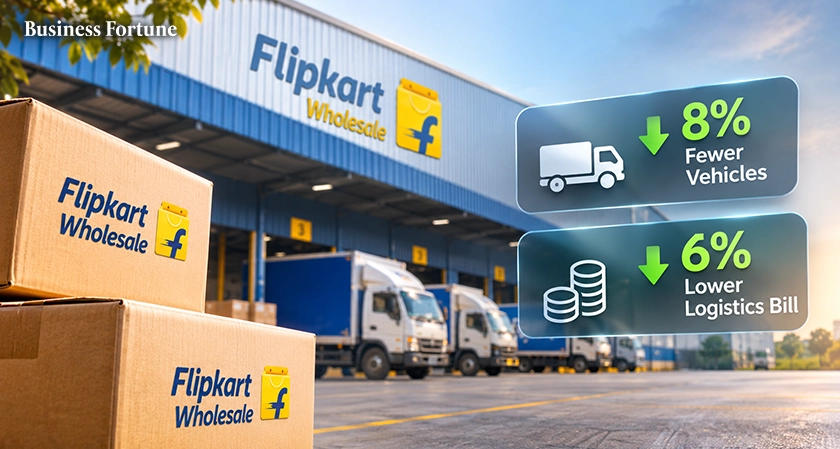
Flipkart Wholesale has cut its logistics cost with the help of Far Eye's AI software goods. Read how it keeps trucks busy, cuts paperwork and makes restocking easier for your local kirana store.
Flipkart Wholesale has done what every delivery business wants to do which is spend less and still deliver on time. The B2B arm of the Flipkart Group cut its logistics spend by 6 % and its vehicle deployment by 8 % across India. AI-powered software firm FarEye said on Sunday that its platform made this possible.
Trucks Now Spend Less Time Doing Nothing
Vehicle idle time is down by 10 %. Return-to-origin cases, where goods come back undelivered, have dropped by 1 %. Delivery speed has not suffered.
The scale is big. The network has 26 stores and one cross-dock. Each month it handles more than 200,000 orders and about 195,000 vehicle assignments. Until now, much of this dispatch work was manual and scattered across many hands.
What Actually Changed?
FarEye connected dispatch, routing, compliance and payment collection into one digital workflow. Dynamic routing now matches the number of vehicles to the work at hand, so trucks are not sent out half empty. E-way bills, a paperwork-heavy step, are now generated automatically. UPI payments are also built into delivery, so drivers handle less cash. The companies say this saves 0.25 per cent on the cash collected.
Gautam Kumar, chief operating officer of FarEye, put the idea simply. He said growth must now come from running existing capacity more smartly, not from adding more of it. He also said the physical distribution network behind India's retail sector has not kept up with the growth of digital payments and online buying. That gap, he said, is a chance for technology to help.
Why Should the Corner Kirana Store Care?
India has more than 1.4 crore kirana stores, and they account for an estimated 75-80 per cent of FMCG sales. Their buying is moving online. The government-backed DigiDukaan initiative on ONDC has already linked more than 21,000 retailers with over 450 brands in three cities.
Placing an order is getting easy. The harder part is what happens next, which is getting goods to the shop quickly and cheaply.
What Could Come Next?
As Business Fortune anticipates this model works at scale, other wholesale and FMCG distributors may follow. Smarter routing, paperless compliance and digital payments could soon be normal for any business that moves goods. For small shop owners, that could mean faster restocking and fewer delays.
Sources: https://www.business-standard.com/companies/news/fareye-helps-reduce-e-commerce-major-flipkart-logistics-expenses-by-6-126112200607_1.html https://www.moneycontrol.com/news/business/companies/flipkart-wholesale-cuts-logistics-costs-by-6-vehicle-deployment-by-8-with-fareye-14086384.html




















.webp)

.webp)
Comments