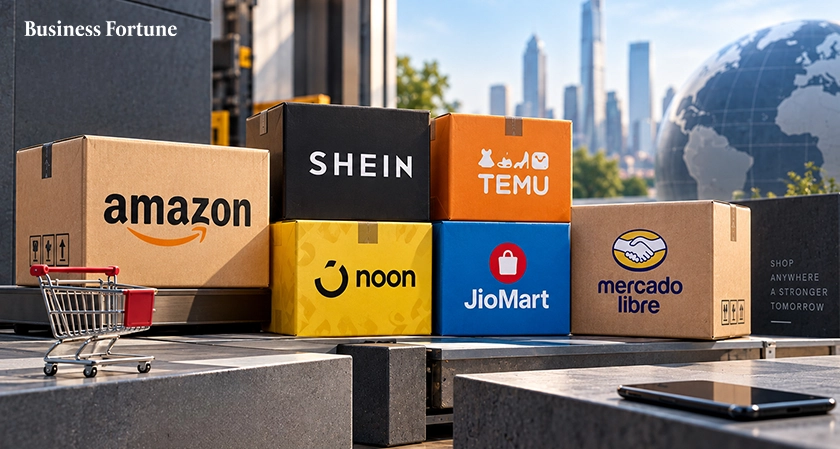
Amazon still dominates U.S. online retail, but a new generation of top emerging e-commerce platforms 2026, hyper-local marketplaces and logistics-first challengers are quietly rewriting the rules of global e-commerce. Here's who's actually gaining ground in 2026 and why.
The Upstarts Coming for Amazon: Inside the Top Emerging E-Commerce Platforms 2026
Amazon is not going away. Sales on third parties alone are estimated to amount to about $300 billion in the U.S. But what it does not realize is the sheer variety of ways consumers are now allocating spending and attention that have emerged in the last five years, using apps and marketplaces that did not exist before. This is the context for the search of the top emerging e-commerce platforms 2026: not so much a challenge from a singular entity against Amazon but the fragmentation of online shopping into a set of increasingly diverse, but equally competitive, avenues around the world, from video to quick regional transport to social resale and value imports: all cutting into a slice of Amazon's attention and spending.
Which E-Commerce Platforms Are Growing in 2026?
If you want a shortlist for the top emerging e-commerce platforms 2026, the evidence points fairly clearly to a number of names: TikTok Shop, Temu, Coupang, Shein, Meesho and regional heavyweights such as Noon and MercadoLibre are the emerging Amazon competitors to watch. What they share in common is a finding of a growth lever that Amazon will not or cannot pull as aggressively.
TikTok Shop is arguably the most obvious example. According to a report TikTok Shop's U.S. gross merchandise value in the first half of the year grew 103% year-on-year to reach $11.8 billion in the first half of 2026 and globally the platform's GMV reached $50.3 billion, up 92% year-on-year. That has placed it on track to comfortably clear $100 billion in worldwide GMV for the year, with some projections putting the full number as high as $123.5 billion. What is interesting about that growth is its maturity. Early on, TikTok Shop's sales were skewed to livestream selling, the Chinese Douyin equivalent, but this has shifted.
Coupang, South Korea's dominant marketplace and arguably one of the digital commerce platforms Amazon should worry about most on an execution level, is another example. For 2025, Coupang reported total revenues of about $34.5 billion, a 14 percent year-over-year increase and achieved its fourth consecutive year of inclusion in the Fortune 500, rising 10 places to No. 132.
Coupang has built a reputation for its same-day and next-day "Rocket Delivery" logistics systems, which rival or beat Amazon's own fulfillment speed in its home market and is taking them overseas now, with over $5 billion worth of American goods exported internationally.
Temu is a wildcard among the emerging e-commerce companies, hitting an estimated $22 billion in U.S. GMV, falling just short of its earlier $24 billion target. The reason for this is the U.S. suspension of the de minimis import exemption, which pushed Temu to pivot to domestic fulfillment rather than direct-from-China shipping. It is now actively recruiting third-party sellers with onboarding incentives, which will gradually move it away from the import bazaar and into a traditional marketplace.
Global E-Commerce Companies Reshaping Regional Markets
Not all of Amazon's potential e-commerce marketplace competitors are looking inward, but are instead shaping markets where Amazon does not have a structural advantage.
In India, Meesho has disrupted the market with a social-commerce, reseller model built around ultra-low prices, a format which fits its price-sensitive, mobile-first population better than Amazon's traditional offering.
JioMart, on the other hand, has taken a different tack with the mix of ordering online with offline retail and local kirana (corner) stores, using existing infrastructure that Amazon does not have in India.
In the Gulf, Noon has become the leading homegrown alternative to Amazon in the UAE and Saudi Arabia, backed by the Saudi Arabia's Public Investment Fund. It offers Arabic-language support and regional payment methods, which puts it out front in terms of its fulfillment network, electronics and fashion in particular, which Amazon's regional arm has struggled to match, having been based on its 2017 acquisition of Souq.com.
Latin America has a similar story with MercadoLibre, which has an integrated payments/logistics/financing ecosystem that is arguably more of a draw for regional sellers than its pricing advantage, removing key barriers for them to enter what is already a fragmented market.
Shopee continues to hold a commanding amount of presence in the region (Southeast Asia) built on mobile-first discovery and localized payment options.
How Are New E-Commerce Companies Competing With Amazon?
Truthfully, it is not that the new e-commerce platforms challenging Amazon are trying to replicate the everything-store of Amazon at its scale and speed. Each is instead competing on a specialization.
Shein and Temu compete on price and speed-to-trend, using a vertically-integrated model to undercut Amazon on cost for fashion and low-cost items.
TikTok Shop competes on discovery, transforming entertainment consumption directly into purchase intent that Amazon's search-driven approach was never built to handle.
Coupang competes on logistics density in a single geography, achieving delivery speeds that a globally-distributed company like Amazon cannot easily replicate outside its most optimized markets.
Regional players such as Noon, JioMart and MercadoLibre compete on trust and localization - payment rails, language, delivery networks and cultural familiarity that a foreign multinational has to build from scratch.
It is the unifying feature behind every one of these e-commerce platforms that are challenging Amazon, as they are not fighting a war of attrition on Amazon's home turf, but are finding underserved dimensions of the shopping experience and building the entire platform around winning on that one dimension exceptionally well. It is also worth noting how competitive the platforms have become with each other, not just with Amazon.
Online Shopping Platforms 2026: What's Actually Changing for Shoppers?
For the everyday consumer, the shift manifests in the fragmentation of spending habits. They may still default to Amazon for a phone charger or a last-minute gift, but increasingly find a skincare product through a TikTok video, buy a $6 phone case through Temu and do grocery runs through a hybrid app such as JioMart. Where loyalty was once platform-agnostic, is now task-specific and the competition has shaped the very premise of how different e-commerce platforms are structured in their approach to retail.
What is the Future of E-Commerce Platforms beyond Amazon?
The logistics gap is closing faster than the product-selection gap. Over years, Amazon's primary advantage over competitors was its ability to get products to the consumer faster. That advantage is being eroded in specific geographies-Coupang's near-instant Korean delivery network and Temu's forced pivot to domestic US fulfillment are both steps towards competitors matching Amazon in their own backyard, however limited that footprint may be.
Data trust is an emerging differentiator. Coupang's announcement of a large-scale breach and subsequent government investigation (ongoing through 2026) is a reminder that convenience is not always a substitute for perceived safety. A rising volume of consumers are willing to pay for assurance that their data will not be misused, abused or held hostage.
Livestream commerce is not universal. While effective in China and Southeast Asia, many tactics used in those regions have proven ineffective in the US context. TikTok's own US data demonstrates that techniques which drive conversions and engagement in Asia have little analogue in the American consumer, necessitating a bifurcated approach to operations.
The evolution of e-commerce industry trends 2026 is unlikely to feature a single dominant successor to Amazon, but rather a proliferation of specialized competitors.
TikTok Shop has demonstrated that entertainment and commerce are mutually reinforcing, representing a fundamentally new category of purchase-funnel design.
Coupang has dedicated resources to dramatically out-invest its logistics position in a single market, representing a new type of threat to Amazon's domestic dominance.
Temu and Shein have both demonstrated that price competition, while severely limited by regulatory headwinds, can still drive eye-opening volumes of product traffic.
Finally, regional players have all demonstrated that a careful eye to localization can frequently outweigh the advantages of scale in establishing consumer trust and infrastructure.
Amazon's position is still strong and none of these forces are likely to fully displace the company anytime soon.
However, Business Fortune believes, the competitive landscape is evolving towards a multi-polar model in which specialized retailers capture increasing shares of consumer time and attention.


.webp)






























Comments