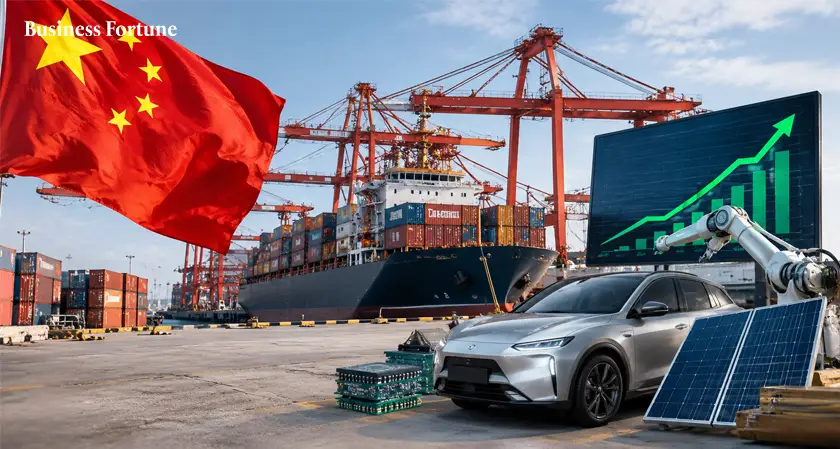
China’s trade surplus just crossed $1 trillion in 10 months. See how the AI is the reason, why the EU is worried, and what could come next.
China’s trade surplus has just crossed $1 trillion, and it took only ten months of 2026 to get there. A trade surplus is simply the gap between what a country sells to the world and what it buys. Customs data shows China’s gap now stands at $1.04 trillion, compared with $964.8 billion at the same point last year.
China is running ahead of last year’s pace and last year was already a record. The reason is that countries and tech giants everywhere are racing to build AI systems, and they need huge amounts of chips, servers and other high-tech gear. A big share of that gear is made in China, so orders keep pouring in, even while shoppers back home are spending less.
Exports Refuse to Slow Down
Exports jumped 35.2% in October from a year earlier, just under September’s 36.3%. Imports grew even faster, at 41.6%, helped by higher energy prices and AI-related shipments. The October surplus came in at $105.3 billion, lower than September’s $133.5 billion.
Chips tell the biggest story. The value of integrated circuit exports shot up 111% in ten months, yet the number of units shipped rose only 3.2%. In other words, higher prices did most of the work. Citi estimates AI-related goods made up 28% of China’s exports in the first three quarters.
Why Is the World Getting Nervous?
China’s surplus with the European Union hit a record $310 billion, already above the $292 billion for all of last year. The EU has put tariffs on Chinese electric vehicles and a quota on hybrids, and more steps may follow. Several emerging markets are also adding trade defences.
Joe Peissel of Trivium China says the risk of new tariffs and trade barriers will stay high through 2027 as Chinese manufacturers keep expanding abroad.
What Happens Next?
As Business Fortune observes, the trade numbers hide a softer picture inside China. Shoppers are holding back because the property slump has hurt household wealth. Domestic car sales have now fallen for 12 months in a row, so carmakers are looking overseas, and vehicle exports rose 50% to 9.74 million units.
All eyes turn to next week’s APEC summit in Shenzhen, where Xi Jinping and Donald Trump are expected to meet for the third time this year. The two countries have just extended their trade truce by two months. Macquarie expects exports to speed up in the fourth quarter and then cool from early 2027. Citi warns that any slowdown in US AI spending would hurt China’s shipments. The future of this surplus depends on how long the AI boom lasts.
FAQs
How big is China’s trade surplus in 2026?
It stands at $1.04 trillion for January to October, a new record pace.
What is driving the surplus?
Global demand for AI-related products, especially semiconductors and other high-tech goods.
Did China cross $1 trillion before?
Yes. Last year’s full-year surplus reached a record $1.2 trillion, but this year’s mark came a month earlier.
Why is the EU unhappy?
Europe fears cheap Chinese goods are hurting its own industries, and its surplus with China hit a record $310 billion.
Could the surplus shrink?
Possibly. Analysts say trade growth may moderate next year, especially if AI spending cools or tariffs rise.
Sources: http://reuters.com/world/asia-pacific/chinas-trade-surplus-soars-past-1-trillion-october-exports-jump-352-yy-2026-11-10/ https://edition.cnn.com/2026/11/09/business/china-trade-surplus-1-trillion-intl-hnk https://www.ft.com/content/a267d321-a489-4426-940e-1e4be712dc09?syn-25a6b1a6=1





























.webp)




Comments