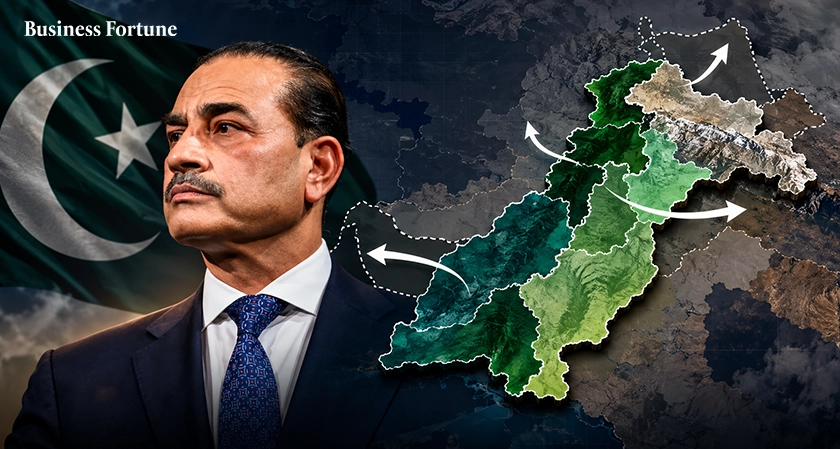
Could Pakistan soon have 15 provinces instead of four? Asim Munir’s reported plan is raising questions about what could change and who might gain more power.
Pakistan could be heading towards one of the biggest changes in its political structure since independence. Army chief Asim Munir is considering a plan to divide the country’s four provinces into smaller administrative units, potentially creating 12 to 15 provinces or empowering governments across 160 districts. The move has sparked discussions about whether it would improve public services or strengthen the military’s control over the country.
Pakistan currently has four provinces: Punjab, Sindh, Khyber Pakhtunkhwa and Balochistan. Supporters of administrative reforms argue that such large regions are hard to manage. However, critics believe that breaking them up would weaken current political power structure and increase the influence of the central government.
Why Does Pakistan Want Smaller Provinces?
The size difference between Pakistan’s provinces is significant. The number of people living in Punjab stands at about 128 million, which is more than half the country’s population. Despite being the largest province in terms of size, Baluchistan has a population of 15 million people.
Taking care of such huge numbers of people becomes an issue when providing public services to them. In some regions of Punjab, people have to travel great distances to receive their public services.
Planning Minister Ahsan Iqbal has previously discussed creating 12 to 15 provinces or strengthening local administration across 160 districts. These are different proposals: one would change provincial boundaries, while the other would give district governments more responsibility without necessarily creating new provinces.
The proposal has also triggered concerns about the balance of power between elected governments and the military. Punjab and Sindh have traditionally served as important political bases for the Pakistan Muslim League-Nawaz (PML-N) and the Pakistan Peoples Party (PPP), respectively.
Constitutional Hurdles Could Delay the Plan
Constitutional amendment would be needed to create new provinces because the decision cannot just be made by the government, but under Article 239 amendments will need to pass both the lower and upper houses of the parliament by a two-thirds majority, and for those changes that involve provincial boundaries, two-thirds majority in the concerned provincial assembly is required as well.
The province of Sindh has already shown their strong resistance against the plan. The provincial assembly of Sindh passed resolution on September 3, rejecting all ideas about division of the province or putting any part of the province under federal administration.
What Happens Next?
The leaders of Pakistan have a hard choice to make in deciding whether to reform local governance or maintain the political balance between the provincial and federal powers. The parliamentary debates that are scheduled to take place in October may help in distinguishing the conflicting suggestions, but no decision about the future structure reform has been made according to the provided information.
As Business Fortune observes, the discussion will most probably be decided by political consensus, legal obligations, and public approval. Regardless of what changes Pakistan makes, it will have long-term consequences for its political structure and the civilian-military relationship in the future.
Sources: https://www.indiatoday.in/world/story/pakistan-field-marshal-asim-munir-wants-to-split-country-four-provinces-into-smaller-states-3012893-2026-10-09 https://www.moneycontrol.com/world/why-is-pakistan-debating-new-provinces-and-what-would-it-take-to-create-them-article-14048147.html#google_vignette https://www.economist.com/leaders/2026/10/08/a-selfish-ploy-to-break-up-pakistan


.webp)































Comments