
Red Hat Hybrid Cloud is changing the paradigm in how organizations can evolve their modern infrastructure strategy. Organizations can now mix and match on-premises, private infrastructure, public clouds and edge locations while maintaining a more consistent development, security and operational approach.
Red Hat Hybrid Cloud: Why Getting the Strategy Right Matters
Let's pretend this scenario.
Your customer-facing application is on a public cloud, but your most sensitive customer records are in a private data center, your manufacturing system needs to operate close to a factory floor and your developers want the flexibility to build and release without having to wait weeks from your infrastructure teams.
This is the problem many IT departments are facing today.
Hybrid cloud offers flexibility, but without proper planning, flexibility can become complexity.
Red Hat's open hybrid cloud approach is focused on providing a consistent basis for development, security and operations across different environments with technologies such as Red Hat Enterprise Linux, OpenShift and Ansible Automation Platform playing an important role.
The focus is not to make every environment the same, but to ensure that the experience of developing, deploying, securing and managing workloads is more consistent.
So what does a good hybrid cloud strategy actually look like?
Let's break it down.
- Start With the Workload, Not the Cloud
One of the easiest mistakes to make is to decide where an application will run before understanding the application itself.
It sounds like backwards, but many cloud initiatives start with questions such as, "Should we use public cloud A or public cloud B?"
A better question to ask is, "Where should this workload live to deliver the most value?"
Some applications benefit the most from being on a public cloud, but others may need to stay closer to data, existing systems or hardware, or even workloads operating at the edge as pushing every piece of information back to a central data center would introduce unacceptable latency.
Red Hat Cloud Platform itself promotes the workload-centric approach to hybrid cloud rather than assuming all applications must be in the same environment.
Before you move anything, look at:
-
Data sensitivity
-
Regulatory requirements
-
Performance parameters
-
Application dependencies
-
Availability needs
-
Cost
-
Network latency
- Build Around a Consistent Application Platform
Imagine you are developing an application within a certain environment, rewriting its operation process for another and designing a different operation model for a third environment.
This is how cloud complexity grows.
A consistent platform can reduce some of these frictions.
OpenShift is being positioned as a hybrid cloud with Red Hat platform that delivers a consistent basis for building and scaling containerized applications across infrastructure environments. Red Hat
This is one reason why OpenShift hybrid cloud strategies can be appealing to organizations looking to give developers the ability to work against familiar tools without binding every application to one infrastructure provider.
- Make Automation the Default
If your hybrid environment requires an administrator to manually configure hundreds of systems, something has gone wrong.
Manual work doesn't scale particularly well when an organization has multiple clusters, clouds, operating systems, networks and application teams.
Automation should therefore be part of the architecture from the beginning rather than being added later.
Red Hat Ansible Automation Platform is designed to automate, coordinate and orchestrate infrastructure, applications, security and other operations across hybrid environments.
- Treat Security as a Design Principle
Security shouldn't be the final checkpoint before an application goes live.
In a hybrid environment, there are too many moving parts to make it a last-minute item.
You may have workloads in a data center, applications operating on public cloud infrastructure and services operating at remote locations, with each connection creating a new place where identity, access, data protection and configuration need to be addressed.
Red Hat's security approach focuses on protecting workloads and application lifecycles across hybrid environments, including the use of automation and DevSecOps practices.
A practical security strategy should include:
-
Strong identity and access controls
-
Least-privilege permissions
-
Encryption of sensitive information
-
Centralized visibility
-
Regular vulnerability management
-
Policy enforcement
-
Secure software supply chains
-
Automated security processes
The key is consistency.
- Stop Configuration Drift Before It Starts
Imagine this scenario. Two application environments were originally configured the same way, but six months later, one has received a handful of manual changes while the other has been updated through automation. Nobody remembers exactly what has changed.
Then something breaks.
Welcome to configuration drift. Drift tends to be a problem in hybrid environments because there are already multiple platforms to contend with.
Automation can help organizations define the desired state and repeatedly apply it. Red Hat's automation tools are built to help teams create consistent operational processes across different environments.
The trick is to avoid treating it as a collection of random scripts.
-
Create reusable workflows.
-
Document them.
-
Version them.
-
Test them.
-
Give appropriate teams permissions to use them.
-
And most importantly, make the automated process the normal process.
- Design for Portability-But Don't Chase It Blindly
Portability sounds great.
Move an application from one environment to another anytime you like.
Done.
Unfortunately, reality is not as kind.
Most applications depend on databases, networks, identity services, storage systems and cloud specific capabilities.
So rather than chasing to make everything run everywhere, organizations should look to identify which workloads require portability and design their applications accordingly.
- Give Developers a Better Experience
Hybrid cloud is all about people as much as infrastructure.
If developers have to learn a different deployment process for every environment, productivity takes a hit.
A strong platform strategy can give developers consistent tools, workflows and interfaces.
This is where a Red Hat cloud solutions platform approach can help businesses establish common patterns for application development and operations while letting infrastructure teams control the appropriate parameters.
The objective is not to hide infrastructure completely; developers still need to know where their applications run and what constraints exist.
- Build Governance Into the Platform
Governance sometimes gets a bad reputation.
People hear the word and think of committees, paperwork and someone asking for another approval.
But effective governance can actually speed things up.
The difference is automation.
Rather than manually checking if every application follows organizational policies, businesses can increasingly use policy-driven controls and automation.
Red Hat's cloud workload guidance highlights complementary approaches for identifying misconfigurations, auditing cluster state and enforcing policies across environments.
Useful governance can cover:
-
Resource tagging
-
Identity policies
-
Security configurations
-
Approved images
-
Compliance requirements
-
Network controls
-
Data handling
-
Deployment standards
The best governance doesn't constantly interrupt developers, but quietly stops expensive mistakes.
- Don't Forget Virtual Machines
The conversation around cloud-native often sounds like containers will wipe out all of your virtual machines overnight.
Enterprising IT does not work that way.
Many organizations have years or even decades-old applications running on virtual machines.
A sensible modernization strategy needs to take into account these workloads instead of pretending they don't exist.
Red Hat OpenShift Virtualization is designed to allow virtual machines and containerized workloads to operate within the OpenShift ecosystem, giving organizations a pathway for modernization without requiring all of their workloads to transform immediately.
- Measure the Hybrid Cloud Like a Business
A hybrid cloud project shouldn't be considered successful just because applications have moved.
Moving workloads is an activity, and creating business value is the outcome.
Organizations should measure meaningful indicators such as:
-
Application availability
-
Deployment frequency
-
Recovery time
-
Infrastructure utilization
-
Cloud spending
-
Security incidents
-
Operational workload
-
Developer productivity
-
Time required to provision environments
This is where hybrid cloud best practices start to go beyond just technical recommendations.
Making Hybrid Cloud More Human
There's another side to hybrid cloud that doesn't get much attention: people.
Technology teams don't struggle with hybrid cloud because Kubernetes, Linux or automation are impossible to understand.
They struggle because every additional platform is a new decision.
-
Where does this application run?
-
Who owns it?
-
Who can access it?
-
Which team patches it?
-
How is it monitored?
-
What happens when the network disappears?
-
Who gets called at 2 a.m.?
These are all organizational questions masquerading as technical questions.
Which is why most successful hybrid cloud programs involve collaboration between development, operations, security, networking, finance and business teams.
A technically brilliant architecture can go down if nobody agrees on who is responsible for running it.
What Makes Red Hat's Approach Different?
The appeal of Red Hat's approach lies in its focus on consistency across environments rather than looking at hybrid cloud as a collection of disjointed technologies.
Red Hat describes their open hybrid cloud strategy as a foundation for developing and operating applications across public, private and hybrid environments and their portfolio of Red Hat Enterprise Linux, OpenShift and Ansible Automation Platform as important building blocks. Red Hat
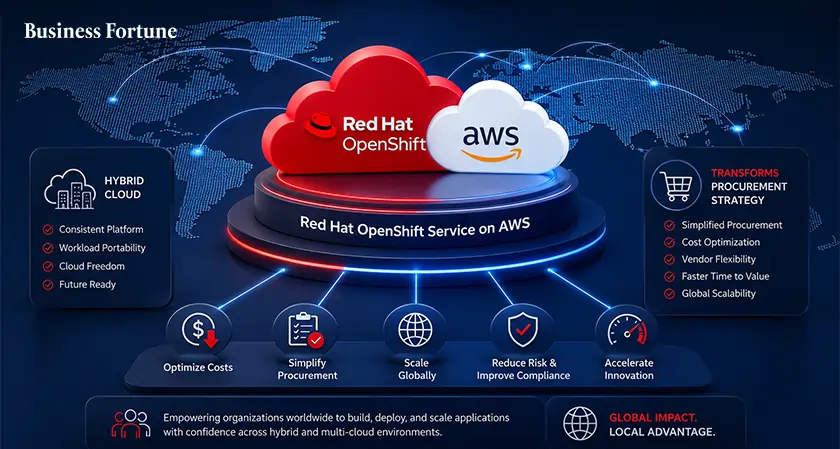
OpenShift provides the application platform layer while Ansible Automation Platform handles automation across infrastructure and operational domains. Red Hat also provides managed cloud services built around OpenShift, giving organizations the option of not running everything themselves.
This creates an interesting balance.
Organizations can retain flexibility over where workloads operate while pursuing greater consistency in how those workloads are developed, deployed and managed.
This becomes increasingly important as businesses add AI applications, edge computing, virtualization and new cloud services to their existing environments.
Red Hat's current hybrid cloud messaging increasingly emphasizes operating across different footprints rather than forcing organizations into a single destination.
Red Hat Hybrid Cloud is not about bifurcating applications between two places just for the sake of putting them there. It's about building an operating model that lets organizations have the flexibility of multiple environments without the chaos that comes with that approach.
Business Fortune believes that the most successful strategies will focus on workloads and utilize consistent application platforms, automate operations and consider security as a design element while also recognizing the need to evolve at a pace that fits the business.
FAQs
- What is Red Hat Hybrid Cloud?
Red Hat Hybrid Cloud encompasses an approach to building, deploying and managing applications in a way that spans across disparate infrastructure including on-premises, private and public clouds as well as the edge.
- Why is OpenShift important to hybrid cloud?
OpenShift is a hybrid cloud application platform built on Kubernetes that can support containers across infrastructure. It provides that much needed consistency when it comes to application development and delivery while also letting organizations select the infrastructure of their choice.
- How does automation play into hybrid cloud management?
Much like the need for consistency, automation is also a vital element to making hybrid cloud effective. It reduces the amount of manual, error-prone tasks that need to be done while also enforcing policies across environments.
- Can we have a Red Hat hybrid cloud without containers?
Certainly. While many organizations are looking at containers as the end-state for many applications, there's no requirement to abandon virtual machines right away. With Red Hat OpenShift Virtualization, organizations can have VMs run alongside containers as part of a broader hybrid cloud approach.
- What's the most important piece of advice for organizations looking to implement hybrid cloud?
Focus on the workload and not the technology. Ask what a specific application needs in terms of performance, security, compliance, data and operations before selecting where it should run. Then enforce consistency and automation.


.webp)





























Comments