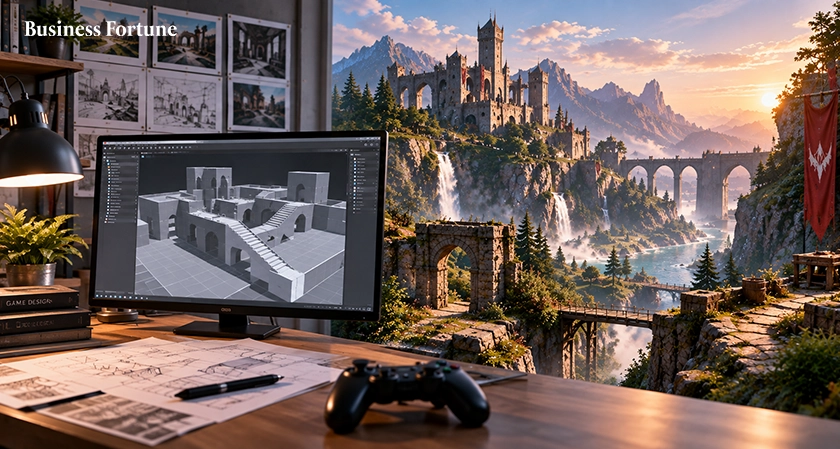
AI Game World Generation is set to revolutionize the realm of virtual worlds, but does that mean out-of-door design is doomed?
Imagine launching a game to find a city changed since your last visit. The roads are different. The buildings are relocated. A side street leads somewhere strange. The characters remember what you did on your previous exploration and adapt their world around you. Sounds like science fiction, but game designers are bringing these ideas to life with AI Game World Generation.
The game design industry faces a paradoxical problem - players crave expansive worlds full of detail, but these environments can require a small army of artists, designers, writers, programmers and testers to bring to fruition.
AI is poised to change the equation.
So the natural question becomes: if AI can design a level, then what does that mean for the level designer? It's not as simple as declaring that AI wins.
From Placing Every Tree to Designing the Rules
Traditional level design can be incredibly hands-on.
A designer might spend hours choosing the placement of a door, the distance between enemies, where a weapon falls or the turn in a hallway before a larger room opens. Multiply this across hundreds of levels and thousands of items, and the scale is staggering.
AI Game world generation and procedural systems take a different approach. Instead of placing each tree in a forest, a designer can set rules - trees appear thicker near water, paths remain traversable, certain squares are always dark and specific items appear in isolated zones.
The system populates the environment based on the rules.
This is still an important distinction. Instead of creating every object, the designer is dictating the system's ability to affect the world. It's less of a handoff of a designer's job and more like giving a designer an incredibly unusual new tool.
Why AI Game World Generation Is So Exciting?
The most obvious appeal of AI-assisted game design is speed.
Creating a large, sprawling environment manually is an incredible time sink. AI-assisted systems can accelerate the processes of terrain creation, asset population, variety and prototyping. That's only part of the appeal, though.
Variation is the real intrigue.
While a manually designed level typically has a single design, a procedural environment can generate multiple options.
Imagine a survival game with a landscape that shifts based on how aggressively the player explores it. Or a dungeon that rearranges itself while maintaining essential design elements.
This is where AI game development can evolve beyond merely quickening production. It can begin to make the world more dynamic.
The Difference Between Generation And Good Design
However, there's a critical caveat. Generation isn't design.
AI can create a forest with thousands of trees, but that doesn't make for an interesting forest.
It can generate a maze, but that doesn't ensure an interesting maze.
It can populate a city with structures, but that doesn't guarantee the player wants to explore it.
Great level design involves crafting a compelling rhythm, tension, contrast, readability, story, challenge, reward and emotional engagement.
A designer could tell an AI system to build a ruined coastal settlement in which the safe path takes approximately five minutes and gives visual clues pointing toward the direction of the abandoned lighthouse but not revealing the location of the main enemy until the player has explored two side areas.
The system could generate dozens of possibilities.
The designer could choose, modify, reject and iterate far faster than if they built every variation from scratch.
AI vs Manual Game Level Design: What Actually Changes?
The truth is, the comparison isn't really about replacement. It's about where the human effort is applied.
Manual design provides incredible precision and control. A designer knows the location of each object in a room and can build a specific moment-to-moment experience.
AI-assisted design offers scale and iteration. A developer can create multiple options and spend more time with the elements the players will actually see.
The question is one of control.
An artist who builds a room knows what's in it. A generative system could build new combinations.
Sometimes, those combinations are fantastic. Sometimes, they're horrifying.
Research into AI-assisted level design tools has already found that designers have varying preferences for the degree of control they want AI to exert, finding that AI can alter design practices rather than merely replacing human labor with machine labor.
That, perhaps, is a vital insight into the future of level design in games.
The future probably isn't "AI designs everything".
It may be "designers decide how much AI is allowed to design".
How AI Is Changing Game Level Design
The impact of AI is already being seen at multiple stages in the level design process.
The first step is ideation - developers can use AI to brainstorm ideas of environments, themes, layout, characters and situations.
Next comes prototyping - instead of spending weeks creating a polished environment to discover that the concept is flawed, teams can move much more quickly.
Then comes content generation - procedural systems can populate terrain with objects, foliage, structures and more.
Following this is testing - AI-assisted tools can analyze play sessions, discover issues and assess player movement patterns.
Finally, there's iteration.
A developer can generate a version, test it, tweak the rules and regenerate it - this feedback loop could fundamentally change the production process.
How Game Developers use AI for Level Design
The most pragmatic applications of AI may not be that developers can type out a sentence and get a complete game back in return.
Rather, they can apply AI at points where the process is cumbersome.
Like
-
generate many terrain concepts for the developer to choose from
-
populate large environments with procedural rules
-
generate variations of rooms or encounters
-
produce assets for prototyping
-
study player movement and the patterns where they can get stuck
-
generate alternate layouts for testing
-
help create elements of environmental storytelling
-
produce early concepts of dialogue or quest design
-
automate testing
Generative AI for Game Development has a Bigger Problem than Creativity
The technology is impressive, but game studios can't just generate content without having thought out the source, copyright, ownership, training data, consistency, quality control, performance and disclosure.
It's also a practical problem - content overload.
If generating a thousand environments is easy, players don't necessarily want a thousand environments, they want memorable ones.
A world full of procedurally generated content might end up feeling emptier than a world with a small handful of unique locations.
The problem then isn't generating content, but curating meaningful content.
Recent research synthesizing studies of generative AI in game production also highlights broader changes in creative workflows and the relationship between AI systems and human creators, rather than a straight narrative of replacing creative labor.
Will AI Replace Manual Level Design?
It's likely not going to happen in the ways people often imagine.
Manual design is going to become less about doing repetitive construction and more about using their imagination in making creative decisions.
Think of photography - cameras automate exposure, focus, image processing, but photographers did not die out, they just changed what they spent their time doing.
Level design could be going through a similar evolution. Rather than placing 5,000 rocks, a designer may specify the ecological rules that determine where those rocks appear.
The job changes - it becomes less about placing everything and more about shaping possibilities.
AI Game World Generation - Worlds that Respond
The exciting destination is not bigger worlds, but living worlds.
Imagine a horror game that learns which environmental patterns make a particular player uncomfortable and subtly changes the experience.
Here, AI could become much more than an asset-generation tool, but part of the world's underlying behavior.
Of course, it's still an emerging destination rather than a solved problem. Current systems still require constraints, testing, optimization, artistic oversight and considerable engineering.
What Happens to the Level Designer?
The level designer of the future may look surprisingly different than today's version.
They could spend less time moving individual assets and more time building systems, testing player psychology, tuning procedural rules and deciding which generated ideas deserve to survive.
That could make the profession more creative!
There is also an opportunity for smaller studios. Large open-world games traditionally require enormous teams and budgets. If AI is going to reduce some of the repetitive workload, smaller teams may be able to experiment with worlds that previously needed a much larger production resource.
But efficiency shouldn't be an excuse to flood players with generic content. The best studios will probably use AI to make more possibilities rather than simply more stuff.
The Human Touch Still Matters
AI Game World Generation is changing the economics and mechanics of building virtual worlds. It can accelerate environment creation, generate variations, assist with testing and make large-scale procedural experiences more practical. But generating a world and designing an experience are two very different things. The strongest future for game development is likely to combine machine speed with human taste. The future of AI game world generation can explore thousands of possibilities - designers can decide which ones are worth keeping.
So, is manual level design ending?
Not really. It may be evolving.
Business Fortune believes that the level designer may no longer be the person who places every tree, wall, rock and enemy by hand. Instead they may become the person who teaches the world how to build itself and more importantly, know when the world has finally become worth playing.


.webp)
































Comments