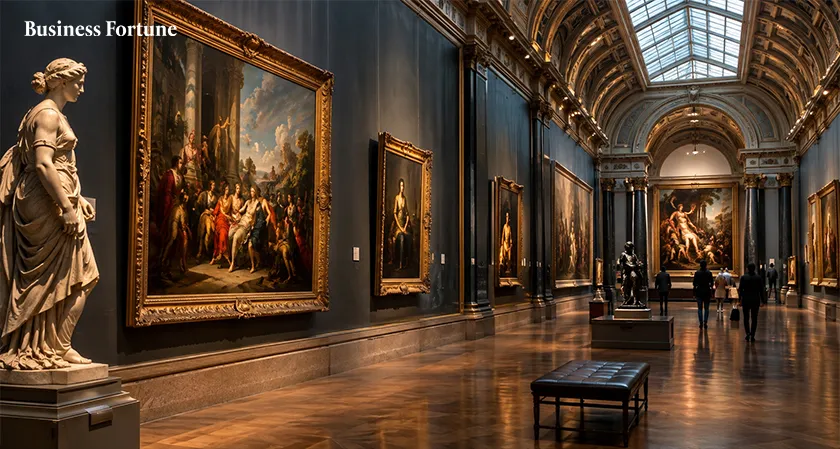
Discover the world’s most iconic art galleries, exploring their masterpieces, cultural significance, rich histories, architectural beauty, and enduring appeal.
Apart from just serving as visual displays, artworks represent ideas, history, emotions and various cultures and perspectives. This is what art galleries offer through creation of space that allows displaying visual arts in such a way that people can enjoy it. Galleries have developed throughout centuries together with development of art as such and can be found not only in historical palaces but also in modern cities.
The history of art galleries goes back many centuries ago to the period when art was exhibited in aristocratic homes, churches and architectural passages. It is from these places that dedicated art buildings were created to store and present artworks and to become the predecessors of contemporary art museums and galleries.
Today, the gallery has a lot of roles. While some galleries are used for conservation and education, others have the role of giving artists a chance to display and sell their work. They are also used in connecting artists to collectors, critics, historians and art lovers, thus contributing to the greater art market.
How Did Art Galleries Become the Heart of the Art Market?
The existence of art galleries as a commercial and cultural entity is relatively modern. It traces its history to the early modern period where art began to extend its scope from private commissions by aristocrats and churches to public exhibition. In the medieval period, artists would mainly work through guilds producing artworks for wealthy people and religious institutions. With the establishment of art academies in the 16th century, artists were elevated from craftsmen to creative professionals.
In the Victorian period, art galleries were well-established as a result of the development of a middle and upper-class lifestyle that sought to own items of culture and aesthetics. With the end of the 19th century and the dawning of the 20th century, the nature of art had transcended from just being an aesthetic entity to also being a tool to achieve some sort of objective.
Gallerists became significant intermediaries between the artists and art collectors. They arranged exhibits, promoted artists, presented new works to the clients and facilitated the sale process. What started as a practice confined primarily to great centers of art, including Paris, London and New York, soon became a worldwide phenomenon.
Today, galleries are not restricted to their physical location and are engaged in the activities at international art fairs, bringing together artists and collectors from all over the world.
Which Top Art Galleries Belong on Every Art Lover’s List?
What is unique about an art gallery? Is it because of the number of paintings in the gallery, the famous paintings displayed in the gallery, the architecture of the place, or the relation of one artwork with the other? Some of the finest art galleries around the globe offer all these facilities to their visitors simultaneously.
Top art galleries are unique in many ways from small galleries packed with famous masterpieces to giant museums that cover thousands of years of art history. While some museums are recognized for their special collections, other museums shine because of their variety of artists and periods covered.
For art enthusiasts, deciding which art galleries to visit first is not an easy task. There are, however, a few places around Europe and America which attract attention for their unique collections and importance from the point of view of culture. Let us have a look at five such art galleries.
-
The Getty Center, Los Angeles, USA: The Getty Center combines the visual appeal of European art with that of architecture and breathtaking views of Los Angeles. The gallery houses various artworks like paintings, manuscripts, sculptures, decorative arts, photographs and antiques. The location and buildings of the museum contribute to its visual appeal.
-
The Mauritshuis, The Hague, Netherlands: The Mauritshuis provides a unique gallery of paintings by Dutch and Flemish masters. It is here that we find Vermeer’s Girl with a Pearl Earring and View of Delft, Rembrandt’s The Anatomy Lesson of Dr Nicolaes Tulp, as well as Fabritius’s The Goldfinch.
-
The Metropolitan Museum of Art, New York, USA: The Met is an immense cultural odyssey that goes back thousands of years through many civilizations. It is home to artworks of Europe, antiquities, Americas, fashion, photography and decorative arts. Artworks of Vermeer, Rembrandt, Monet, Picasso and Caravaggio make it a destination to visit.
-
Tate Britain, London, UK: The Tate Britain gallery presents the development of British art from the 16th century up until the present day. The gallery houses historical, modern and contemporary works of art. It is especially known for its vast collection of the work of J.M.W. Turner.
-
The Belvedere, Vienna, Austria: The Belvedere combines Baroque architecture with a remarkable display of the art from Austria. This museum is renowned for its collection that includes Gustav Klimt’s Kiss and many others work. The magnificent palace, garden and unique atmosphere of this place make it an unforgettable experience for the art lovers.
Which Are the Biggest Art Galleries in the World?
How large can an art museum really become? Beyond their amazing collections and historical significance, there are some museums which have distinguished themselves due to the immense amount of area devoted to the showing of their collections. With their massive galleries, visitors will have the chance to travel back in time, learn about various cultures and encounter many kinds of art all at once. To those who love art, size can actually be another element of their experience, providing chances to see more art pieces and spend hours roaming around huge exhibition areas. The biggest art galleries in the world are more than just big buildings; they are monuments to the world’s artistic heritage. Whether they be historical European institutions, prominent art galleries in Asia and North America, the following are some examples of places where art is housed in huge spaces. These are the five largest art galleries of the world, based on gallery space.
-
Louvre, Paris, France: With approximately 72,735 square metres (782,910 sq ft) of gallery space, the Louvre ranks among the world's largest art museums. Established in 1792, it combines centuries of history with an enormous collection spanning ancient civilizations through modern European art.
-
British Museum, London, UK: Established in 1753, the British Museum has around seventy thousand square metres (753,000 sq ft) of gallery space. Its vast exhibitions explore human history, archaeology, culture and art from civilizations across the world.
-
State Hermitage Museum, Saint Petersburg, Russia: Founded in 1764, the State Hermitage Museum offers approximately 66,842 square metres (719,480 sq ft) of gallery space. Its collections cover European art, antiquities, decorative arts and numerous historical periods.
-
National Museum of China, Beijing, China: With around 65,000 square metres (700,000 sq ft) of gallery space, the National Museum of China is one of the world's largest cultural institutions. Its exhibitions highlight Chinese history, art, heritage and civilization.
Which Art Galleries Deserve a Place on Your Bucket List?
-
Accademia Gallery, Florence, Italy: There is probably no other art experience more unforgettable than seeing the statue of David created by Michelangelo. Apart from being the highlight of the exhibition, Accademia provides an amazing opportunity to immerse oneself in the history of Florentine art.
-
Guggenheim Museum, Bilbao, Spain: Guggenheim by Frank Gehry is not only a piece of art in itself even without stepping inside, but the titanium-coated building will take your breath away once you walk into the museum where contemporary masterpieces and exhibits are displayed.
-
Louvre Museum, Paris, France: The Louvre goes beyond a museum since it is an experience of a journey through the ages of human creativity. The expansive gallery features paintings, sculptures, Egyptian artifacts, decorative arts and much more, along with the historical architecture of the building itself.
-
Metropolitan Museum of Art, New York, USA: Metropolitan Museum like an entire world in one roof. With its millions of artifacts dating back thousands of years, it is possible to see everything from ancient Egyptian artifacts to classical paintings of Europe and modern art pieces.
-
Museum of Modern Art (MoMA), New York, USA: People who have an interest in both modern and contemporary art would find it exciting to explore the MoMA art collection, which features some of the movements of art such as post-impressionism, cubism, surrealism and pop art among others.
The Timeless Allure of Art Galleries
Art galleries are much more than just constructions that house paintings and statues. These institutions unite history, imagination, culture and the human expression in one place which gives people an opportunity to feel and live the ideas which can span decades and continents. In any small or large galleries, people can find a different interpretation of how art represents our world.
The most striking characteristic of the top art galleries in the world is not the amount of masterpieces they keep and the volume of exhibition rooms. The peculiarity of these galleries is that they are able to generate a feeling of surprise and discovery, preserve culture and promote the recognition of artists. While some people will start getting interested in the history of particular eras, others will get a completely new outlook on the world.
Finally, the greatest gallery is often the one which leaves you with a different perception of the world even long after you've left it.


.webp)































Comments