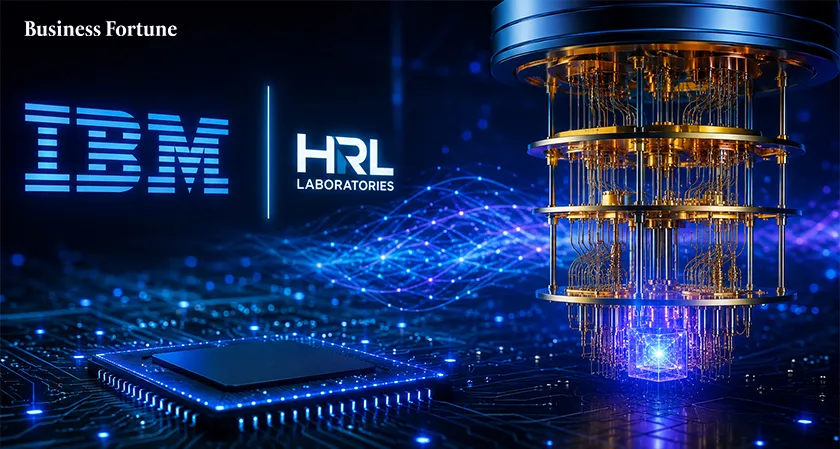
What does the IBM acquisition of HRL Laboratories mean for quantum computing? Explore what IBM gains from the deal and what comes next.
IBM acquisition of HRL Laboratories brings the California based research company’s expertise in quantum computing, quantum sensing, advanced materials and electronics into IBM. The financial details of the deal were not disclosed but IBM aims to make quantum computers more powerful. IBM acquisition of HRL Laboratories
HRL Laboratories has been working on silicon spin qubits, while IBM has mainly focused on superconducting qubits. In simple terms, these are two different ways of building the tiny components that power a quantum computer. By bringing HRL into the company, IBM gets access to new skills and technologies in areas such as quantum materials, cooling systems, control electronics, packaging, and connections between different parts of quantum hardware.
And that matters because building a useful quantum computer involves much more than making a powerful processor.
What does this mean for IBM’s quantum plans?
IBM is working toward quantum computers that can solve much more complex problems than today’s machines. The company is developing hardware, software, algorithms, and error correction systems to make this possible.
Its roadmap includes IBM Quantum Starling, a fault tolerant quantum computer that IBM expects to have ready by 2029. The company says Starling could perform 100 million quantum operations and offer far more computing power than current quantum computers.
IBM plans to follow Starling with Blue Jay, another fault tolerant quantum computer targeted for the mid 2030s.
“The acquisition brings together two leading organizations with a shared commitment to advancing the frontiers of science and technology,” IBM said.
HRL’s expertise could also help IBM improve the way quantum hardware is manufactured. IBM said its silicon based technology could support work with Anderon, its quantum wafer foundry, helping researchers test and improve different approaches more quickly.
Boeing and General Motors, which previously owned HRL, will continue working with IBM and HRL on quantum applications and advanced technology projects.
IBM is also making a move in AI
While quantum computing is the big focus of the acquisition, IBM is also expanding its AI lineup with Granite 4.2. The new open weight models come in 3B, 8B, and 30B versions and support a 128,000 token context window. The larger 8B and 30B models are trained to work with tools, search the web, and use terminals.
IBM describes Granite 4.2 as a reasoning focused model family. In simple terms, the models are designed to handle tasks that require several steps instead of simply giving a quick answer. Because these models can be downloaded and self hosted, developers and businesses can run them on their own systems rather than depending completely on cloud based AI services.
What’s Next?
As Business Fortune observes, IBM is betting on two important areas of computing: AI today and quantum computing for tomorrow. The HRL acquisition gives IBM more technology and expertise as it works toward quantum machines that can handle real world problems. If its plan stays on track, the next few years could be an important period for turning quantum computing from an experimental technology into something businesses can actually use.
FAQs
What did IBM acquire?
IBM acquired HRL Laboratories, a research organization specializing in quantum computing, sensing, advanced communications, electronics, manufacturing, and materials science.
Why is HRL important to IBM?
HRL adds expertise in silicon spin qubits, quantum materials, cryogenics, electronics, packaging, and related technologies.
What is IBM Quantum Starling?
Starling is IBM’s planned fault tolerant quantum computer, targeted for 2029, with a goal of performing 100 million quantum operations.
What is Granite 4.2?
Granite 4.2 is IBM’s latest family of open weight AI models, available in 3B, 8B, and 30B parameter versions.
When does IBM expect its next generation quantum systems?
IBM is targeting Starling for 2029, followed by Blue Jay in the mid 2030s.


.webp)





























Comments