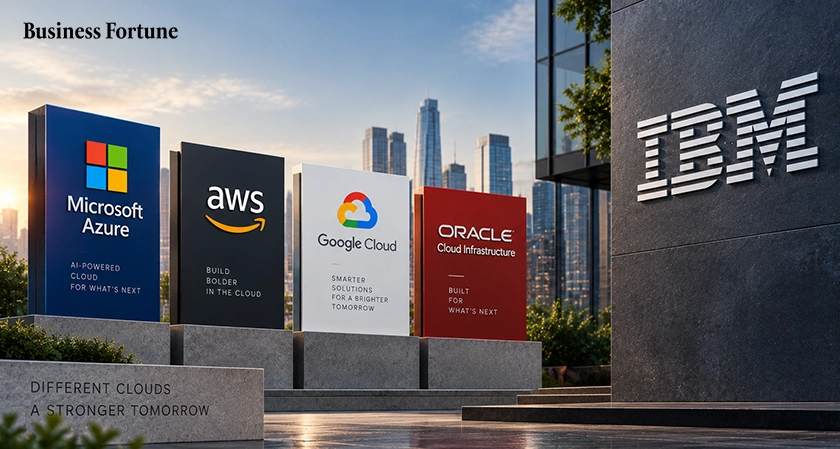
IBM Cloud faces growing pressure as enterprises explore powerful alternatives for AI, hybrid infrastructure, data management, security, and modernization in 2026.
The Best IBM cloud competitors are becoming increasingly important as businesses rethink how they build applications, manage data, deploy artificial intelligence and modernize older IT systems. IBM Cloud continues to focus heavily on enterprise workloads, hybrid cloud, regulated industries, AI and its integration with Red Hat technologies. At the same time, companies such as Amazon Web Services, Microsoft Azure, Google Cloud and Oracle Cloud Infrastructure are expanding their own enterprise capabilities.
In business enterprises, selecting a cloud vendor is not as straightforward as offloading servers from the physical office or data centers. They prefer a cloud platform that supports Artificial Intelligence, cybersecurity, analytics, containers, database, application migration, etc. This has made the cloud market more competitive and more specialized.
IBM Cloud remains distinctive because of its connection with Red Hat OpenShift and its focus on hybrid and multicloud environments. IBM says its cloud portfolio combines enterprise cloud capabilities with Red Hat's open hybrid cloud technologies, while its managed OpenShift offering supports mission-critical applications, AI acceleration and modernization.
However, when the need arises for the company to explore beyond IBM, the solution is determined by many factors including the current technological state of the organization and its workload needs.
Why are IBM Cloud competitors attracting enterprise attention?
Cloud computing market has evolved to become an extensive ecosystem where providers compete in infrastructure, AI, databases, analytics, security, application development and industry-based services.
The IBM competition in cloud computing comprises some of the largest technology companies in the world. AWS provides a wide range of cloud services in computing, storage, databases, AI, analytics, security, networking and industry solutions. Currently, AWS states that its portfolio comprises over 240 comprehensive services.
Microsoft Azure has built a similarly broad enterprise platform covering AI, analytics, compute, containers, databases, security, hybrid cloud, networking, storage and application development.
Google Cloud and Oracle Cloud Infrastructure also compete for organizations looking for specialized capabilities in areas such as AI, data, infrastructure, enterprise applications and modernization.
This means businesses searching for cloud platforms for businesses are no longer comparing only basic infrastructure prices. They are examining the wider technology ecosystem surrounding each provider.
How does IBM Cloud differ from other cloud providers?
Hybrid cloud, enterprise workloads, regulated industries and Red Hat technology have given IBM Cloud a particularly strong identity.
Red Hat’s OpenShift on IBM Cloud is the managed solution for developing and running container-based apps. According to IBM, OpenShift can facilitate uniform application deployment in hybrid cloud environments. In other words, OpenShift helps organizations have flexible options while working in multi-cloud environments.
In addition, IBM has also made progress in extending its cloud offerings in support of artificial intelligence and virtualization. In May 2026, IBM introduced its managed Red Hat AI Inference and Red Hat OpenShift Virtualization cloud services.
This positioning creates an important distinction. IBM Cloud is not simply competing on the size of its infrastructure portfolio. It is also connecting cloud infrastructure with Red Hat, AI, hybrid cloud management and enterprise modernization. For organizations already using IBM technologies or Red Hat environments, that combination can be an important factor when evaluating cloud options.
Which companies compete with IBM Cloud?
Several major technology companies appear frequently when businesses examine IBM Cloud market competitors and alternatives.
Amazon Web Services
Among the many options that are considered as replacements to IBM Cloud, AWS is probably the most recognizable name. The range of its products includes infrastructure, databases, AI, analytics, storage, networking, security, applications and even industry solutions.
AWS will thus be able to attract organizations seeking a wide array of cloud solutions in one single ecosystem. Its marketplace and partner network also extend the range of technologies available to customers.
Microsoft Azure
Microsoft Azure is another major player among cloud computing competitors to IBM. Microsoft offers services covering AI, application development, data analytics, security, hybrid cloud, infrastructure, containers and databases. Its connection with Microsoft's wider business and developer ecosystem can also be relevant for enterprises that already depend heavily on Microsoft technologies.
Google Cloud
Google Cloud competes across infrastructure, AI, data analytics, application development and cloud-native technologies. For organizations placing strong emphasis on data-intensive applications and AI, its technology portfolio makes it an important provider to evaluate alongside IBM Cloud.
Oracle Cloud Infrastructure
Oracle Cloud Infrastructure, or OCI, is another significant enterprise option. Oracle positions OCI around performance, security, AI and running demanding applications.
The financial performance of Oracle in 2026 also reflects the growth of its cloud infrastructure, which had generated revenues of $18.1 billion in FY2026, according to Oracle.
What should businesses look for in the best cloud providers for enterprises?
There is no cloud solution platform that suits all organizations. Organizations should analyze the underlying technology of the platform and its compatibility with the organizational infrastructure.
Important considerations include:
-
AI and machine learning: Can the platform support current and future AI workloads?
-
Hybrid cloud: Can applications operate across public cloud, private infrastructure and other environments?
-
Security and compliance: Does the provider support the regulatory requirements of the industry?
-
Application modernization: Can older applications be migrated or redesigned without unnecessary complexity?
-
Containers and Kubernetes: Does the platform provide suitable tools for cloud-native development?
-
Data and analytics: Can teams process and manage large volumes of business data efficiently?
-
Cost management: Can the organization monitor and control cloud spending as workloads expand?
-
Enterprise support: Are the provider's support and professional services suitable for mission-critical systems?
These factors help explain why the leading cloud computing companies 2026 landscape cannot be understood through market size alone. A provider's suitability depends on the specific workload and business environment.
Are there strong IBM Cloud alternatives in 2026?
Yes. The IBM Cloud alternatives 2026 landscape includes AWS, Microsoft Azure, Google Cloud and Oracle Cloud Infrastructure, among other specialized providers.
Gartner Peer Insights' IBM Cloud alternatives page shows that customers evaluating IBM Cloud also consider AWS and other cloud platforms, with comparisons spanning areas such as integration, deployment, service and support, contracting and product capabilities.
The practical choice comes down to what a company needs its cloud environment to accomplish. A company prioritizing a broad service portfolio may examine AWS. An organization deeply connected to Microsoft technologies may investigate Azure. A business focused on data and AI may evaluate Google Cloud, while companies with substantial Oracle workloads may consider OCI. IBM Cloud, meanwhile, remains closely positioned around hybrid cloud, Red Hat OpenShift, AI, security and enterprise workloads.
What will shape the IBM Cloud competitive landscape next?
The next phase of competition is likely to revolve around AI infrastructure, hybrid cloud management, application modernization, cybersecurity and increasingly specialized computing requirements.
IBM's recent introduction of managed OpenShift virtualization and AI inference services illustrates how cloud providers are moving beyond traditional virtual machines and storage toward platforms designed for AI and modern enterprise applications.
At the same time, competitors are continuing to expand their AI, analytics, infrastructure and enterprise portfolios. This could make cloud selection more complicated, but it also gives businesses more options when designing their technology strategies.
The future of the market may therefore be less about finding one universal cloud provider and more about finding the right combination of platforms for specific workloads.
As enterprises move deeper into AI, hybrid infrastructure and cloud-native development, the Best IBM cloud competitors will continue to evolve alongside changing business requirements. Business Fortune expects the cloud market to remain highly competitive, with IBM and its major rivals continuing to invest in AI-ready infrastructure, hybrid cloud technologies, security and enterprise modernization. The companies that can connect these capabilities with practical business needs will remain central to the next stage of enterprise cloud computing.


.webp)





























Comments