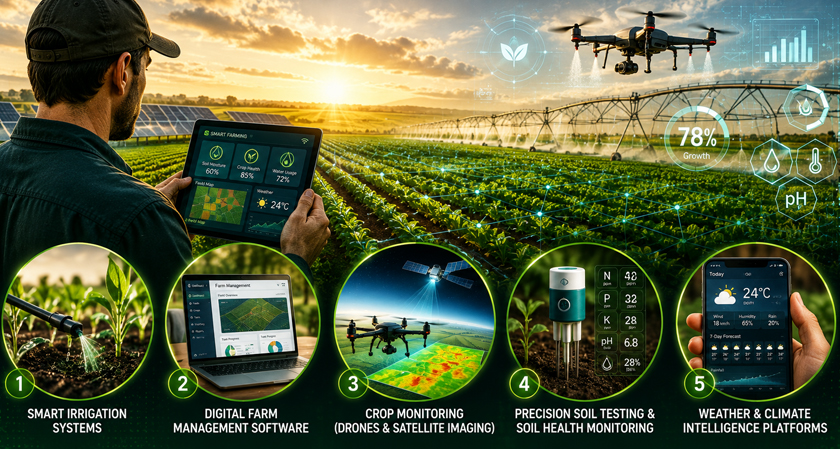
You don't need futuristic robots or expensive machines to farm smarter. Here are the affordable and practical tools that make up the best smart farming tools and tech in 2026.
Farming has never been an easy job. Some days you're hoping for rain, other days you're praying it stops. And then there is rising fertilizer prices, shrinking water supplies, unpredictable weather, and the constant challenge of finding enough labor during peak seasons and it's clear that today's farmers have more on their plate than ever before. Relying on instinct alone isn't always enough anymore but technology can help. If you're wondering which are the best smart farming tools and tech in 2026, the answer isn't about expensive robots or futuristic gadgets.
It is smart farming tools, like an extra pair of eyes and hands that help farmers make better decisions. Whether it's an irrigation system that waters crops only when they're thirsty, software that keeps every farm operation organized, or drones that spot crop stress before it becomes a bigger problem, today's tools are helping farmers more than you know.
Ready to farm a little smarter? Here are the 5 Best smart farming tools and tech in 2026
The 5 Best smart farming tools and tech in 2026
- Smart Irrigation Systems
If you've ever stood in a field wondering, "Should I water today or wait another day?” this is for you.
Too little water can stress crops. Too much, and you're literally washing money into the ground. Instead of watering on a fixed schedule, these Smart Farming Tools use soil moisture sensors, weather forecasts, and automated controllers to figure out when your crops actually need water. If rain is expected tomorrow, the system can hold off. If the soil is drying out faster than expected, it can adjust on the fly.
This is one of the biggest smart farming technology trends 2026, especially in regions where every drop of water counts. Many modern systems also work alongside IoT Farming Solutions, allowing farmers to monitor irrigation from a smartphone instead of making repeated trips across the field. Let your crops decide when they’re thirsty.
Popular Smart Irrigation Tools
-
Netafim NetBeat™ combines irrigation, fertilization, and field monitoring in one connected platform.
-
Rain Bird IQ4 helps farmers automate and remotely manage irrigation schedules.
-
Valmont AgSense lets farmers control pivots, pumps, and irrigation equipment remotely.
Whether you're managing a few acres or a large commercial operation, smart irrigation proves that sometimes the best investment isn't adding more water. It's knowing exactly when not to use it.
- Digital Farm Management Software
Running a farm today involves far more than planting, watering, and harvesting. There's inventory to track, workers to manage, equipment to maintain, expenses to record, and countless decisions that can affect the season's outcome. Keeping all of that in mind or scattered notes can be really hard. However, using Farm Management Software, allows you to plan crop rotations, record field activities, monitor equipment, track costs, schedule tasks, and even compare this year's performance with previous seasons. Many platforms also include AI Farming Tools that analyze field data and offer recommendations.
One of the biggest advantages of this Digital Farm Management Software is visibility. Think of it as your farm's digital control room. You know what's happening across every field, it also makes it easier to spot patterns, control spending, and improve productivity over time.
Some of the most popular platforms include
-
Climate FieldView
-
FarmERP.
- Crop Monitoring (Drones & Satellite Imaging)
Walk through a field and you might spot yellowing leaves or patches that don't look quite right. The problem is, by the time you notice them from the ground, the damage may already be spreading. Crop monitoring flips that around by giving farmers a bird's-eye view, literally.
Using drones and satellite imaging, this branch of Precision Farming Technology helps farmers keep an eye on every corner of their fields without having to walk every acre. High-resolution cameras and multispectral sensors can detect signs of water stress, nutrient deficiencies, pest infestations, and crop diseases long before they're visible to the naked eye.
The biggest advantage is catching small problems before they become expensive ones. Instead of treating an entire field, farmers can focus only on the affected areas, saving time, fertilizer, pesticides, and fuel. It's no surprise that drone and satellite monitoring continues to be one of the fastest-growing smart farming technology trends 2026.
-
DJI Agriculture offers drones designed for crop mapping and field analysis
-
Sentera combines drone imagery with advanced crop analytics.
-
Satellite-based platforms like EOSDA Crop Monitoring, OneSoil, and Planet provide regular field updates, vegetation maps, and crop health reports without requiring farmers to launch a drone themselves.
- Precision Soil Testing & Soil Health Monitoring
Ask any experienced farmer what's behind a great harvest, and they'll say it is the soil. It might sound like a simple thing but it's where everything begins. After all, even the best seeds can't do much if the ground they're planted in isn't up to the task.
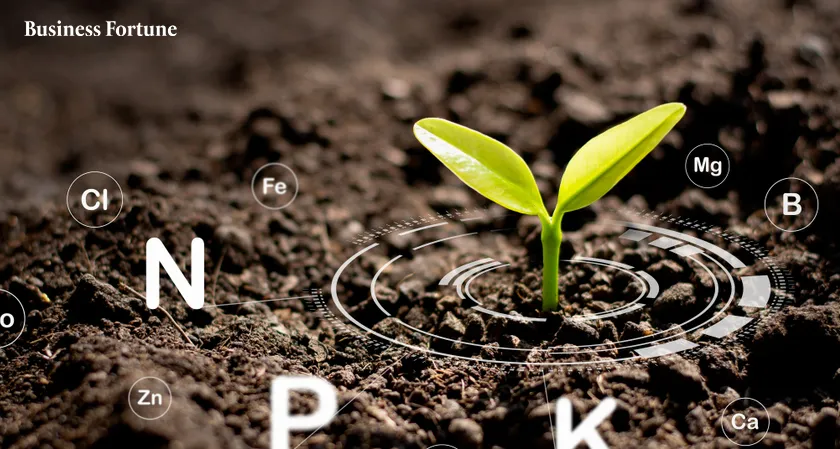
That's why precision soil testing has become one of the most valuable Smart Farming Tools in recent years. Digital soil testing tools measure everything from soil moisture and pH levels to nutrient content, salinity, and organic matter. The result? A clearer picture of what the soil actually needs and what it doesn't.
Better soil data means fertilizers can be applied more precisely, reducing unnecessary costs and minimizing environmental impact. Combined with other IoT Farming Solutions, soil monitoring forms the foundation of Smart Agriculture Technology, giving farmers reliable data instead of educated guesses.
-
CropX combines in-ground sensors with cloud-based analytics to monitor soil conditions in real time.
-
Teralytic offers wireless soil sensors that track moisture, temperature, and nutrients continuously.
-
Veris Technologies specializes in soil mapping and nutrient analysis
-
SoilOptix uses high-resolution scanning to create detailed maps of soil variability across entire fields.
- Weather & Climate Intelligence Platforms
Farming has always depended on the weather but in recent years, the weather has become far less predictable. That's why weather and climate intelligence platforms have become one of the best smart farming tools to have in 2026.
These platforms do much more than tell you whether to carry an umbrella. They combine hyperlocal weather forecasts, satellite data, historical climate patterns, and field-level insights to help farmers decide the best time to plant, irrigate, spray, fertilize, or harvest.
The benefits are hard to ignore. Better timing means fewer wasted inputs, healthier crops, and lower chances of weather-related losses. When combined with other Smart Farming Tools and Farm Management Software, weather intelligence becomes another layer of smarter decision-making, helping farms stay productive even when Mother Nature refuses to cooperate.
Some of the leading platforms include
-
IBM Environmental Intelligence Suite
-
Farmonaut
How to Choose the Right Smart Farming Technology
Here's the truth nobody tells you at an agri-tech expo: the best smart farming tool is not necessarily the most advanced one. It's the one that saves you time, money or stress before the next sunrise. You see drones flying over fields, apps showing colorful maps, and tractors that almost drive themselves. The temptation is to think, "I need all of this." The truth? Most farmers don't.
Before spending a single rupee, ask yourself a few simple questions.
-
Small farm? Start with soil monitoring or weather intelligence. They are affordable and give quick returns.
-
Fruit, vegetable, or high-value crops? Crop monitoring and smart irrigation usually pay off faster because every plant matters.
-
Tight budget? Choose a subscription-based platform before buying expensive hardware.
-
Not very tech-savvy? Pick tools with mobile apps, local language support, and simple dashboards.
-
Already using drip irrigation or modern equipment? Make sure the new tool can connect with what you already own.
And never ignore support. A slightly less fancy platform with a local dealer who answers your calls is often worth more than a powerful system that leaves you watching YouTube tutorials at 10 p.m. during peak season
A Quick Guide: What Problem Are You Trying to Solve?
|
Difficulty |
Best Technology |
Recommended Platform |
|
Water shortage or high irrigation costs |
Smart Irrigation Systems |
CropX Netafim NetBeat™ |
|
Too many records and farm activities to manage |
Farm Management Software |
John Deere Operations Center Agworld |
|
Crop diseases or pests are noticed too late |
Drone & Satellite Crop Monitoring |
EOSDA Crop Monitoring Sentera |
|
Fertilizer costs are increasing every season |
Precision Soil Testing |
SoilOptix Teralytic |
|
Weather keeps disrupting farm operations |
Climate & Weather Intelligence Platforms |
DTN Ag Weather Tomorrow.io |
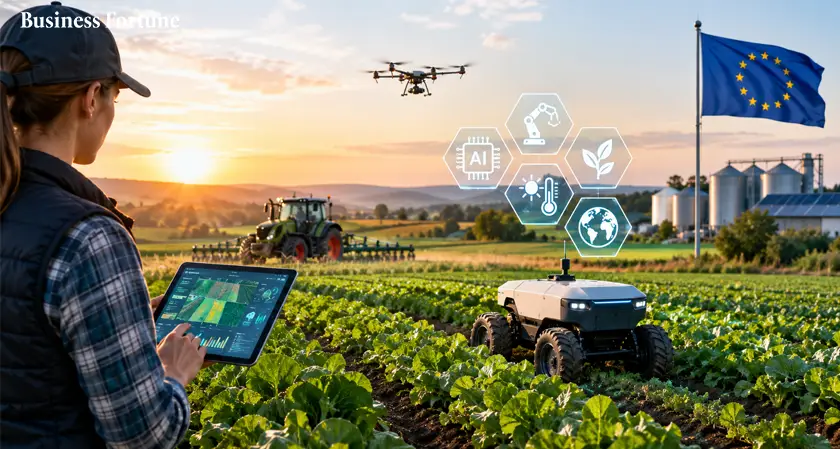
A lot of farmers hear words like AI, drones, IoT and precision agriculture and immediately picture a million-dollar setup with autonomous tractors roaming the fields like something out of a sci-fi movie. But it’s not the reality. Most farms don't need every new gadget on the market. They need tools that fit their farm, their crops and their budget.
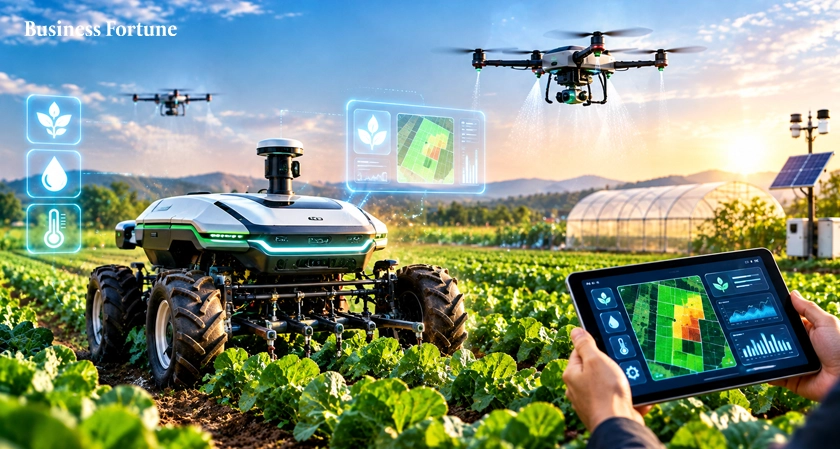
This is especially important because not every technology is practical for every farm. Autonomous tractors, robotic weeders and precision sprayers are impressive but they can be expensive and may not make sense for many small and medium-sized farms. The tools covered in this Business Fortune article, such as smart irrigation, soil monitoring, weather platforms, and Farm Management Software, are far more achievable and often deliver faster results for the investment.
FAQs
What are the best smart farming technologies in 2026?
Some of the best include Smart Irrigation Systems, Farm Management Software, Drone And Satellite Crop Monitoring, Precision Soil Testing, and Weather Intelligence Platforms.
How does smart irrigation improve crop yields?
Smart irrigation systems use soil moisture sensors, weather forecasts, and automation to water crops only when needed. This prevents overwatering and underwatering, helping plants grow more consistently while conserving water and reducing irrigation costs.
What is digital farm management software?
Farm Management Software is a digital platform that helps farmers manage everyday operations from a single dashboard. It can track field activities, crop plans, expenses, inventory, labor, machinery, and harvest data, making farm management simpler and more organized.
Are drones useful for crop monitoring?
Yes. Drones equipped with high-resolution and multispectral cameras can quickly identify crop stress, pest infestations, diseases, and nutrient deficiencies. They give farmers a clear view of their fields, allowing problems to be addressed before they affect yields.
Which smart farming technology is best for small farms?
For most small and medium-sized farms, smart irrigation systems, weather intelligence platforms, and affordable Farm Management Software offer the best value. These tools are relatively easy to adopt, don't require major investments, and can deliver noticeable improvements in productivity and resource management.
How does weather intelligence help farmers?
Weather intelligence platforms provide hyperlocal forecasts, rainfall predictions, frost alerts, and heat stress warnings. This helps farmers plan irrigation, spraying, fertilization, planting, and harvesting at the right time, reducing weather-related risks and avoiding unnecessary input costs.


.webp)























Comments