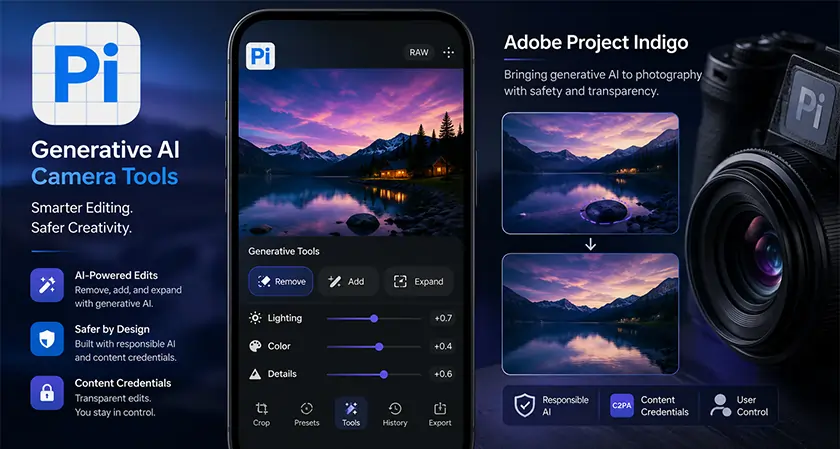
Adobe Project Indigo brings generative AI camera features to smartphone photography, offering smarter editing tools while focusing on privacy, transparency, and responsible AI use.
How Adobe Project Indigo Is Redefining Mobile Photography
Adobe is exploring the future of mobile photography with the launch of Adobe Project Indigo, introducing an experimental AI Playground that integrates generative AI capabilities directly into its camera app. The new feature aims to help users edit images immediately after capture rather than relying on separate editing platforms after taking photos.
The Adobe camera with generative AI technology enhances creative control by offering AI-powered tools for object removal, artistic transformations, lighting adjustments, and photography guidance. The experimental feature is currently available to a limited number of users through Project Indigo 1.1 as a free experience without requiring an Adobe account.
How Adobe Project Indigo Is Redefining Mobile Photography
The AI Playground includes four major sections: Object Editing, Styles, Photo Guidance, and Custom Edit. Users can remove distractions, create depth-of-field effects, apply artistic styles, and use text or voice prompts to customize their images. The Photo Guidance feature can analyze photographs and provide suggestions for improving composition, shooting angles, and editing decisions.
Adobe said the goal is to make AI-assisted photography more accessible while keeping users in control of their creative process. “Generative AI image editing has advanced quickly, but we are exploring ways to make these tools more useful within the photography workflow itself,” Adobe’s team explained while introducing the feature.
The AI Playground initially used Google’s Nano Banana image-generation model. Adobe may explore additional models, including its own Firefly technology, in future updates. Since Nano Banana operates through the cloud, the feature requires an internet connection to process AI edits.
Adobe Prioritizes User Privacy with Responsible AI Practices
Adobe has also focused on transparency and responsible AI use. The company stated that user prompts and images will not be reviewed, uploaded for training purposes, or used to improve AI models. The company is also working with the Content Authenticity Initiative to add metadata to AI-edited images and improve digital content verification.
However, Adobe acknowledges challenges remain which include maintaining facial identity during edits, improving prompt-based controls, and developing smaller AI models that can operate directly on smartphones.
With Adobe Project Indigo and its Adobe camera with generative AI capabilities, the company is positioning AI as a creative assistant for photographers while continuing to explore how artificial intelligence can reshape the future of image creation.
According to Business Fortune, Adobe demonstrates how generative AI could be made more accessible while ensuring privacy and trust.
FAQs
What is Adobe Project Indigo?
Adobe Project Indigo is an experimental computational photography camera app that combines advanced camera controls with AI-powered editing features.
What does the Adobe camera with generative AI offer?
The Adobe camera with generative AI provides tools for object removal, style changes, photo improvements, custom AI edits, and photography suggestions.
Does Adobe use user photos to train AI models
Adobe stated that user images and prompts from the AI Playground experiment are not used to train AI models.
Which AI model powers Adobe’s AI Playground?
The AI Playground initially used Google’s Nano Banana image-generation model, with potential support for other AI models in the future.
Is Adobe Project Indigo available to everyone?
Currently, Adobe Project Indigo’s AI Playground is available only to a limited number of users.


.webp)





























Comments