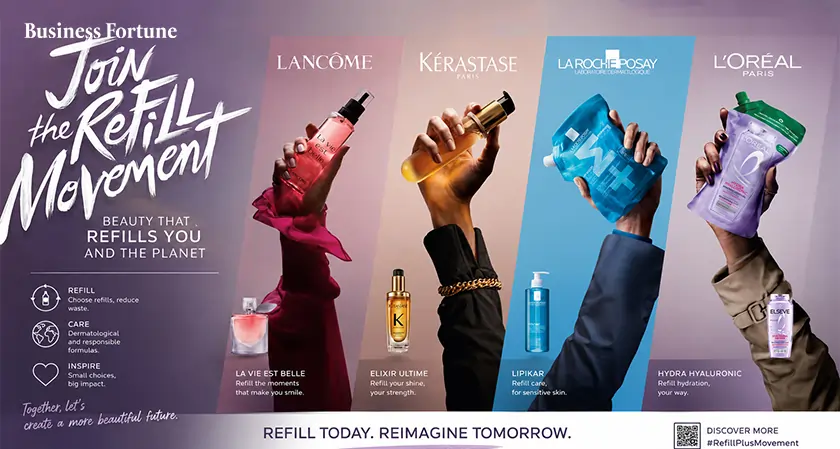
Campaign for World Refill Day highlights L’Oréal’s refill expansion, raising questions about whether sustainable packaging can reshape the future of beauty.
L’Oréal has expanded its sustainability initiatives by scaling up its refill awareness campaign into new brands and product categories, aiming to encourage consumers to adopt reusable packaging solutions. The company’s latest efforts, introduced through the Campaign for World Refill Day, focus on increasing awareness about refillable beauty products and highlighting their role in reducing packaging waste across the industry.
The global beauty group has expanded its #JoinTheRefillMovement campaign to include a wider selection of products from its portfolio. The edge brings together multiple brands and refillable solutions across skincare, fragrance, makeup and haircare segments, reflecting L’Oréal’s continued focus on circular packaging models and more sustainable consumption patterns.
Can L’Oréal’s Refill Campaign Transform Consumer Behaviour Toward Sustainable Beauty?
The campaign seeks to address consumer awareness challenges by demonstrating how refill systems can become part of everyday beauty routines. L’Oréal aims to make refill options more visible and accessible while encouraging customers to consider the environmental sustainability impact of packaging choices when purchasing beauty products.
The company has continued developing packaging innovations designed to support a more circular economy. Through refillable formats, consumers can reuse existing containers and purchase replacement units, helping reduce the demand for single-use packaging materials.
-
Refill products help reduce packaging waste and resource consumption
-
Campaign promotes sustainable choices across global beauty markets
Will Reusable Packaging Become a Mainstream Solution for the Beauty Industry?
A variety of brands and products are covered by L'Oréal's expanded refill strategy, which enables sustainable packaging choices to reach various customer segments. The company wants to broaden the availability of reusable solutions beyond the luxury cosmetics markets by providing refill formats in a number of categories.
The initiative also reflects a broader transformation within the beauty sector, where companies are increasingly exploring ways to balance product innovation with environmental responsibility. Refillable packaging has gained attention as brands seek alternatives that reduce waste while maintaining convenience and product quality.
However, there are still obstacles to the industry's adoption of refill systems, such as infrastructural requirements, customer education, accessibility, and shifting consumer behavior. Successful adoption is dependent on making refill choices convenient, inexpensive, and easily accessible to customers worldwide.
The company's attempts to increase consumer involvement in sustainable practices are highlighted in L'Oréal's most recent campaign. Future packaging choices are expected to be increasingly influenced by refillable items as the cosmetics sector continues to investigate circular solutions.
Thus, Business Fortune is of the view that L’Oréal’s refill expansion could accelerate sustainable beauty practices through innovation and consumer engagement.
FAQs
What is L’Oréal’s refill campaign focused on?
L’Oréal’s refill campaign focuses on promoting reusable packaging and encouraging consumers to adopt sustainable beauty solutions.
What categories are included in L’Oréal’s refill initiative?
The initiative includes products across skincare, fragrance, makeup and haircare categories.
How do refillable products support sustainability?
Refillable products allow consumers to reuse containers, helping reduce packaging waste and resource usage.
What challenges affect the adoption of refillable packaging?
Challenges include consumer awareness, convenience, availability and the need for suitable refill infrastructure.
Why is refillable packaging gaining importance in the beauty industry?
Refillable packaging is gaining attention as brands seek ways to reduce environmental impact and support circular economy practices.


.webp)