Fastest Growing Companies to watch 2026
Business Fortune
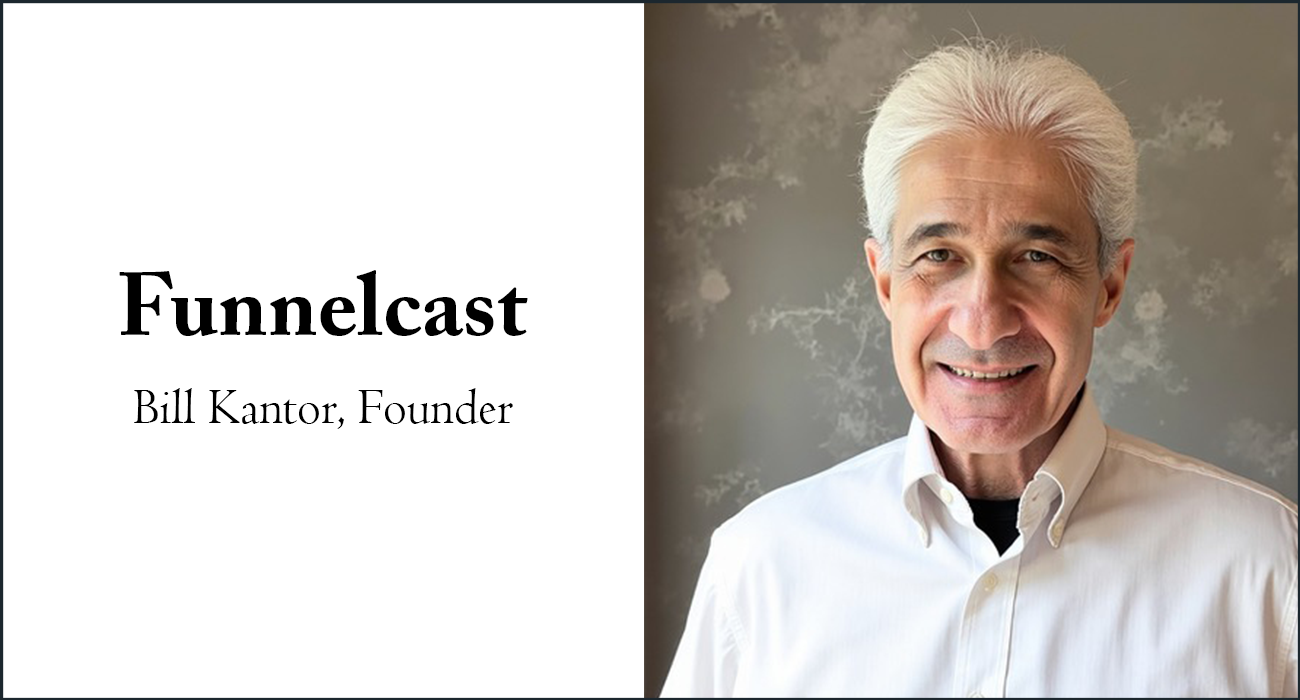
The world of B2B sales forecasting is crowded with confident predictions, colorful dashboards, and bold claims of artificial intelligence. Yet beneath the surface, most revenue leaders share the same quiet anxiety: despite all the tools, they are still guessing. Forecast calls stretch late into the quarter, pipelines are padded with optimism, and performance metrics often obscure more than they reveal.
Bill Kantor built Funnelcast because he recognized that this uncertainty wasn’t a failure of effort or ambition. It was naïve sales math.
As the founder of Funnelcast, Kantor has anchored the company around a deceptively simple mission: to free sales organizations from guesswork by applying practical, transparent mathematics to the sales process. In an industry increasingly obsessed with opaque “AI-powered” predictions, Funnelcast stands apart by championing clarity over mystery, by delivering models leaders can understand, trust, and act on.
At its core, Funnelcast is not trying to predict the future better than everyone else. It is trying to help companies change it.
A Personal Frustration, Not a Startup Pitch
Kantor’s journey to founding Funnelcast did not begin with a startup blueprint or venture capital ambitions. It began with a recurring frustration born from experience. With a background in mathematics and engineering, he had spent years running and scaling sales teams, and watching leadership teams make high-stakes decisions – hiring plans, quotas, financing – using forecasting logic that was fundamentally flawed.
Sales operations, he observed, relied heavily on static averages: a single win rate applied universally, a fixed probability assigned to a deal stage, a point forecast treated as fact. The problem was obvious to him. Sales outcomes are temporal. The likelihood of closing a deal changes dramatically depending on how long it has been in a stage, and how much time you have left in the quarter. This can all be modeled based on how similar deals have historically behaved over time.
Using oversimplified averages didn’t just produce inaccurate forecasts. It warped KPIs, encouraged the wrong behaviors, and made planning unreliable. Kantor often describes the experience as trying to steer a ship with a faulty compass.
So he did what engineers do when a system fails. He built a better one.
Working initially for his own use, Kantor developed a time-based probabilistic model that treated the sales funnel as a dynamic process rather than a static snapshot. Instead of asking, “What’s the win rate for this stage?” the model asked deeper questions: How long has this deal been here? How does that duration affect its probability of closing? How does time itself change the forecast?
The impact was immediate. The company president began relying on Kantor’s model instead of the official board plan when making decisions about staffing and compensation. That shift, quiet but decisive, was the first signal that something important was taking shape.
The Moment It Became Bigger Than Sales
To pressure-test his thinking, Kantor brought the model to his friend Bryan Lewis, a mathematician with deep expertise in applied statistics. Lewis’s reaction was immediate and clarifying.
“This is survival analysis,” he told Kantor.
Lewis recognized the same statistical techniques used to model patient health outcomes and time-to-event probabilities. What Kantor had built was not an improvised sales hack; it was a robust, well-established mathematical framework being applied to a business problem that had long been underserved by serious modeling.
That realization marked a turning point. Funnelcast wasn’t just improving forecasts. It was applying proven statistical science to revenue operations, an area that, despite its importance, often relied more on KPIs that are easily gamed, flawed math, and conventional wisdom, rather than rigor.
But an even more important insight followed. A perfect forecast, Kantor realized, is not the ultimate goal. Even if such a thing were possible, it would still be passive. The real power of a transparent probabilistic model lies in its ability to influence outcomes, to show teams where to focus, what to prioritize, and how to actively improve results.
That shift in thinking became the foundation of Funnelcast’s mission: to move organizations from merely reporting the sales news to giving them the tools to make their own news.
Challenging Habits, Not Technology
Ironically, the greatest challenges Funnelcast faced were not technical. The math worked. The models held up. The resistance came from mindset.
Sales leaders are conditioned to seek certainty: a single number to rally around, a definitive target to commit to. Funnelcast introduced probability distributions, a range of likely outcomes rather than a single forecast. For many, that initially felt like ambiguity rather than clarity. But it’s actually more clarity than people initially realize.
Kantor learned quickly that change management in this space could not begin with theory. Explaining statistical models upfront only invited debate and skepticism. Instead, Funnelcast shifted its approach to lead with utility.
Rather than starting with methodology, the company shows leaders a simple before-and-after. First, a baseline forecast: here is the likely outcome if you keep doing what you have been doing. Then, immediately, a prescription: here is the optimized list of deals your team should focus on this week. If you do that, here’s what
changes.
When leaders follow that guidance and see tangible results, often an average 60 percent increase in sales productivity – the conversation changes. Trust transfers from outcome to method and communication. The sophistication of the math becomes strength rather than a barrier.
The lesson was clear: communicate in outcomes, not jargon. Demonstrate value first, and the model earns its credibility.
Turning Forecasting Into a Control System
Funnelcast’s platform reflects this philosophy. It is designed not as a collection of reports, but as an integrated system for revenue control.
At its center is The Funnelcast Report, a daily command center for sales leadership. It begins with honest forecasting, presenting a probability distribution rather than a single guess, so leaders understand the realistic range of outcomes they face.
But forecasting is only the entry point. The real power lies in optimization. Funnelcast’s Open Pipeline Coach analyzes the active pipeline and identifies which deals deserve immediate focus to maximize expected revenue and minimize risk. At the same time, the New Pipeline Planning Coach looks forward, pinpointing the most productive market segments to target and quantifying how much new demand must be generated to hit future goals.
This dual approach fundamentally changes sales strategy. Teams stop chasing myopic commit numbers and start allocating effort where it mathematically matters most—to maximize sales.
Supporting this is Funnelcast’s KPI Analytics suite, which cuts through vanity metrics using time-to-event analysis. Instead of distorted averages, leaders see true win rates and advance rates across segments, revealing where processes break down and where they excel.
Layered on top is scenario planning. Leaders can ask meaningful “what if” questions – what if win rates in a specific segment improved by 10 percent, or pipeline generation increased by 20%, and immediately see the impact on revenue forecasts.
The result is a shift in behavior. Sales organizations stop rationalizing past performance and start actively shaping future outcomes.
Why Transparency Beats Black Boxes
In a market saturated with AI and machine learning claims, Funnelcast takes a deliberately different stance. Kantor is direct about the distinction.
Many platforms use AI as a black box to predict what might happen. Funnelcast is built to explain why it’s happening, and how to change it. Classical statistical models form the backbone of the system, not because they are old, but because they are interpretable—and they work really well!
A sales leader can see exactly why a deal is prioritized: its size, its stage duration, its probability based on similar deals. The logic is visible. It can be questioned, validated, and trusted.
That transparency matters because it enables action. When sellers and leaders understand the rationale behind a recommendation, they are far more likely to follow it. And when following it consistently delivers measurable gains, trust compounds.
For Kantor, the test is simple. Does a technology help customers change their outcomes, or does it merely decorate a dashboard? If the underlying math is already clear and actionable, adding complexity for its own sake is counterproductive. Sometimes the most advanced solution is the one that removes noise and allows teams to focus on selling.
Separating Execution from Creation
One of Funnelcast’s most important distinctions is its separation of open pipeline and new funnel modeling, a choice that reflects business reality rather than convention.
Most forecasting tools focus on deals already in the pipeline. That approach may work for short-term execution, but it fails catastrophically for long-term planning. A significant portion of future revenue often comes from deals that do not yet exist. Ignoring them is like steering a ship by looking only at its wake.
By modeling these engines separately, Funnelcast enables planning and accountability over timeframes from current month to next year. The open pipeline model answers the execution question: given what exists today, which deals should be prioritized to maximize closes now? The new funnel model answers the generation question: what volume and quality of opportunities must be created to hit future targets?
This clarity aligns sales and marketing around shared, quantified goals and reduces the cycle of finger-pointing that often follows missed targets.
Beyond Sales: Toward Enterprise Modeling
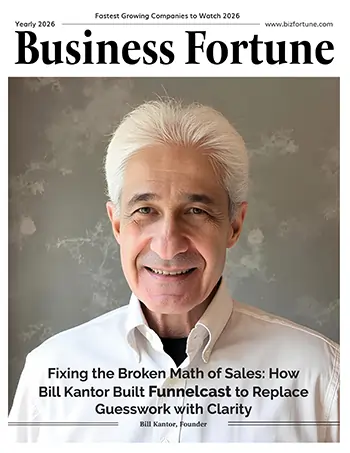
Although Funnelcast began with sales, its trajectory has always pointed beyond it. Kantor describes the platform not as a sales tool, but as a business modeling engine that solves acute sales problems first.
Marketing is the next frontier. A product currently in beta uses Funnelcast’s analytics to empirically define an Ideal Customer Profile based on actual win/loss data, replacing intuition with evidence. The goal is not more leads, but better ones, those most likely to convert efficiently.
This naturally extends into full revenue operations, where a single probabilistic model becomes the source of truth across sales, marketing, and finance. From there, the leap into broader business planning is logical. A reliable revenue model informs hiring, territory expansion, investment decisions, and runway planning.
Kantor’s vision is ambitious but grounded: to give executives the ability to run confident, model-driven “what if” scenarios for the entire enterprise.
A Different Kind of Leadership
Bill Kantor is not chasing trends. Funnelcast is not built around buzzwords or hype cycles. Its leadership philosophy is rooted in discipline, transparency, and respect for complexity without obscuring it.
By refusing to treat sales forecasting as guesswork or theater, Kantor has built a company that challenges how revenue leaders think, plan, and act. Funnelcast does not promise certainty. It offers something more valuable: clarity, control, and the ability to systematically influence outcomes that maximize sales instead of forecast accuracy.
In a business world hungry for reporting the past and predicting the future, Kantor is quietly redefining leadership around changing the future. And in doing so, he is proving that sometimes the most transformative innovation is simply getting the math right.


.webp)