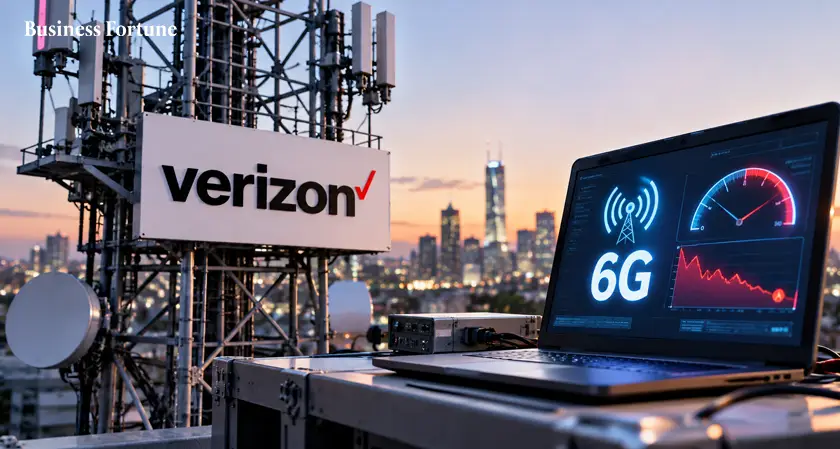
The Verizon 6G test found 7GHz struggles indoors. Hear the CTO’s honest opinion, see what could fix it, and learn what the NTIA’s December 10 report may change.
Verizon’s 6G test is facing an early problem. After a recent field test on the 7GHz band, Verizon CTO Yago Tenorio said the indoor coverage results were “not super encouraging.” Last month, Verizon and Ericsson made the first 6G call in the field using pre-commercial equipment. Now the carrier is sharing what it learned and it shows that 6G may need much more than a new network to work well inside your home.
Why Do Walls Matter So Much?
To check how signals behave indoors, Verizon built a small house with different wall and window materials. Devices inside connected to the 6G network, and engineers measured how much signal was lost along the way.
Speaking at the Brooklyn AI-Native 6G Summit, Tenorio said, “7GHz versus 3.5GHz, not surprisingly, has some challenges in penetrating buildings.” Higher frequencies simply struggle more with walls, and 7GHz is no exception.
Tenorio does not think the band is a lost cause. Fixing it will take denser antennas, more active elements, higher output power and higher EIRP limits. Even then, he said matching the footprint of the C-band, which sits between 3.7GHz and 4.2GHz, will probably stay hard.
Washington Is Still Backing 7GHz
The US government sees 7GHz as a prime 6G band. It is one of four bands the NTIA is studying, and its report is due on December 10. The report will cover how much spectrum can be cleared, when it can be used and what it will cost to move federal users out. NTIA chief Arielle Roth hopes the FCC will then move quickly toward an auction. The US will also push for the band at next year’s World Radiocommunication Conference.
Is Channel Size the Bigger Problem?
Tenorio says the bigger worry is getting channels as wide as 400MHz, which 6G standards are aiming for. He called 2.7GHz “narrow,” 4GHz “uncertain” and 7GHz “challenged.” None of them offers a clear path to a 400MHz channel.
Width matters for integrated sensing and communication, or ISAC. “Your ability to detect and resolve targets is proportional to bandwidth,” he said.
As Business Fortune observes, Verizon has had a busy year. It got a temporary FCC license to test 6G in the 4GHz band around its Los Angeles lab, and it added nine members to its 6G Innovation Forum. Tenorio sees AI wearables, ISAC and “symmetrical uplink” as the clearest use cases so far. With 2030 as the target, the next few years will decide which bands carry the 6G era.
FAQs
What did Verizon’s 6G test find?
Indoor penetration on 7GHz was weaker than on 3.5GHz, and Tenorio called the results “not super encouraging.”
Why does 7GHz struggle indoors?
Higher frequencies lose more signal passing through walls and windows than mid-band spectrum does.
Can the problem be fixed?
Possibly. Tenorio points to denser antennas, more power and higher EIRP limits, though matching the C-band footprint may still be hard.
What is ISAC?
Integrated sensing and communication lets a network detect and track objects as well as carry data. It works best with wide channels.
When will the US decide on 7GHz?
The NTIA releases its 7GHz report on December 10, and an FCC auction process could follow.
Sources: https://www.lightreading.com/6g/verizon-cto-assesses-7ghz-band-for-6g-after-first-call-in-the-field https://www.phonearena.com/news/verizons-cto-speaks-out-against-current-6g-spectrum-leader_id184678




























.webp)




Comments