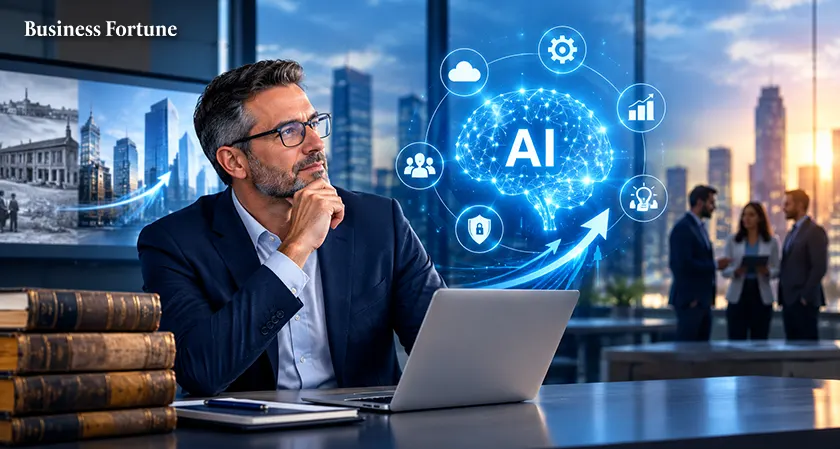
Discover how technology leaders overcome outdated systems, unlock AI's hidden potential, and help traditional businesses achieve measurable results through smarter enterprise strategies.
Artificial intelligence is revolutionizing the way established organizations conduct their businesses. Banks are leveraging the power of AI for improving fraud detection, retailers are providing customized shopping experiences and manufacturers are integrating intelligent systems with their factories. However, one challenge which is rarely discussed enough is the how does an organization which has been working with obsolete systems and cumbersome processes for years incorporate AI into its operations?
The answer often starts with technology leadership. The Best CTOs leading AI transformation understand that buying an AI tool is only the beginning. They must regulate where the technology can deliver actual value, get the company’s data ready, update their systems and ensure that the staffs can learn to work differently. They must strike a balance between innovating and protecting privacy and accountability.
The potential here is great. According to Accenture, generative AI and business reinvention, 97% of all respondents who were top executives realized the potential of generative AI to transform their businesses and the industry as a whole. However, hope alone cannot guarantee success for businesses.
In this Business Fortune article, we examine technology leaders and established companies putting AI into practice, explain what makes their approaches noteworthy and explore the lessons businesses can use to develop successful enterprise AI strategies. The real issue here is not the firm that makes the greatest claim about its AI achievements. It is those who have the ability to make AI lead to business successes
Who Are the Best CTOs Leading AI Transformation?
There is no generally accepted list of the top CTOs who are responsible for transforming businesses using artificial intelligence technology. The following individuals stand out because of their involvement in technology strategies and their application of artificial intelligence in already existing business contexts.
Kevin Scott, Microsoft
The chief technology officer of Microsoft, Kevin Scott, has been instrumental in charting out the future directions for the technologies of Microsoft and its entry into the domain of artificial intelligence. The strategy followed by Microsoft with regards to AI comprises AI infrastructure, cloud services, development tools and productivity applications.
In January 2025, Microsoft launched CoreAI, Platforms & Tools, which was an engineering division dedicated to the development of AI platforms and tools. This was a direct result of Microsoft's strategy for providing the next-generation of AI-enabled products and services.
The key takeaway is that businesses can leverage what they already have through systems and their customers. When AI is used organically within existing programs, the possibilities for adopting it become greater.
Peter Koerte, Siemens
Peter Koerte serves as the CTO and CSO at Siemens. The role of Peter is pertinent to industrial AI, whereby the technology has to co-exist with sophisticated machinery and engineering systems.
At the 2025 CES event, Siemens announced its industrial AI capabilities which were supposed to inject some level of intelligence into the factories. Specifically, the Siemens Industrial Copilot for Operations was designed to assist factory workers and technicians to get access to information quickly.
This approach shows why AI implementation in established companies requires more than a powerful model. The industrial system is expected to satisfy stringent criteria with regard to reliability, safety and integration. The technology leaders need to know about the working environment first before making any decisions regarding AI.
Suresh Kumar, Walmart
Suresh Kumar, Walmart's global chief technology officer and chief digital officer, has helped guide the retailer's technology and AI direction. The company uses AI in its shopping experience, tools for employees, product information and internal operations.
In July 2025, Walmart Global Tech explained how it is shifting towards an integrated network of AI agents and not a group of stand-alone tools. This shift was meant to ensure the easy deployment of AI abilities all over the business.
It is clear from the approach of Walmart that AI must solve particular problems while being integrated into an overall business system. The individual tools may prove helpful, but they can only be effective when employees do not have to move between different applications.
These leaders represent different models of AI leadership in business. Microsoft relies on platforms, Siemens on industry and Walmart integrates AI into its massive retail business. The cases clearly indicate why an appropriate strategy would depend on what a firm needs, its customers and technology.
Why Is CTO Leadership Critical to Successful AI Adoption?
The use of AI-based systems may not be successful despite having the best technologies available to the firm. Poor data quality, outdated software, lack of clear goals and employee struggle may pose barriers to operations.
This is where chief technology officers and AI strategy intersect. CTOs assist in determining if the proposed system will match up well with the company’s infrastructure; if there will be enough protection for any sensitive data; and if the solution will scale up from a test run. They need to coordinate technical decisions with other departments like finance, operations, legal and HR.
According to Accenture’s study conducted in May 2025 about scaling artificial intelligence, out of 2,000 firms surveyed, only 8% could be considered as front-runners who were scaling artificial intelligence by incorporating it into their core strategies. This indicates that being interested does not necessarily lead to adoption.
Effective leadership of the CTO ensures that there is alignment between business needs and technical implementation. It also ensures there is accountability, which means the company can measure performance rather than just buying technology.
Which Legacy Companies Have Successfully Adopted AI?
Several established businesses illustrate how AI can support existing operations while opening up new opportunities.
Microsoft implements AI through cloud computing, developer tools and business software. This strategy demonstrates how businesses can enhance existing offerings by adding intelligent functionalities rather than creating new offerings from scratch.
Walmart is creating agents that are capable of performing AI tasks related to retail purposes, namely customer shopping and employees' work. As mentioned in the company's article from May 2025, the agents of Walmart are created according to the use cases and the retail data of the company. Also, the company claims that the time required for the creation of new fashion products can be reduced by 18 weeks.
Siemens is bringing AI in industries using technology that facilitates engineering, automation and factory operations. The example of Siemens shows how AI may be used to supplement existing knowledge of industries.
These examples mentioned above do not indicate the success of all the AI programs implemented by the organizations. These examples show the application of AI to practical business processes, with each company selecting appropriate applications.
How Are CTOs Driving Enterprise AI Adoption?
The factors that influence how CTOs push for the use of AI in organizations are determined by what challenges they wish to address. One company could be interested in equipment failure prediction, whereas another would be interested in detecting fraudulent transactions.
A practical adoption plan usually follows four steps:
- Identify a clear business problem. Set a measurable objective, such as reducing processing time or improving service quality.
- Prepare the technology foundation. Check data quality, application connections, infrastructure, privacy and cybersecurity.
- Test before expanding. Run a controlled pilot, gather employee feedback and measure performance under real working conditions.
- Scale what works. Expand successful applications while monitoring costs, accuracy, reliability and business outcomes.
It is equally essential that CTOs know when not to use AI technology. There are times when conventional automation or simply better software will do the job in a more cost-effective manner.
What Makes AI Transformation Successful in Traditional Businesses?
Successful enterprise AI solutions involve a combination of technology, people and quantifiable objectives for the business. Existing firms have many years of historical data as well as systems that do not work together. Disregarding this problem can cause even advanced AI to be untrustworthy.
The AI strategy for enterprises should consequently incorporate data preparation, cybersecurity, training of employees, and establishing regulations for human supervision. Companies need to decide which people can have access to sensitive data and how the results of artificial intelligence will be verified.
Companies should also track practical results, including:
-
Time saved on repetitive tasks.
-
Changes in errors and service quality.
-
Customer and employee satisfaction.
-
Implementation and maintenance costs.
-
Security, privacy and compliance performance.
These measures help leaders distinguish useful improvements from impressive demonstrations that never deliver lasting value.
What Is the Future of AI-Driven Business Transformation?
The application of artificial intelligence to business transformation may extend from software that helps write content or summarise data to systems that would be capable of performing tasks under proper supervision. This trend will present new chances for CTOs, however, it will require them to pay even more attention to governance, access control and accountability.
According to Business Fortune, the leaders of tomorrow will be assessed not on how rapidly they initiate an AI project, but on how efficiently they incorporate it into their routine. Those who will win will have the right mix of technological investments, employee training, oversight and understanding of customers' needs.
If it comes to traditional businesses, the idea should not be in replacing what they know with something else. It should be in mixing all this knowledge with the potential of artificial intelligence.
FAQs
Who are the best CTOs leading AI transformation at legacy companies?
Kevin Scott at Microsoft, Peter Koerte at Siemens, and Suresh Kumar at Walmart are notable technology leaders whose work illustrates different approaches to integrating AI into established business operations.
Why is CTO leadership important for successful AI adoption?
CTOs align AI investments with business goals, modernize legacy systems, oversee data security, and coordinate implementation across departments to ensure AI delivers measurable results.
How can traditional companies implement AI without replacing their existing systems?
Companies can integrate AI with suitable legacy applications through APIs, cloud platforms, and targeted upgrades, modernizing systems gradually while maintaining essential business operations.
What are the biggest challenges in enterprise AI transformation?
Common challenges include poor data quality, outdated infrastructure, cybersecurity risks, employee resistance, implementation costs, and difficulties scaling pilot projects across the organization.
How can businesses measure the success of an AI transformation strategy?
Businesses can evaluate success by tracking productivity gains, operating costs, error rates, customer satisfaction, employee adoption, and the measurable business value generated by AI solutions.

.webp)




























Comments