
A data-driven look at the GPU cloud providers shaping 2026: CoreWeave, Nebius, Lambda and Crusoe, plus pricing, power limits and buyer tactics.
The GPU Cloud Providers to Watch in 2026 and the Numbers Behind Them
CoreWeave ended June with a $104.2 billion revenue backlog. Nebius is guiding to $3.0 billion to $3.4 billion of 2026 revenue and Crusoe was valued at $30.9 billion in September. The GPU cloud has stopped being a sideshow to chip sales; it is where the money and the strain, now sits.
This guide covers the four independent providers that matter most this year, what each is really selling and the constraint none of them can engineer away. Figures come from company filings, earnings-call material and price trackers, mostly dated August to October 2026. Where outlets disagree, we say so.
Which GPU cloud providers are worth watching in 2026?
Four independents anchor any serious list of the top GPU cloud names. The table puts them on equal footing.
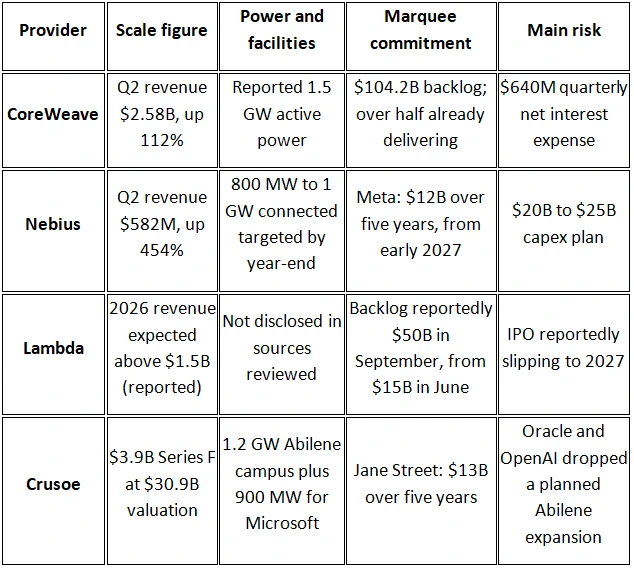
Read across the rows. CoreWeave and Crusoe hold the biggest contracts, Nebius is growing fastest and Lambda is still deciding when to list.
Why does CoreWeave still lead the GPU cloud race?
Scale.
Second-quarter revenue reached $2.58 billion and management raised 2026 guidance to $12.4 billion to $13.2 billion on its earnings call. The $104.2 billion backlog excludes more than $25 billion of commitments signed in early Q3, according to Yahoo Finance.
The catch is the cost of carrying it.
Khan Capital's reading of the filing puts net interest expense at $640 million for the quarter, enough to turn a near-breakeven operation into a $626 million net loss. Capex guidance now runs $35 billion to $39 billion, per Market Daily. A backlog is a promise, not cash.
Delivery is the tell.
More than half the backlog sits under contracts where service has begun, and management expects that to pass two-thirds by year-end. If the ratio stalls, interest keeps running while revenue waits. Any sensible GPU watch starts there.
Is Nebius the fastest-growing challenger?
By percentage, yes. Nebius posted $582 million of second-quarter revenue, up 454%, with its AI cloud unit supplying $575 million of it, per its August filing. It reaffirmed 2026 guidance of $3.0 billion to $3.4 billion and a year-end annualized run-rate target of $7 billion to $9 billion.
The pitch is capacity sold before it exists. In March the company signed a five-year, $12 billion agreement with Meta built on Nvidia's Vera Rubin platform. Of the first quarter, CFO Dado Alonso said, "Once again, we sold out our capacity as demand continued to exceed available supply," as Futurum reported.
Two details deserve scrutiny. Most 2026 capacity lands in the second half, so the revenue curve is back-loaded. And customer prepayments, expected to top $9 billion this year, are doing work that debt would otherwise do. Prepayment is cheap financing until delivery slips.
What is happening with Lambda's IPO?
Reports disagree, which is itself the story. Nvidia-backed Lambda was widely expected to list in the second half of 2026. TechCrunch reported on October 6 that it is raising up to $4 billion at a $14.5 billion pre-money valuation and secondary coverage now points to 2027 for a listing. One aggregator claims an S-1 was filed in July; Forge's tracker says Lambda has not filed. Treat any filing as unconfirmed.
The better-sourced numbers: Bloomberg-cited reporting expects revenue above $1.5 billion in 2026 and a letter to investors reportedly shows backlog rising from $15 billion in June to $50 billion in September. A reported $35 billion Anthropic deal for Texas capacity could explain that jump. That link is speculation, not a confirmed fact. One anchor tenant can double a backlog and a risk profile in the same quarter.
Why is Crusoe valued like a utility?
Because it builds the power-hungry halls rather than only renting chips. On September 17 Crusoe announced a $3.9 billion Series F at a $30.9 billion valuation, co-led by Atreides Management, Mubadala Capital and Valor Equity Partners, per The AI Insider. Revenue comes from leasing data center space, renting its own GPUs and selling inference.
The anchor is Abilene, Texas: a 1.2 gigawatt campus built for Oracle, where OpenAI runs workloads, plus a 900 megawatt campus for Microsoft. Modular "Spark" units that ship by truck aim to shortcut construction and local opposition.
Concentration cuts both ways. Oracle and OpenAI dropped a planned Abilene expansion this year and Crusoe exited a project called Jade, per Value Add VC. Land, megawatts and a handful of tenants make a business closer to a landlord's than a software firm's.
What does a GPU cloud actually cost in 2026?
More than it did and the answer depends on who is counting. H100 rental fell from above $7 an hour in early 2024 to roughly $3.38 by late August, per AIMultiple's index as summarized by Shattered. Then it turned. Trackers disagree on the level and agree on the direction.
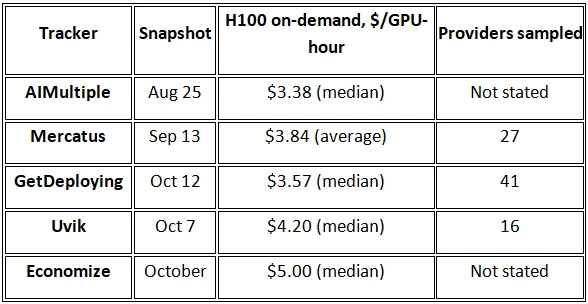
A spread of $3.38 to $5.00 reflects differing provider mixes, not noise. The strong number is the hyperscaler premium: on-boards report that pricing for H100s at hyperscalers is at $7.89 against $4.50 at dedicated GPU clouds, 75% higher; a premium for a H200 is 101% for a B200, 67%.
Contracts have shifted: Uvik reports the one-year index of H100s at SemiAnalysis went up 38% between October 2025 and March 2026, from $1.70 to $2.35 per GPU-hour and Nebius boosted its on-demand H100 price from $3.85 to $4.50 on October 1.
Are data centers becoming a tighter limit than chips?
For many buyers, yes. A signed power agreement now secures GPUs faster than a GPU order can secure power, contends Inflect, as grid connection timelines are years (vs. eased chip supply). AI racks require 40 to 250 kilowatts versus 10 to 15 for conventional loads, per Vultr. Goldman Sachs Research, per a Flex proxy filing, sees data-center power demand rise up to 170% by 2030 vs. 2025.
Operators agree.
The implication is to rank providers by contracted megawatts and delivery dates rather than GPU counts.
Usable capacity, per a Nasscom analysis, = GPUs x infrastructure readiness, network efficiency and utilization.
How should buyers carry out their own GPU watch of the day?
Four habits pay:
Follow the delivery ratio: the backlog headlines; the share in service provides the evidence
Read the tenant list: a campus relying upon one or two customers adopt their plans
Compare three trackers when signing: request the all-in rate, including networking/storage
Match the term to the job: spot discounts are at 40% to 60% and reserved are at 15% to 35% when economizing; interruptible capacity suits checkpointed jobs; reservations suit steady loads.
More to Know
Backlog math varies: CoreWeave's $104.2 billion is as of June 30. One outlet, Tech Times, totals about $129 billion as of August 11 by adding Q3 commitments
Hyperscaler list prices remain high: AWS's p5.48xlarge lists at $55.04 an hour for eight H100s, about $6.88 per GPU, per CloudZero; effective rates are lower with capacity blocks.
Blackwell is rising: Bank of America tracked B200 spot near $5.66 an hour in August; Uvik's October median is $8.19. Methods vary but the trend is up.
Floors exist with caveats: Cudo Compute listed H100 SXM from $1.79 an hour in September, per a DEV Community survey; no marketplace capacity guarantee.
Smaller players are scaling: QumulusAI guided to $300 million of forward ARR on 18 MW of capacity in a July 8-K.
The top GPU cloud names have one thing in common: contracts signed way ahead of the buildings to serve them. That makes 2026 a test of execution, financing and power, not of demand. CoreWeave must convert backlog to delivered service, Nebius must land its back half capacity, Lambda must settle its listing and Crusoe must retain its few big tenants. Meanwhile, buyers face prices that are rising. Business Fortune asks readers to compare trackers, read tenant lists and regard megawatts as the scoreboard. Keep these four on your watchlist for the next two earnings cycles and the gap between signed and delivered capacity will be where the story breaks.


.webp)































Comments