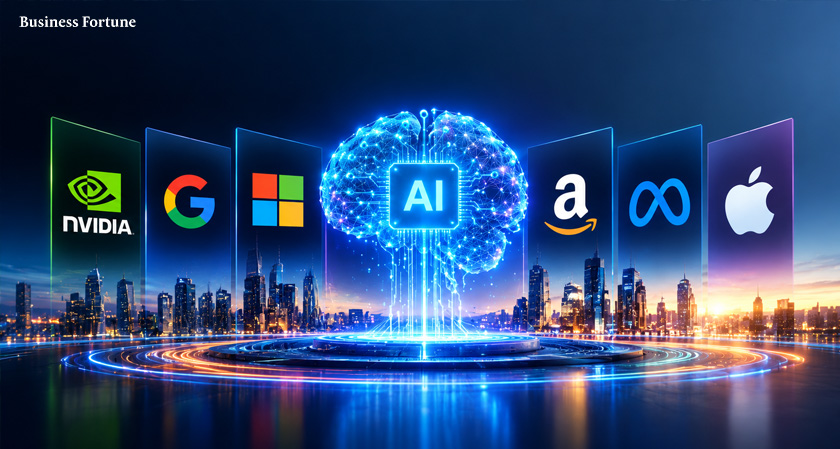
Curious about who's leading the AI race? Meet the Top AI companies leading the industry in 2026 and see how they're changing the way we live and work.
You are wrong if you believe AI is used as a tool only to get answers and create pictures. AI is changing how businesses work, doctors study diseases, banks detect fraud, and people get things done. But which companies are actually leading this change, and what makes them stand out? In this Business Fortune article, we explore the Top AI companies leading the industry in 2026, their technologies, their business strengths, and how they are shaping the future of artificial intelligence.
Top Ten Artificial Intelligence Companies in 2026
The AI ecosystem consists of software companies, chip manufacturers, cloud providers, and AI solution providers who create solutions to solve daily problems of businesses. While some concentrate their efforts on generative AI, others are involved in creating the hardware infrastructure for these solutions. Here is the list of ten leading companies in the AI market, they are not ranked in a strict order because each has a different role in the AI market.
- OpenAI
OpenAI has become one of the most known names in artificial intelligence, largely because of ChatGPT. It is known for providing services to help humans in writing, learning, analyzing information, content creation, and software development. Organizations can even use their AI models through APIs.
Moving from chatbots, the company’s current direction is towards AI technologies capable of accomplishing more complicated jobs like software engineering and business processes. This is evident from the Codex suite and enterprise products offered by the company. Additionally, OpenAI is developing its computing power and partnerships to accommodate increasing demand.
What sets it apart from others is that OpenAI brings AI technology closer to the normal people while providing businesses the means of creating their own AI products.
Google is a major force in AI research, search, cloud computing, and digital services. Its Gemini models support tasks such as writing, coding, understanding images, and working with information across different formats.
The other strength of Google is the reach it has. AI can be implemented into existing products, while Google Cloud provides organizations with access to their AI tools and computing infrastructure. They also conduct research on a number of other fields, including natural language processing, robotics, and science. Google merges AI research with an extensive portfolio of products and services, offering multiple options to deploy emerging technology.
- Microsoft
Microsoft is making AI part of everyday business software. Its Copilot tools can help users draft documents, summarize meetings, analyze information, and work with data. Through Azure, the company also offers cloud infrastructure and AI services for organizations building their own systems.
AI products from Microsoft are particularly valuable for organizations looking for AI integration into existing workplace applications rather than switching to a new platform altogether. The technologies of the company can be used for such areas as customer service, software development, data analysis, and other business processes. Microsoft is also creating its own AI hardware to increase efficiency.
Why it matters because Microsoft is associating AI with existing software and cloud solutions used by enterprises.
- NVIDIA
People tend to talk about AI in relation to chatbots and virtual assistants. However, these technologies require strong hardware to be trained and operated. And that's when NVIDIA steps into the scene.
NVIDIA is developing graphic processing units (GPUs), network equipment, and software that will be able to execute the most complex calculations required by AI technologies. The demand for AI computing also contributed to an increase in investments into big data centers and new chip architecture from technology firms. It is unique because NVIDIA delivers advanced computing solutions that lie in the background of many AI solutions despite the fact that users do not even know about them.
- Anthropic
The reputation of Anthropic comes from its family of Claude models, which are used to assist with tasks such as writing, analysis, coding, and other knowledge oriented tasks. The firm pays particular attention to the reliability, explainability, and guidance of AI systems.
The technology used by Anthropic could be useful for companies which require assistance in reviewing and analyzing large volumes of information and working with documents. Moreover, Anthropic is developing partnerships in the sphere of enterprises, including projects related to introducing AI into highly regulated industries.
Leading AI Companies Worldwide: More Names to Know
The companies building AI models are only part of the story. Social media platforms, cloud providers, and established technology firms are also developing tools that can change how people work and communicate.
- Meta
Meta is bringing AI into its products such as its social networks, and is building models for assistants, content, and software development. Its work on AI also includes research into models, which may be able to understand and produce various different types of information.
In October 2026, Meta launched its Muse Wonder models, and demonstrated its commitment to competing in the field of high-end AI and digital assistants and the usefulness of its products will be determined by a combination of their performance, adoption, and how well privacy and security concerns are addressed. Meta has the ability to combine the development of AI with many of the consumer platforms and communication applications that it owns and operates.
- Amazon
Amazon is expanding its reach into the realm of artificial intelligence, but the company's work extends far beyond the realm of online shopping. Through Amazon Web Services (AWS), the company provides businesses with cloud computing power and AI development tools and infrastructure, and offers the ability for organizations to tap into a range of AI models that can be accessed through Amazon Bedrock. The company's recent partnership with OpenAI, announced in February 2026, highlights its growing role as a key player in the enterprise space and infrastructure for AI.
- IBM
IBM has a strong emphasis on AI for business, data management, and automation, and provides tools that can help enterprises with complex technology infrastructures. Its watsonx platform helps companies to design and manage AI applications, and its teams of consultants can help them to realize the value of these tools and approaches.
Businesses in the fields of finance, healthcare, manufacturing, and other regulated industries need to grapple with issues of privacy, data quality, and governance when choosing and using AI solutions. IBM's concentration on the enterprise space is a major strength and differentiator in the field of AI. It is worth noting that IBM plays an important role in bringing AI technologies into established organizational environments, where governance and data issues are of paramount importance.
- Adobe
Adobe is using the power of AI to transform the way in which people create and manage digital content. Its Firefly tools offer new possibilities for image generation and related creative tools, and its range of AI-enhanced content creation tools can help users to edit and work with design elements, documents, and marketing content.
Such tools have the potential to simplify the editing process, allowing creative teams to realize their potential more fully, but users need to ensure that the content they are generating is accurate, appropriately licensed, and suitable for their particular needs. Adobe's strength lies in its ability to bring AI to the sphere of creative content production, marketing materials, and business processes, and it is a major player in the world of design.
- Salesforce
Salesforce is introducing AI into customer relationship management (CRM), where companies store, analyze, and manage information about their customers, along with their sales, service, and marketing activities. The company's tools and the Agentforce platform can help businesses to develop applications that can provide customer service, respond to questions, and carry out selected business functions.
For instance, a service team could use AI to summarize a conversation with a customer, or help an employee to quickly find the information they need to address a particular request. Such systems always require careful consideration of the data, rules, and oversight provided by humans when it comes to making decisions that affect customers.
What Makes These Companies Leaders in AI Innovation?
The role of a company as a leader in AI is not just to have the most advanced algorithm. It will also depend on the effectiveness of its technology, how available it is to others, and its ability to solve any real problems. Three important areas explain the competition.
Computing power: AI needs chips, data centers, and reliable infrastructure. Companies such as NVIDIA, Microsoft, and Amazon play important roles here.
Useful AI products: OpenAI, Google, Anthropic, and Microsoft are developing tools for writing, research, coding, and business tasks.
Industry-specific solutions: IBM, Adobe, and Salesforce focus on bringing AI into areas such as enterprise operations, creative work, and customer service.
This is the reason for the varied strategies that the top AI companies in the world use to compete. Some develop the algorithms, while others offer the computing power needed. Others assist organizations in implementing the AI technology.
Generative AI Companies and Machine Learning Companies: What's the Difference?
It is common to hear about generative AI and machine learning in similar context, but there are differences between the two terms.
Machine learning refers to the ability of computers to learn from data. In banks, machine learning can be used to detect abnormal transactions, whereas, in retail businesses, it can be used for forecasting demand.
Generative AI, on the other hand, refers to the process of creating content using artificial intelligence. ChatGPT, Claude, and Gemini are popular tools based on generative AI.
Both these sectors are areas of specialization for some of the leading and most innovative AI companies. What counts is not the technology itself, but its utility.
How Are Enterprise AI Providers Changing Business?
Businesses are getting more and more interested in AI that is capable of much more than answering queries. They are looking for tools that would assist their employees in task completion, information search, data comprehension, and customer service improvement.
However, the use of AI carries with it certain responsibilities. Private information should be protected, AI-assisted conclusions should be verified, and workers should know when a human decision is required. Those businesses will prove to be leaders in AI development which manage to convert their amazing technologies into reliable and practical products. Having only a great model will not be enough.
FAQs
Which AI companies are leading the industry in 2026?
OpenAI, Google, Microsoft, NVIDIA, Anthropic, Meta, Amazon, IBM, Adobe, and Salesforce are major players. Their roles differ, from developing AI models and chips to delivering enterprise and creative software.
What technologies are driving growth among leading AI companies?
Generative AI, machine learning, advanced computing chips, cloud infrastructure, AI agents, and multimodal models are important areas of development. These technologies help systems create content, analyze information, and perform increasingly complex tasks.
How are top AI companies transforming global industries?
They are helping businesses automate routine work, support customer service, analyze data, improve software development, and create digital content. In healthcare and finance, AI can also support research and analysis, although important decisions require appropriate expert oversight.
Who are the major players in the global AI market?
The major players include AI developers such as OpenAI and Anthropic, technology platforms such as Google and Microsoft, and infrastructure providers such as NVIDIA and Amazon Web Services. IBM, Adobe, Salesforce, and Meta also contribute through their specialized products and platforms.
How can businesses choose the right AI company?
Businesses should start by identifying the problem they want to solve. They should then compare accuracy, cost, security, privacy protections, compatibility with existing systems, and customer support. Testing a solution on a small project before wider adoption can help them understand whether it delivers real value.


.webp)































Comments