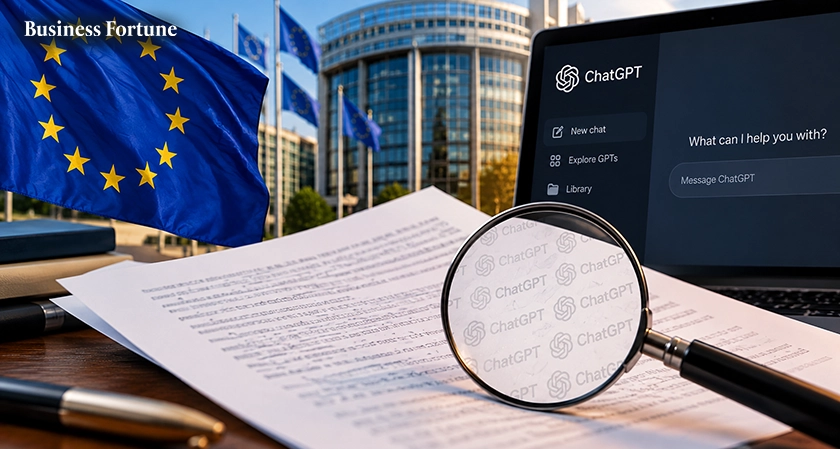
OpenAI is adding invisible watermarks to ChatGPT text in Europe, while keeping its detector away from the public.
OpenAI to Add Invisible Watermark to ChatGPT Text in EU in Coming Weeks
The open-source AI research company OpenAI is going to start adding an invisible watermark to text produced by ChatGPT in the European Union in the coming weeks, as a response to a new EU law that requires generative AI developers to make their text output detectable by machines.
Overview
What: An invisible text watermark, called textGrain, is being added to ChatGPT and Codex text output in the EU.
When: Announced on October 5, 2026; OpenAI says it will roll it out in the EU in the coming weeks; it is available as an opt-in for API customers today.
Who: Done by OpenAI, at the request of the EU and the detector is available only to approved researchers.
What does this mean for ChatGPT users in Europe?
Eligible ChatGPT and Codex text on all plans will be watermarked in the EU. But not elsewhere, at least not yet; OpenAI made it clear that watermarking will not be enabled by default outside the EU. Eligible API customers worldwide can turn it on if they wish, as of today.
How does the new ChatGPT watermark work?
By using a system called textGrain to nudge the model into making subtle word-choice changes that a detector can pick up, without changing anything noticeable to a human reader.
According to OpenAI, it performed at least as well as the other methods it tested, including SynthID for text and showed no detectable drop in quality in tests on its Astra model; an open-source implementation is expected. However, it is often possible to defeat the watermark by replacing every other word or so in a 400-word chunk of text with synonyms, reducing the detection rate from 92% to 66% in one test and 25% replacement would reduce it to 17%.
The length of the text matters too: at a 1% false positive rate, the detector correctly identified 80% of 200-word psychology-style texts and 95% of 400-word ones, but only 45% of math-style texts of the same length. OpenAI is not being coy about the limitations of text watermarking: “Text watermarking and detection are still emerging technologies that have substantial performance limitations.”
Who can check for the new ChatGPT watermark?
Not the public; only approved researchers and expert third parties, because of “risks of false positives and negatives,” for now. Detection for images and audio is already available to the public, as is a tool to verify them at openai.com/verify. A positive detection result is not much of a result: it can’t tell you who wrote the text or how much they wrote or whether the text is even accurate. And a negative one doesn’t mean anything, either.
Why is this happening?
Because article 50 of the new EU AI Act became directly applicable on August 2nd; roughly seven weeks after the EU’s final Code of Practice was published on June 10th and the EU has been pushing big tech companies to adopt watermarking for some time.
Anthropic announced similar plans for Claude last week. OpenAI’s hesitation is understandable: in 2024, a spokesperson said their approach to text provenance was “a deliberate balancing act.”
More context
As mentioned above, image and audio watermarking are already in place: OpenAI has Content Credentials for supported images and invisible SynthID watermarks for audio, with public verification available at openai.com/verify. OpenAI is also working on bringing watermarking for model outputs to cloud partners in the coming weeks.
It is not yet known if ChatGPT EU users will be able to turn off the watermark; the OpenAI post did not say. OpenAI has quietly added text watermarking to ChatGPT, but with limitations it made public. The watermark only applies in the EU for now and it can be defeated simply by editing the text. Researchers and approved third parties can check individual texts for the watermark, but that might take some time for large bodies of text.
Business Fortune concludes, how seriously these concerns are being taken by the EU and others will become apparent as soon as the watermark becomes available in the EU and some detection results become public.
Sources
OpenAI: Our approach to EU text provenance rules · Engadget · Emerging Europe · AI Weekly · Gigazine · Implicator


.webp)































Comments