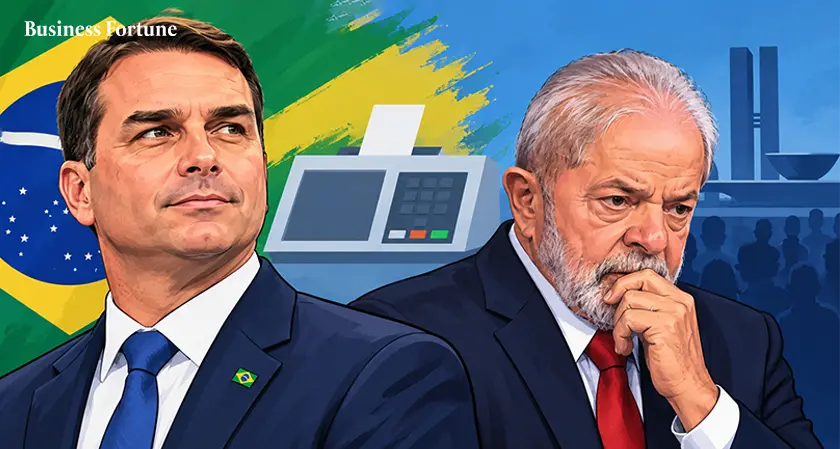
Brazil’s presidential race enters a crucial phase as voter transfers, economic expectations, security policies and right-wing alliances could determine October’s final result.
The Brazil election has entered a decisive stage after Flávio Bolsonaro emerged ahead of President Luiz Inácio Lula da Silva in the first round, setting up a closely watched run-off on October 25. According to The Financial Times, Bolsonaro received 47.1% of votes against 45.1% for Lula. This was above the predictions made by some polls and the conservative candidate now has an upper hand in the next round of voting.
What happened in Brazil's first round?
The first round of Brazil election voting produced a stronger-than-expected performance for Flávio Bolsonaro, the 45-year-old senator and son of former president Jair Bolsonaro. He has found himself in a favourable position since some of the candidates who were eliminated in the first round belonged to the right-wing political parties.
In presenting this outcome as evidence of many Brazilians desiring a political change, Flávio Bolsonaro said that the vote distribution other than the top two candidates could be key for both camps as they try to win over more supporters ahead of the run-off.
Flávio Bolsonaro Builds Momentum
This has been a major blow to Lula, who is trying to win his fourth non-consecutive term as president at the age of 80. This campaign revolves around increasing social welfare, improving labor rights, safeguarding the environment and building good relations with emerging global superpowers.
Moreover, the result brings back the political rivalry which has been the hallmark of Brazil’s last presidential elections. In 2022, Lula beat Bolsonaro in a razor-thin margin to become president for the third time. This year, however, Flávio Bolsonaro makes it through the runoff with a lot of strength.
Economic and security policies are predicted to be at the forefront of the election campaign. Bolsonaro plans to adopt more stringent measures against criminal activities, cooperate more closely with the USA and cut down public spending. Furthermore, he said that he will work to get his imprisoned father released from jail, because his father has been accused of staging a coup attempt.
Markets Watch the Run-Off
The Brazil presidential elections have also drawn investor interest. A Bolsonaro win might signal expectations of tighter fiscal policy and economic reforms that would favor Brazil’s financial market environment.
According to The Financial Times, economists have suggested that the result of the initial round may lead to more gains for the Brazilian real and stocks as well as further declines in domestic government bond rates. But this will ultimately be determined by the results of the runoff elections on October 25.
Now that the race has been boiled down to Lula and Flavio Bolsonaro, Brazil is looking at a vote that will have tremendous consequences for its economy and politics.
Thus, Business Fortune believes that Brazil’s run-off will shape its political direction, economic outlook, investor confidence, and regional influence for years ahead.
Sources: https://www.ft.com/content/028da85c-0e1f-4f1b-ad04-eac78c4f18c0?syn-25a6b1a6=1 https://www.thehindu.com/news/international/brazil-election-results-updated-flavio-bolsonaro-luiz-inacio-lula-da-silva/article71545022.ece
FAQs
Who leads after Brazil’s first election round?
Flávio Bolsonaro leads Lula with 47.1% compared with 45.1%.
When is Brazil’s presidential run-off?
The run-off is scheduled for October 25.
Who is Flávio Bolsonaro?
He is a Brazilian senator and the son of former president Jair Bolsonaro.
What are Bolsonaro’s key campaign issues?
Security, organised crime, government spending and closer US cooperation are major themes.
Why are investors watching the election?
The result could influence Brazil’s fiscal policy, currency, stocks and government bond markets.


.webp)
































Comments