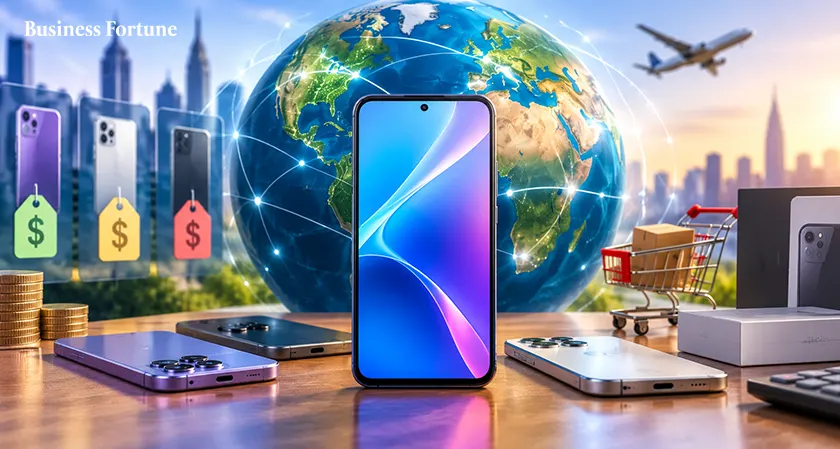
Explore how rising manufacturing costs, AI technology, and global market shifts could affect smartphone prices in 2027and what consumers can do to make smarter buying decisions.
It might become difficult to afford a new smartphone in 2027, regardless of whether one needs the latest features or not. Higher component costs, growing demand for AI-powered devices, and changes in the global market could push prices upward. But will every phone become costlier, and will buyers in all countries feel the same pressure?
In this Business Fortune article, we explore the reasons behind rising smartphone prices in 2027, compare how different regions could be affected, and examine what consumers can expect from the smartphone market.
Why suddenly phones become more expensive?
Upgrading a phone usually begins with a common issue, such as the battery not lasting throughout the day, storage being exhausted, or an application not performing well anymore. However, in 2027, purchasing a new phone will be more expensive than expected.
This is not because companies just want to increase prices. There are several components involved in the production of smartphones, such as memory chips, processors, screens, software development, transportation, and manufacturing. If the cost of any of these increases, then manufacturers have to make a choice of either covering it or passing it to consumers.
Another issue is the increased need for higher memory and computational capacity, which is partly due to AI. In addition, smartphone manufacturers are in competition to provide improved cameras, longer battery life, brighter screens, and faster processors.
Such enhancements may be beneficial, but they raise the cost of developing such products. However, an increase in price is not a guarantee for all smartphones. It will depend on competition, local demand, exchange rates, and the manufacturers’ decision.
Rising smartphone manufacturing costs
One thing that needs to be watched out for is memory chips. Smartphones use memory to store files and applications, while temporary memory allows smartphones to multitask. This is because there will be an increase in demand for memory as more data centers, computers, and AI systems require memory.
Another big cost is that of processors. The high-end mobile phones need to have strong processors that can manage the gaming, camera, security, and AI capabilities without rapidly depleting the battery. The development and production of such processors involve high technology and high costs.
The display used will also determine the price point. High-resolution OLED displays, higher refresh rates, and increased brightness will cost more to produce than a simpler display.
Finally, there is the battery, camera sensor, packaging, assembly, and testing. An increase in any one of these costs may place a strain on the budget of the manufacturer.
How AI could change smartphone prices
AI has become a critical factor in marketing the smartphones of various brands. Modern smartphones are capable of using AI for editing pictures, translating talks, summarizing content, improving the functioning of voice assistants, and even doing certain jobs right on the device.
This functionality requires efficient processors and usually more RAM. Certain AI functionalities are dependent on cloud services, thus leading to additional costs for companies.
Companies are investing in development of special chips and software to increase performance of these features. This investment includes costs associated with testing, security, and support of the new functionality during the following years.
For individuals that make use of such features on a regular basis, either at work, studies, or creative activity, a more powerful smartphone would be worth it. For an individual that mostly makes calls, sends messages, watches movies and surfs the internet, the benefits are not so useful.
In other words, AI could raise costs, but it does not automatically mean every smartphone will become more expensive.
Smartphone component costs and the global supply chain
The making of a smartphone is done through an international network of suppliers. An phone made in one country can include chips made in another country, displays from yet another country, and final assembly from another.
Such a setup provides companies access to specialized capabilities but also leaves them vulnerable to shifts in trade policies, logistics costs, foreign exchange rates, and shortage of supply.
For instance, any disruption in the process of manufacturing chips would make some components less available. Increased freight fees would lead to increased delivery costs, whereas new tariffs would make some parts or phones more expensive.
Movements of currency are also important factors. In case the costs of a firm are denominated in US dollars, but the revenue in another currency that depreciates against the dollar, importing parts or phones becomes more expensive.
These are the reasons why the prices of mobile phones can vary dramatically across countries. For example, Apple's iPhone 17 (256 GB) costs $899 in the United States and ₹99,900 in India.
How will smartphone prices differ across regions?
The world smartphone market does not have only one pattern in setting prices. A smartphone which seems to be cheap in one region will cost dearly in another one. The local taxation system, the fluctuations of exchange rates, customs, the level of local incomes and competition affect pricing.
India reacts strongly to changes in price due to its customers' demand for budget and mid-end devices. Thus, in 2026, according to the data of Counterpoint Research, prices of smartphones sold in India were up 21% during that year. In Asia-Pacific, 2026 prices of phones were up 19%, in the Middle East and Africa 18%, in Latin America 16%.
In the US market, high-end smartphones and operator promotions have a bigger impact on the purchasing behavior of people buying gadgets. Monthly subscriptions and trade-ins can help to reduce the price of expensive models, but buyers still need to think about the real price.
European buyers could also experience regional differences based on different VAT tariffs, competition in retail sector, and costs of goods delivery. People using imported gadgets can be more vulnerable for exchange rates and additional import taxes.
China produces a lot of smartphones but domestic users are not fully protected from increased component prices. While competition could control the prices of smartphones, manufacturers still have to think about the cost of the memory, processors, etc.
Will prices keep rising in 2027?
The research company IDC predicts that there would continue to be problems related to the supply of memory until 2027. IDC predicts that prices may not come down below their 2025 levels, but even if prices rise at a slower rate. Global smartphone shipments are predicted to grow in 2027 after falling in 2026.
This is not mean that each phone is going to get a price hike. As long as there is an improvement in the supply of components, there would be some control over costs of production. Competition and discount offers can also help keep prices down.
On the other hand, ongoing demand for AI memory, high costs of producing chips, and weak currencies in some countries might continue exerting pressure on prices.
Therefore, it can be said that the future prediction of the smartphone industry in 2027 can be seen as the case of a market in which price, quality, and availability can all change at once. Users may find themselves paying more for their devices, having less selection when choosing cheap devices, or getting phones with different specs.
The future of smartphone pricing: What should buyers do?
In case you are planning to purchase a new mobile phone in the year 2027, there is no hurry to do so yet. You should start off by examining if your current mobile phone is working according to your needs. In case of purchasing a new one, make sure that you check various other models, not just from a certain brand. These factors often matter more over several years than a feature you may rarely use.
Moreover, compare the total cost of the installment package to the price that you would have paid had you bought the phone all at once. The trade-ins could help you, but remember to take the conditions and their values into account.
However, the future of smartphones is going to depend on the ability of the manufactures to manage costs versus customer willingness to pay. AI might make smartphones better, but cost will still be a significant consideration in determining the success of any device.
FAQs
1. Will all smartphones become more expensive in 2027?
No. Some models may become more expensive, while others could retain their prices or receive discounts. Component costs, competition, taxes, and local demand will influence the final price.
2. Why can AI make ordinary smartphones more expensive?
AI features can require more memory, powerful processors, and additional software development. Higher demand for memory from AI data centres may also increase costs for phone manufacturers, including those selling devices without advanced AI features.
3. Which smartphone market could feel price increases most strongly?
Markets with large budget-phone segments may face particular pressure because manufacturers have less room to absorb higher costs. The impact will vary by country, currency, taxes, and local competition.
4. Is 2027 a good time to buy a new smartphone?
It depends on your needs and budget. If your current phone works well, waiting may give you more options. If you need a replacement, compare current prices and specifications rather than relying on uncertain forecasts.
5. Could refurbished phones become more popular in 2027?
Yes. If new devices become more expensive, refurbished phones could appeal to buyers looking for lower prices. Their value depends on battery condition, repair quality, software support, warranty coverage, and the seller's reliability.


.webp)






























Comments