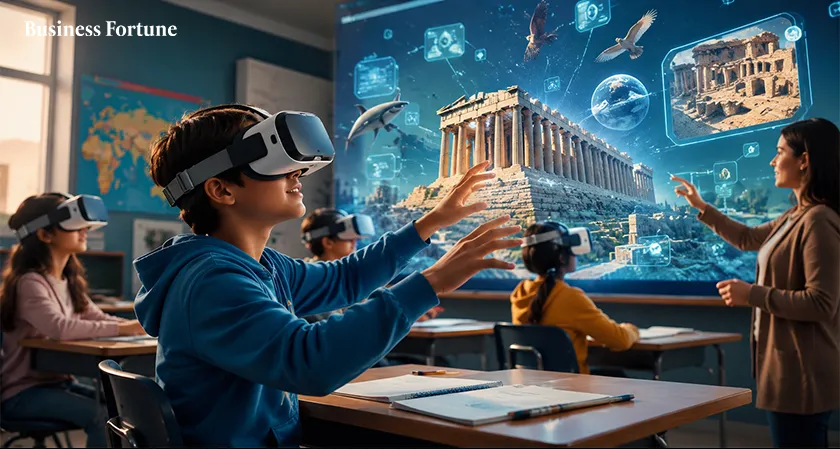
VR Classrooms are changing how students learn by turning abstract lessons into interactive experiences. Discover how immersive technology is making hands-on learning safer, more engaging and more accessible in 2026.
Walk into a classroom in 2026 and you might be greeted with something that would seem shocking a decade prior: a group of students, complete with headsets, peering around corners, investigating a building or an object that only exists in their screens.
It sounds incredible.
But inside VR Classrooms there are activities going on that go far beyond and in some cases, well beyond, what a curriculum has to offer. Students aren't just viewing a volcano in a documentary or a diagram of the human heart; they get to investigate and interact with them.
That's why VR is such an appealing option for education: it creates much more active lessons.
And in 2026, an active lesson isn't a novelty anymore.
So Here Are Some Reasons Why VR Is Beneficial To Students:
Abstract Concepts Can Be Tangible
An abstract concept is one that can't necessarily be touched, seen or even heard. It might be a sound wave, a math equation, the structure of a cell, something that can't be experienced firsthand, but is vital for students to know about. A teacher might be able to display a picture, graph, or even write out the equation on the board, but they can't hold it in their hands.
This is a place where VR Classrooms can help students to experience and understand abstract concepts. Compare the in-depth, but still two-dimensional, lesson on the solar system with the ability to stand beside the planets and view them side by side. The information presented isn't changed, but the way it's represented can make a huge difference to how well it's received by students.
Science Experiments Can Be Repeated
There's something exciting about conducting a science experiment, but that excitement can often lead to failure, injury, expensive clean up and finding out later that the lab was already booked for the day.
VR simulations can't replace actual experiments, but they can serve as a reliable second option for students who want to conduct research without the restraints and dangers of the real world.
VR education technology is one of the most pragmatic applications of VR-supported education. As the modern educational world moves towards more immersive simulations for students' STEM-related classes, colleges are also capitalizing on the applications of VR for physics, chemistry, engineering and medical sciences.
Meta's reports on VR in education in 2026 go into detail on how universities are capitalizing on VR's potential for physics and chemistry labs and other simulations.
The important word there is repeat, as students can make mistakes without wasting resources. The opportunity for practical practice is invaluable, but it's not always available. A VR lab can give students another opportunity to conduct their experiment, learn from their mistakes and further their knowledge.
Field Trips Don't Require Buses.
Field trips are always exciting, but they come with a hefty price tag and footprint. A school can't exactly take a class of two hundred students halfway across the world to an excavation site or on a journey to Mars.
VR environments can't completely replace the authenticity and practicality of a field trip, but they can give students the opportunity to see things that they otherwise wouldn't have. Within the confines of their school building, students can witness ancient civilizations, travel to dangerous regions of the world, and even visit other planets.
This is a particularly valuable application for less privileged areas, where opportunities for students are often limited. That's an important consideration, as it ties into the value of an immersive education.
Rather than asking the age-old question of “Can wealthy schools afford VR?”
We can instead ask, "How can we bring these opportunities to more students?"
Lessons Are More Active.
There's a big difference between asking students to memorize all the parts of a machine and asking them to identify all the parts while exploring a virtual one. The latter requires some level of activity on the students' part and it's that level of engagement that can make a lesson more memorable and exciting.
An article on experiential learning and virtual reality learning in 2026 goes into detail on how students benefit from an active learning experience.
It's clear that having the immersive education technology is one thing, but engaging students in an activity that makes them a part of the lesson is vital for an active lesson to be effective.
That doesn't mean that a flashy headset is a bad thing, but it does mean that an activity paired with the technology can make a much stronger lesson plan.
Collaboration Can Continue Outside Of The Classroom.
VR has a reputation for putting people in a bubble, with everyone donning a headset and disappearing into their own little world. That doesn't have to be the case, however, as shared VR environments can let students collaborate, study, and even conduct research together.
Some of the examples from universities in 2026 even speak to collaboration within shared projects, even if students aren't occupying the same physical space. It could be valuable to both universities, in their experiments with distributed learning, and students who want to conduct research without leaving their homes.
A group of engineering students can look over the same machine, or students from two different schools can conduct an archaeological dig in the same virtual space.
The idea of a classroom is much more fluid when students aren't restricted to one physical location.
It Can Make Intimidating Subjects Less Intimidating.
Let's be honest, some subjects just have a reputation for being difficult or intimidating. Math, physics, chemistry, anatomy and engineering are all subjects that students often dread, often without reason.
It's not always the subject's fault, but the way that it's presented can certainly contribute to a student's apprehension. A wall of equations can be much less daunting when it's placed inside a three dimensional simulation that a student can manipulate. It's not an outright dismissal of a subject's difficulty, but it can help to ease the initial apprehension of a student.
A student can evolve from, "I don't understand this," to, "What will happen if I do this?"
That change in mindset can lead to a much stronger relationship with the subject at hand. That being said, enthusiasm doesn't always equate to success, so let's turn to another example.
The author notes that enthusiasm for VR applications in education can often lead to an underestimation of the technology's limitations and importance of appropriate applications.
VR Is Finding Its Way Into Less Privileged Areas
The most exciting development, however, is that VR is finding its way out of privileged urban areas and into more rural, less privileged ones.
Technology has a tendency to be a part of the digital divide, with well-endowed urban schools being able to utilize much more advanced applications than those in rural areas. This can be an issue for immersive technologies, as a school would have to make a much larger financial investment to own a VR laboratory.
That could change, however, if the model turns from individual ownership to shared use.
Rather than every school owning and maintaining a VR lab, a mobile facility can travel from school to school, limiting the financial and logistical burden on any one institution.
It's an especially practical consideration as VR becomes much more widespread, as it allows for much easier access for schools that otherwise wouldn't have the resources.
There's Also The Obvious Caveat That VR Isn't Magic.
For all the excitement surrounding immersive technologies, there are also limitations that should be borne in mind.
Headsets can be expensive, limiting what a school can do with the technology, and teachers still have to put in time and effort in order for it to be successful.
Students can get caught up in the novelty of the technology rather than actually engaging with the lesson.
There are also concerns about privacy, accessibility, and student data that a 2026 review on extended reality in education touches on in much greater depth.
Specifically, the review details limitations of immersive technologies in education, such as costs, complexity, privacy and biometric data, that should be considered before implementing them in an educational setting.
It's possible that a textbook and a diagram are sufficient for certain lessons and a teacher asking students to memorize ten vocabulary words doesn't necessarily need to put them all in a headset. Educational technologies need to recognize the value of the tools they're utilizing.
VR Doesn't Replace Real-World Experience
This is an important distinction to make. Whilst virtual training can prepare students, physical experience still counts for something.
A medical student will need to work with real equipment eventually, an engineering student needs to understand physical materials and a science student should gain real laboratory experience wherever possible.
The best model is a combination of both. VR can give them the rehearsal, visualisation and repeat practice that they need.
The physical classroom can give them the tactile experience, teamwork and real-world unpredictability.
VR Classrooms are not going to put textbooks, teachers or physical laboratories out of business. Nor should they. What they can do is address a long-standing gap in the education system by giving students more opportunities to experience what they are learning.
Business Fortune believes that the most successful classrooms will not be the ones with the most expensive headsets. They will be the ones where technology serves to generate curiosity. After all, once a student stops asking "Will this be on the exam?" and starts asking "What happens if I try this?” something interesting has happened. The classroom has started teaching them how to explore.
FAQs
What are VR Classrooms?
VR Classrooms are learning environments which utilise virtual reality headsets and interactive digital experiences as teaching tools.
How do VR Classrooms improve hands-on learning?
They allow students to interact with simulations, practice procedures, explore three-dimensional concepts and repeat activities without the cost or risk of some real-world exercises.
Can VR replace traditional classrooms?
No. VR can be a valuable supplement to teachers, textbooks, physical laboratories and real-world activities.
Which subjects benefit most from VR?
Science, mathematics, medicine, engineering, geography and technical or vocational training can particularly benefit as many concepts can be viewed in 3D, practised or simulated.
What is the biggest challenge with VR education?
Cost, teacher training, technical support, accessibility, privacy, suitable curriculum content are important challenges. The technology should also be used appropriately.


.webp)





























Comments