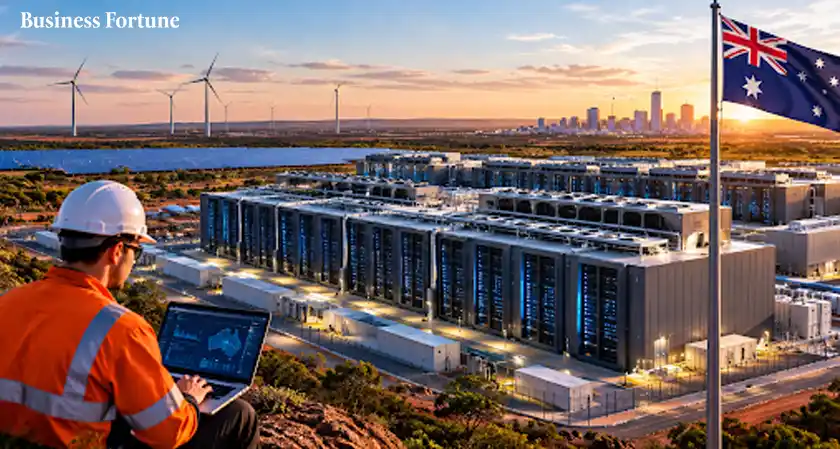
Australia’s AI infrastructure push is creating new challenges around cooling, grid capacity and resource management as governments tighten efficiency rules.
Australia’s AI data center boom is pushing developers toward larger facilities that may rely on private infrastructure and water-saving cooling systems as governments tighten resource rules. Authorities face pressure to protect electricity networks and water supplies while supporting AI expansion.
Bigger facilities reshape the infrastructure race
The scale of planned projects is rising. A 612-megawatt facility planned in Sydney by NEXTDC for OpenAI would rank among the world’s largest AI data centers. Its original plan to use recycled water was dropped because pipeline infrastructure was unavailable, forcing a move to waterless cooling that can require more electricity.
Key developments include:
-
AI facilities are demanding unprecedented levels of electricity.
-
Cooling systems are becoming central to resource planning.
-
Developers increasingly need dedicated infrastructure for growth.
-
Regulators are tightening water and energy efficiency.
-
Private power solutions could reduce pressure on grids.
How are operators responding to water limits?
Water availability is a major planning factor in Australia, where drought and restrictions can affect communities. NSW guidance encourages recycled water for water-intensive cooling where feasible, while hybrid systems can reduce consumption during drought. Some operators are adopting closed-loop or waterless technologies to limit dependence on public supplies.
However, reducing water use can shift pressure elsewhere. The OpenAI-NEXTDC project illustrates the trade-off: replacing recycled-water cooling with liquid cooling and fans avoids direct water consumption but can increase electricity demand.
Why could AI data centers escape restrictions?
The answer increasingly lies in where and how facilities are built. Developers are looking at locations with stronger energy availability, cooler climates, dedicated generation and alternative water supplies. Google’s latest Finland investment combines new data centers with a long-term nuclear power agreement, showing how AI infrastructure is being tied directly to energy sources.
Australia is moving toward stricter oversight. Federal expectations require developers to support the energy transition, use water sustainably and fund their share of grid connections. NSW has separately introduced efficiency requirements and expects projects to contribute to renewable energy and water infrastructure.
AI growth increasingly depends on securing power, cooling and water without shifting costs onto communities. This could favor larger operators capable of financing dedicated infrastructure and advanced cooling technologies. The shift is reshaping how developers choose locations and design future AI infrastructure.
Thus, Business Fortune believes that AI growth must balance innovation with responsible energy use, water conservation, and sustainable infrastructure planning.
FAQs
Why do AI data centers use so much power?
AI servers require high-density computing and continuous electricity for processing and cooling.
Why is water important for data centers?
Water can remove heat from servers efficiently, especially through evaporative cooling systems.
Can data centers operate without using water?
Yes. Liquid cooling, fans and closed-loop systems can reduce direct water use.
Will governments restrict AI data center growth?
Governments are increasingly introducing efficiency, planning and infrastructure requirements.
What is the biggest challenge ahead?
Balancing AI expansion with reliable electricity, sustainable water use and community needs.


.webp)






























Comments