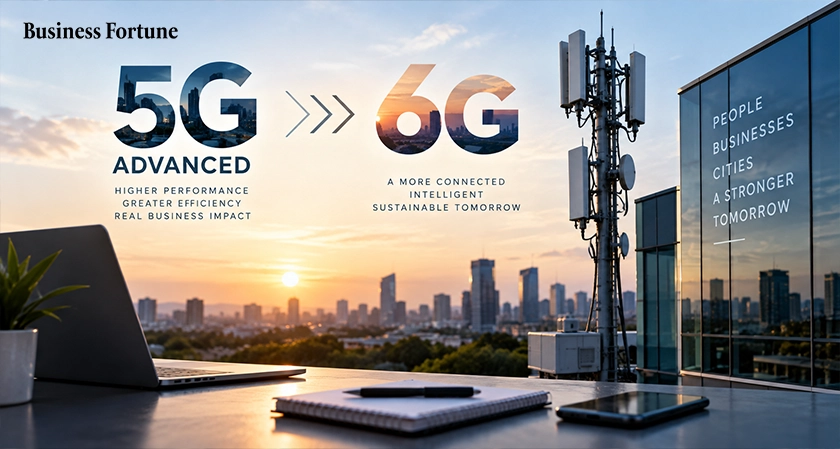
What comes after faster 5G? Explore how 5G Advanced and 6G could reshape business connectivity, from smarter machines to more connected workplaces.
Remember when having 4G felt unbelievably fast? Now, if a webpage takes a few extra seconds to load, we start wondering what went wrong. That is how quickly our expectations around connectivity have changed. 5G Advanced and 6G are not just about making downloads faster or giving people better connections on their phones. The interesting part is that companies do not have to sit around waiting for 6G to arrive. There is already plenty to explore with 5G-Advanced.
While 5G-Advanced is getting nearer to practical business applications in 2026, 6G is still under development within the broader vision of IMT-2030. The 5G-Advanced specifications are being worked out by 3GPP, whereas ITU provides support for the framework for future 6G networks.
This is a great opportunity for businesses to get ready. Businesses can utilize their current 5G network effectively while keeping an eye on potential future technologies. In this Business Fortune article, we explore what 5G Advanced and 6G could mean for businesses and why it is worth paying attention now.
5G business benefits Are Becoming More Practical
5G has already changed how businesses think about connectivity. Its value goes beyond faster smartphone downloads. 5G can be used by companies for connectivity of devices, private network, remote monitoring, smart logistics, industrial automation, and real-time data collection. The advantages of 5G for businesses are more evident if connectivity is considered a feature of the operating model and not just an IT service.
For producers, 5G would allow for connecting machinery and sensor devices inside the production environment. For logistics firms, 5G could be useful in keeping track of vehicles and shipments. For retail organizations, 5G would provide more intelligent retail spaces and enhanced connectivity for customers.
The next phase, which is known as 5G-Advanced, will bring improvements in areas like network performance, positioning, automation, and higher requirements from certain applications. It provides more space for companies to develop their services with smart connectivity.
How 5G-Advanced Will Impact Businesses
One thing to note about network changes is that today’s networks are more capable of dealing with such dynamic needs. It has become crucial for companies to have connectivity that can assist cloud-based applications, AI-based applications, IoTs, and real-time capabilities altogether.
5G-Advanced is also closely connected with the growing use of AI and automation. Network intelligence can help operators manage resources more efficiently and respond to changing demand.
For businesses, this could mean better support for automated factories, connected healthcare equipment, autonomous systems, immersive applications, and large-scale Internet of Things deployments. The important point is that companies do not need to replace everything they already use. In many cases, 5G-Advanced will build on existing 5G investments.
6G Technology Trends Businesses Should Watch
The discussion on the 6G technology trends is no longer just about speed anymore. The ITU's IMT-2030 work points toward capabilities involving AI, sensing, immersive communication, stronger reliability, sustainability, and wider forms of connectivity.
One particularly interesting area is the relationship between communication and sensing. Future networks could potentially use signals not only to transfer information but also to understand aspects of the surrounding environment.
Another major theme is AI-native networking. AI is expected to play a much deeper role in how future networks are designed, operated, and optimized. There is also growing attention on energy efficiency. As businesses connect more devices and rely on larger AI workloads, keeping network and computing infrastructure efficient will become increasingly important.
What 6G Is Expected to Add
As what will be provided by 6G is not yet clear, companies need not take everything that is predicted now is true. But the general trend is becoming more evident that 6G will be designed according to the IMT-2030 standard and will provide greater functionalities than current 5G technologies. Areas that could benefit from the innovations include low latency, sensory abilities, artificial intelligence, communications, and closer integration between communications, computing, and clouds.
This would allow companies to achieve digital twins, automation in industry, advanced robots, extended reality, intelligent transport systems, and new remote collaborations. But the timeline matters. 6G is not simply a new network that businesses can switch on today. Standards and technologies are still being developed. Companies should therefore focus on understanding the direction rather than making major investments based only on early 6G promises.
The Future of Enterprise Connectivity with 5G and 6G
The future of 5G and 6G is not going to be a replacement between technologies where one suddenly replaces another. Instead, enterprises will find themselves in the state of having to run multiple generations of technology at the same time. 4G and 5G networks will remain practical for a range of common uses, while 5G-Advanced adds further features. Eventually, when 6G becomes available, it may be applied in some cases where it makes sense from a business point of view. For technology managers, that suggests that flexibility of infrastructure is usually more important than following every specification.
The future of enterprise connectivity with 5G and 6G will be shaped by more than wireless networks alone. Optical networking, cloud computing, edge computing, data centers, artificial intelligence, cybersecurity, and interconnected devices will all be part of the landscape.
This broader relationship is emphasized by the ITU’s 2026 ION-2030 project that links future optical infrastructure development to 6G, artificial intelligence, data centers, broadband infrastructure, and integrated sensing and communication.
This is an important message for corporate executives. Connectivity is moving beyond a single service into a fully integrated technology platform. Therefore, firms looking ahead should pay attention to flexible infrastructure, cybersecurity, interoperability, and application examples. They should also partner with technology firms capable of implementing upgrades without unnecessary replacement of existing facilities.
Future of Connectivity
Next-generation connectivity sounds exciting but businesses still need to ask basic questions like What problem will it solve? How much will it cost? Does it improve productivity? Can it reduce downtime? Will customers notice the difference? Does it create a new source of revenue?
These questions should guide investment decisions.
A factory, for example, may benefit from highly reliable wireless connections because they support automation and real-time monitoring. A media company may have different priorities, such as immersive experiences and high-volume content delivery. Therefore, the right connectivity strategy will vary by industry.
The journey from 5G to 6G will take time, with many technical challenges remaining unresolved. From the perspective of organizations, however, this is no excuse for delay. Instead, the best course of action is to maximize the utility of current 5G investments, investigate how 5G-Advanced technologies can enhance this process, and follow the evolution of 6G while not basing business strategies on speculative claims.
Ultimately, the value of 5G and 6G connectivity will be determined based on how businesses use these technologies. While speed is important, smart operations, enhanced automation, improved reliability, and new customer experiences may turn out to be even more valuable. With next-gen connectivity in development, those organizations who clearly understand their technical requirements will find it easier to determine where new capabilities fit in their future plans.


.webp)





























Comments