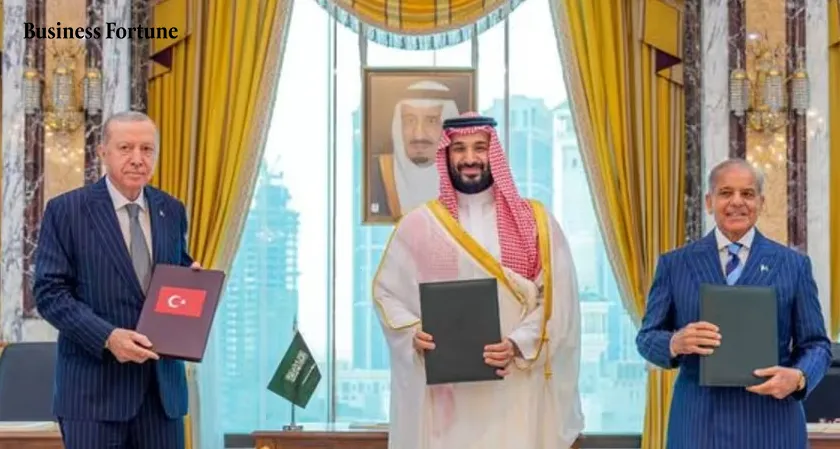
The Mecca Defense Agreement brings Saudi Arabia, Pakistan and Turkey closer, raising questions about regional security, strategic autonomy and shifting alliances.
The Mecca Defense Agreement entered into by Saudi Arabia, Pakistan and Turkey represents a departure in terms of regional security approach. The agreement involves three nations whose common concern about evolving geopolitics has brought them together to defend each other in case of armed aggression against any of them.
A Strategic Partnership Takes Shape
The agreement reflects Saudi Arabia’s effort to diversify its security partnerships rather than rely heavily on a single external power. Riyadh brings substantial economic, energy and political influence, while Turkey contributes advanced defence capabilities and a growing military industry. Pakistan adds extensive military experience and strategic depth.
Key points include:
-
Agreement strengthens trilateral defence cooperation across regions
-
Pact follows decades of Saudi-Pakistani military cooperation
-
Turkey adds advanced defence technology and industrial capacity
-
Strategic geography connects Mediterranean, Gulf and Indian Ocean
-
Signatories describe the agreement as defensive in nature
The defense agreement between Saudi Arabia, Pakistan and Turkey may strengthen deterrence while assisting strategic efforts to build more autonomous national capabilities. The partnership may also grow to include cybersecurity, maritime surveillance, intelligence exchange and vital infrastructure protection.
Turkey and Pakistan Expand Strategic Options
Turkey’s involvement is a testament to the increasing independence of its foreign policy and the need for building a larger network outside its connections within NATO, Europe and the United States. Issues related to Syria, Israel and the Eastern Mediterranean have made a wider partnership even more important.
For Pakistan, the agreement is seen as one that is part of its broader security strategy. The country’s historical rivalry with India and geographical location near Central Asia, Iran and the Arabian Sea has meant diversifying partnerships can be useful. Alliance with both Riyadh and Ankara will present opportunities for Islamabad.
The relationship between the three nations and the three major seas in the area is another key aspect of the Turkish-Saudi-Pakistani cooperation. Specifically, Saudi Arabia faces the Persian Gulf and the Red Sea, whereas Turkey links the Black Sea and the Mediterranean. Pakistan serves as an exit for the Indian and Arabian seas.
Defence Industry Could Become a Major Focus
Beyond military coordination, the Mecca Joint Defence Agreement could eventually encourage deeper defence-industrial cooperation. Turkey has developed significant capabilities in drones, missiles, naval systems and military electronics, while Pakistan has established defence manufacturing expertise. Saudi Arabia, meanwhile, has substantial capital and an ambition to localize defence production.
Nuclear possession by Pakistan in the region adds another dimension to deterrence considerations despite the treaty’s failure to set up a nuclear umbrella for either Saudi Arabia or Turkey. Instead, the deal should be seen as strategic hedging, which enables the countries to diversify their alliances without forsaking the current ones.
Business Fortune is of the view that the Mecca Defence Agreement signals a significant shift toward stronger regional security cooperation and strategic autonomy.
FAQs
What is the Mecca Defence Agreement?
The Mecca Defence Agreement is a trilateral security pact between Saudi Arabia, Pakistan and Turkey focused on mutual defence.
What does the Mecca Defence Agreement provide?
It states that an armed attack against one signatory will be regarded as an attack against all three countries.
Why did Saudi Arabia join the agreement?
Saudi Arabia aims to strengthen deterrence, diversify security partnerships and develop greater independent defence capabilities.
What role does Turkey play in the pact?
Turkey brings advanced military capabilities, defence technology, industrial expertise and significant regional strategic influence.
Why is Pakistan important to the agreement?
Pakistan contributes military experience, defence capabilities and strategic depth, while strengthening the pact’s wider regional reach.


.webp)




























Comments