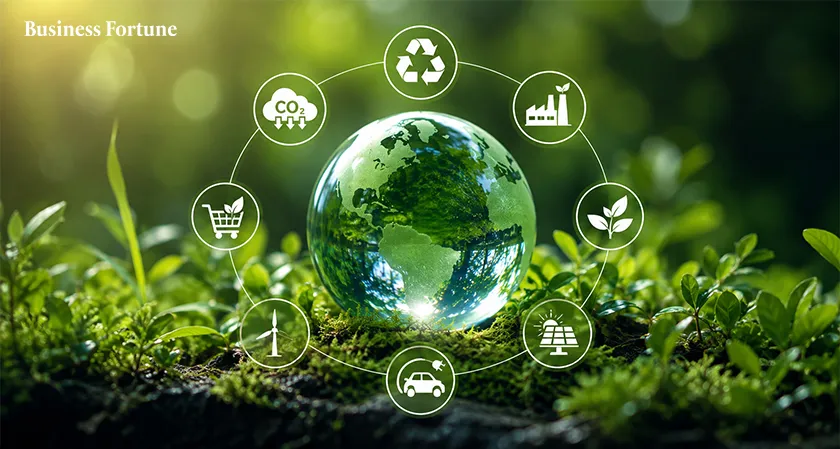
Want a greener business? Discover the 10 environmental sustainability trends shaping 2026 and learn what businesses need to prepare for next.
Do you want your business to be more environmentally sustainable but have no idea where to start? Environmental Sustainability can sometimes feel like one of those things every business talks about, while nobody quite agrees on what it should actually look like.
Sustainability is no longer just about recycling, planting trees or reducing plastic use. In 2026, businesses, governments and consumers are looking at sustainability in a much broader way, from energy generation to product design, transportation, usage and disposal.
Why this is important is that most sustainability concepts are increasingly changing from theory to practice as businesses make practical business decisions. This is due to the fact that the relationship between environmental responsibility and cost, efficiency, reputation, and growth is increasingly becoming more interrelated. Here are 10 major sustainability trends for 2026 that are shaping how businesses and communities think about the future.
Top 10 Sustainability Trends for 2026
- Renewable Energy
Renewable energy continues to gain attention in 2026. Solar and wind energy are emerging sources of electricity, while firms are seeking opportunities to reduce the reliance on fossil fuels. For businesses, the driving force is not environmental concerns only. Energy price, energy security, policy and customer demands also play an important role in making the decision.
Businesses engage in deals related to renewable energy sources and even install solar panels and consider battery storage. Even small businesses have possibilities for using renewable energy sources in their operations through local renewable energy generation and energy companies. Renewable energy source development is one of the environmental trends in 2026 because this process affects almost all economic areas. Clean power generation helps businesses reduce greenhouse gas emissions related with their operations.
- AI and Technology Help Companies Use Resources More Efficiently
AI is becoming a major component of sustainable strategies. It may seem somewhat strange, as the technology needs considerable amounts of computing power but it may also help organizations in saving their efforts and using their resources more efficiently. In buildings, for instance, AI could be used to optimize the use of electricity. In manufacturing, the technology could be used by companies to predict the maintenance of their equipment in order to save on the production process and repair expenses.
Moreover, there are also various other applications of AI in sustainability: transportation routing optimization, demand management for electricity, renewables' forecasting and water management among others. The major concern for 2026 would be about achieving the proper balance. Rather than focusing on what AI can do, people begin to consider how much energy is required for its application.
- The Circular Economy
Traditional business models were quite easy to understand and implement. Traditional businesses produce, sell, use and discard. In 2026, however, the circular economy is becoming increasingly popular. Companies start to create goods that are easy to repair, reuse, refurbish and recycle. This implies that instead of using waste as the last phase of the product's lifecycle, companies will consider it as a possible source of resources.
This approach becomes increasingly popular in such industries as electronics, fashion, automotive, packaging and construction. Some companies also start to use the concept of product take-backs, resale platforms, recycled materials and repairs. All these strategies could be used not only to protect the environment but also to discover new business prospects. When talking about sustainable development trends, the circular economy is very important to consider.
- Supply Chain Sustainability
The organization cannot understand its impact on the environment through examining its own offices and factory facilities alone. Some environmental impact occurs through its supplier networks, transport systems, raw materials, packaging and the usage of the product. As a result, businesses have begun focusing on their supply chains.
In 2026, companies will have started partnering with their suppliers in order to lower their emissions, minimize waste, optimize energy usage and source materials responsibly. With advances in technology, it has become easy for organizations to track their progress through digital supply chain networks which help them gain visibility regarding sources of materials and flow of products through various stages.
This issue becomes even more serious for businesses with operations across the globe since consumers and stakeholders are concerned about the sustainability of their business practices.
- Climate Adaptation
Reducing emissions continues to be important but businesses are now aware of another reality where climate change has become a threat to their business. Heat waves, floods, droughts, storms, water shortages and many others climate impacts may affect the way of doing business, disrupt operations and supply chains. To address these risks, businesses are increasingly considering climate adaptation strategies.
They might relocate equipment from places that are prone to flooding, enhance building designs, develop back-up power sources, diversify suppliers, and manage water resources. The approach has changed from "how can we minimize our environmental footprint" to "how ready are we for the existing environmental challenges." It is likely to become one of the key sustainability trends in 2026.
- Sustainable Buildings
The other major category that people are working on in the field of sustainability is the buildings sector. Offices, houses, factories, hospitals and shopping complexes use a lot of energy and natural resources. In 2026, buildings become smarter and more connected. Sensors can measure all kinds of energy usage including light, heating and cooling, air purification and electric consumption.
It means that building operators can optimize work based on how it is used instead of just letting the systems run constantly. Materials used for green buildings are also becoming important. Companies and developers pay attention to environmentally friendly, insulating, durable and reusable materials. Not only it is important to build an eco-friendly building but also make it work sustainably throughout its lifecycle.
- Carbon Measurement
Companies are facing more and more pressure to know how their emissions are coming from. As a result, carbon measurement is becoming more detailed and data-driven.
Rather than just providing an emissions number overall, more companies are breaking down the numbers by energy, transport, suppliers, production, company travel and the entire lifecycle of products.
Good measurements help make better decisions. If a company finds that a large percentage of its footprint comes from transport, for instance, it might examine the issues of optimizing routes, alternative fuels, electric cars or sourcing locally. Such approach will also enable companies to report their achievements more precisely. Reliable environmental data is becoming an integral part of sustainability management in 2026.
- Sustainable Packaging
The environmental problem of packaging continues to be relevant especially due to the fact that the materials used for packaging are designed to last for a short period of time.
Companies are thus experimenting with various alternative materials including recycled materials, recyclable packaging, compostable packaging, reusable packaging and reduced-material packaging.
But the difficulty is to implement the solution. Although the material may appear environmentally friendly, there might be problems with collecting, processing and recycling this material. This is why companies tend to analyze the entire lifecycle of packaging and not just ask whether packaging includes recycled materials. Companies want to see whether the packaging can be produced, delivered, used, collected and processed effectively.
- Water Sustainability
Water is increasingly emerging as an important sustainability concern. Industries like agriculture, manufacturing, food processing, mining and energy use significant amounts of water. In addition, many places are experiencing water stress and changes in their rainfall pattern. Companies have started becoming more efficient with their water usage, treating their wastewater, identifying leaks and making changes to their production process.
Technology is helping too. Sensors allow companies to monitor water usage while data systems allow them to recognize unusual water consumption and leakage problems. Water sustainability is less talked about than energy or CO2 emission; however, this is not the case anymore. Companies are starting to realize the importance of having access to water at all times.
Businesses are beginning to understand that reliable access to clean water can directly affect operations, supply chains, and local communities.
- Consumers Push Brands Toward More Responsible Choices
Consumer behavior continues to impact sustainability choices, as younger people become more aware of how their products are produced and where raw materials originate. Consumers want products that last long, have sustainable material composition, generate fewer emissions and have better information on their environmental impact.
This does not imply that all consumers will consistently go for the most sustainable product at hand. Price, convenience and quality factors will also be considered by consumers.
However, expectations have changed. The companies making any positive environmental impact should now back up these claims with credible evidence. This makes it necessary for firms to be transparent about sustainability.
Why These Trends are needed for Businesses
The most significant learning from these sustainable development trends is that environmental sustainability is increasingly becoming a part in almost all aspects of a business. Energy impacts operating expenses. Supply chains impact resilience. Packaging impacts product design. Water impacts production. Climate risks impact business continuity. Technology impacts resource efficiency.
It implies that sustainability can no longer remain solely the responsibility of a single department. What the companies will require will be cooperation among leadership, finance, operations, technology, procurement, product development teams, and employees.
Those who view sustainability as a strategic business decision in the long term and not a campaign for the short term are those who will win.
Final Thoughts
Sustainability is gaining a practical meaning in 2026. It means that the companies are going to look for practical ways of reducing waste and resource consumption, preparing themselves for the impacts of the climate change, and developing more sustainable goods and services.
According to this Business Fortune article, it should be noted that these 10 trends are not separate events, it is interrelated. For instance, renewable energy will make organizations' operations cleaner. AI is going to make them more efficient. Circular production is going to decrease waste. Better supply chains are going to make organizations more transparent. Climate adaptation is going to help them to prepare for disruptions.
There is no universal solution to environmental problems. The firms and communities that know how to use modern technologies and make responsible decision will find themselves well prepared for the changes coming ahead.


.webp)





























Comments