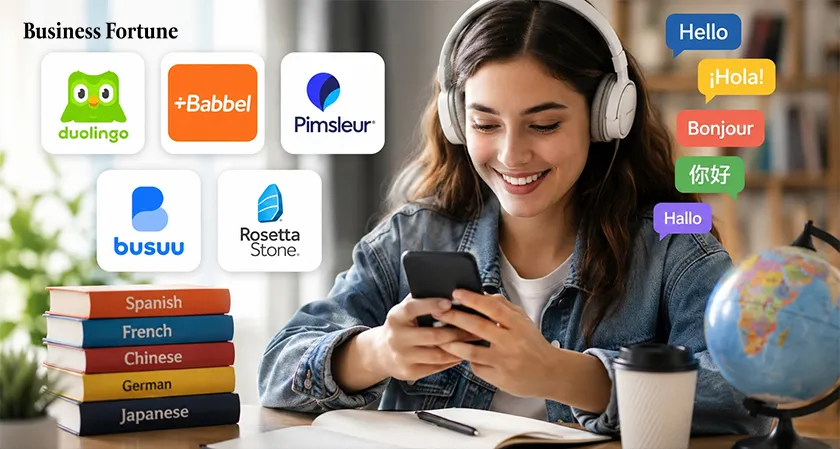
Discover what are the Best Language Learning Apps 2026. Explore top five apps and find out which one could help you learn faster, speak better and stay motivated.
Learning a new language might seem fun until you get to know that you need to memorize hundreds of words, which you have no idea how to pronounce. This Business Fortune article looks at the strengths, learning styles, speaking features and overall experience of the leading platforms for the best language learning 2026 to consider.
It is 2026 and now you have the option of learning Spanish while having breakfast, practice Japanese on your way to work and improve your French vocabulary before bedtime. The problem is not about finding an application for languages but rather selecting one that is worth the time spent on it.
Luckily, there are language applications which turn learning into playing a game. Others focus on grammar and structure. Some are built around speaking, while others use AI to give you a conversation partner whenever you need one. There are five best applications listed below that can make the process of learning languages fun.
Five Best Language Learning Apps 2026
There are lots of apps to learn languages but there are several of them that can make it easier, more practical and even enjoyable .Surely, no application is without flaws, so here we will have a look at both good and bad sides of each..
- Duolingo
If language learning applications have a celebrity, then Duolingo is most likely it. Definitely the best option for those looking for language learning to be a regular thing.
It is easy, quick, and strangely addictive to learn languages on Duolingo. Instead of expecting learners to spend an hour in class, Duolingo simplifies the process of learning into small exercises which can be done within a very tight schedule. This is one of the best attributes of Duolingo. It incorporates games such as streaks, rewards, points, challenges, among others. This could make a big difference for those who struggle with consistency.
The application is especially helpful for those who want to lay a foundation in vocabulary, basic sentences, listening skills, and conversational language. Moreover, its free version makes it one of the most accessible free language learning apps, which requires no financial investment. It allows users to begin with little money and find out if the habit suits them.
However, Duolingo has evolved significantly with the rise of AI in language learning. The paid Max version offers some AI-based functions like Video Call and Roleplay.
The downside
Duolingo does a great job of encouraging practice however, doing exercises by playing game is different from being fluent. If communicating in the language is your final goal, then there will come a time when you need to start speaking everyday.
- Babbel
While Duolingo seems to be a kind of game, Babbel resembles a language course much better. An ideal choice for those students who value structured learning of the language.
Using the language is what Babbel is concerned about. Babbel concentrates on the studying of vocabulary, grammar, pronunciation, listening and speaking rather than memorizing single words.
Also, the lessons from Babbel are quite short. Babbel says that the lessons take around 10-15 minutes and therefore can fit into the everyday routine. The lessons offer real-life dialogues to make students realize the practical application of the vocabulary and phrases.
Another feature that is worth mentioning about Babbel is the possibility to study grammar. Unlike other programs, Babbel explains the reasons for a certain sentence structure.
In 2026, Babbel is placing more focus on practice through conversations. This new technology called Babbel Speak helps users practice realistic conversation topics through interactions with AI-powered partners. Users select a topic of conversation and converse with the partner, after which they receive feedback on their performance. The app also offers speech recognition exercises that help users work on pronunciation.
Babbel is a strong choice if you are learning a language because you genuinely want to use it in real life. Planning a trip to Germany? Moving to Spain? Want to understand French conversations? Babbel's practical approach can be more useful than simply learning vocabulary. For people looking for language learning software that combines structure with practical communication, Babbel is worth considering.
The downside
Babbel has few languages compared to some of other best apps and most of its important features can be accessed only by subscribing.
- Pimsleur
Are you a multi-tasking person? Want to learn a language while driving, walking, cooking, or doing something else? Pimsleur might be the app for you.
The key difference is that Pimsleur makes listening and talking the focus of the entire process. Rather than focusing on your screen the whole time, you listen to expressions and repeat them aloud. Pimsleur proves very useful for people whose primary goal is to talk and communicate.
Let's take the example of your preparation for visiting Italy. You don't have to be capable of writing an essay in Italian. What you need to do is order meals, ask for directions, make introductions, answer simple questions and so on. In this case, the audio method will be helpful for you. Pimsleur's lessons make the learner pay attention to listening, memorizing, and producing the language.
Pimsleur is considered to have the most effective audio language learning techniques. For learners searching for best language apps that focus heavily on conversation and listening, Pimsleur is a strong option.
The downside
Pimsleur's method may not be appropriate for everyone. If you need to study grammar in detail, do writing tasks or see many visual materials when learning, maybe you should choose another app.
- Busuu
If language is supposed to be used among people for communication, then why study all alone?
This is the concept of Busuu. In this way, by combining both language learning and socializing, the application becomes unique among other apps and the whole learning process is done only using the algorithm. The app concentrates on important things such as vocabulary, grammar, listening, reading and speaking.
The social component of the program will turn out to be useful for you if you want your natural language skills evaluated. It is important since there is a huge difference between understanding the meaning of a sentence and whether the native speakers will really use it in the sentence.
Busuu is often included as one of the top language learning apps in 2026, especially for students who prefer to learn in an organized manner and receive community feedback.
The downside
Some of the valuable features of Busuu are available only in its paid version. In addition, community feedback may vary since you are dealing with users.
- Rosetta Stone
Rosetta Stone has been teaching languages for a longer time compared to most apps that are available in nowadays. But it has not entirely gone. A few still use it.
In fact, the biggest strength that Rosetta Stone keeps is immersion. The technique reduces dependence on translation. Instead of offering the English translation of a word all the time, it utilizes visuals, sound, repetition, and context.
Think of how children learn their native language by associating the word "apple" with an actual apple. This is what Rosetta Stone tries to achieve for adult learners. The process might require more patience from you, but some learners appreciate the idea that they don't have to switch back and forth between their native language and the new one all the time.
Pronunciation is one of the aspects of the learning process. The program uses speech recognition technology to teach the learners how words should sound. Rosetta Stone remains a top option for immersive learning even in 2026.
The downside
Not everyone finds the immersive approach appealing. Some beginners can feel frustrated because they want explanations in their native language immediately.
Which Language Learning App Is Best for You?
Choosing the best app becomes much easier when you start with your goal.
.webp)
Can You Become Fluent With a Language App?
The honest answer will be that an app can help you learn a lot but just an app cannot be your only solution to learn a new language fluently. The biggest advantage of these platforms is consistency. You can practice vocabulary on Monday, listen to conversations on Tuesday, work on pronunciation on Wednesday and keep building from there. But eventually, you need to use the language.
Talk to people. Watch movies. Listen to podcasts. Read simple books. Write messages. Make mistakes. You do not become comfortable speaking a language by waiting until you are perfect. You become comfortable by using it badly at first and gradually getting better.
The best way to go about things in 2026 will not simply be just selecting an app and sticking to only that. You can mix and match the different apps based on your needs. This means that you could use Duolingo to create an exercise schedule, Babbel to learn grammar rules and engage in conversations, and real conversations to gain self-confidence.
The process of language learning has become incredibly convenient. It is no longer necessary to attend night classes on a regular basis or to carry around some books in order to master the basics. Just a mobile is capable of providing you with all the required elements, including structured lessons, pronunciation training, AI conversations, listening skills, vocabulary tests and more.
Choose your app and learn a new language today. Whether it’s a language learning app for beginners or any new AI language learning apps, ten minutes today is better than another month of saying, “I really should learn Spanish someday.”


.webp)































Comments