
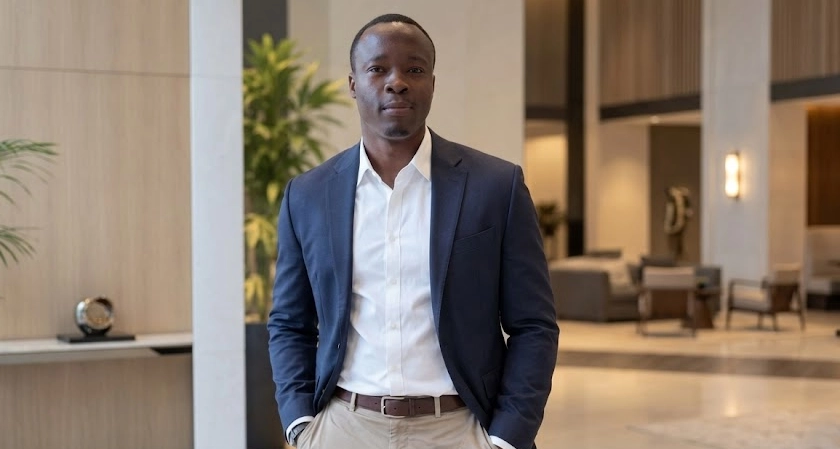
Behind every reliable building lies the work of specialists, whose decisions often go unnoticed by those who use the completed structure. A design engineer is responsible for ensuring that the structure is not only functional but also capable of withstanding the intended loads. Petro Mozil's career exemplifies an engineering career shaped by a combination of a thorough education, years of practical experience, and work on a wide variety of construction projects.
Petro Mozil's interest in engineering began back in his school years. He was passionate about mathematics, participated in competitions, played sports, and in his senior year, began taking extracurricular drawing classes. It was then, he says, that he realized that design allowed him to combine his interest in the exact sciences with the ability to create real-world objects. Before choosing a career, he considered two fields-construction and programming-but ultimately chose civil engineering.
Petro received his professional education at the Lviv Polytechnic National University. During his studies, he participated in academic competitions and olympiads, consistently expanding his knowledge in various areas of structural engineering. His training allowed him to work with wood, metal, and reinforced concrete structures. He defended his master's thesis with honors. Its topic was related to stress losses and the load-bearing capacity of composite beams reinforced with rebar.
After graduating, the practical part of his professional career began. For many years, Petro Mozil worked as a construction engineer for several companies in Lviv and the surrounding region, and since 2019, he has continued his professional career as an independent engineer. His specialization includes the design and engineering of new buildings, the renovation and redevelopment of existing structures, and the mathematical calculations of load-bearing elements.
In his engineering practice, he has worked with a wide range of structural problems, including the calculation of foundations, walls, floors, roofs, frames, columns, trusses, and beams. A significant part of his experience has come from renovation projects, where the specialist must consider the specific features of an existing structure while simultaneously finding technical solutions for its future use.
The professional portfolio includes both civil and industrial projects. Among the completed projects are the reconstruction and expansion of the Rava-Russkaya international automobile checkpoint, the renovation of boiler houses, work on educational and military infrastructure facilities, and the design of individual residential buildings, warehouse complexes, and industrial facilities. Some projects required inspecting existing structures and developing solutions for their reinforcement.
One of the areas of work was engineering work in the field of energy-saving technologies. Projects included, among other things, the reconstruction of a central heating plant, the renovation of boiler houses, and the construction of autonomous and modular boiler houses. This experience allowed us to work not only on individual building structures but also on engineering infrastructure facilities.
His experience working with commercial and industrial properties deserves special mention. Among the projects mentioned in his professional materials are a wholesale office complex, a warehouse complex, production facilities, a trade and exhibition center, as well as work for enterprises, including industrial facilities. In such projects, the engineering challenge required considering not only the building's structural parameters but also the specifics of its subsequent use. Modern engineering is impossible without digital tools. In his professional work, Petro Mozil has used AutoCAD, Lira, Monomah, and SCAD-software solutions used for the design and calculation of building structures. However, technical software is only a tool: the final engineering solution requires a professional assessment of the initial data, the structural diagram, and the calculation results.
Petro Mozil's professional experience is often highlighted in his work, highlighting the importance of his ability to make quick decisions and establish rapport with clients. His work on various projects gradually expanded his practical skills in civil and industrial construction, as well as his experience using computer programs for structural analysis.
Petro Mozil's professional journey continues in the United States. The move marks the beginning of a new chapter for him, in which he intends to use his education and years of experience to further his professional development and work in a new market. As a specialist, he is considering applying his accumulated knowledge to the construction industry and continuing to develop his engineering skills.
Petro Mozil's story demonstrates how multifaceted the profession of a design engineer can be. A single project entails years of education, dozens of technical challenges, working with various types of structures, and constant development of professional skills. In this profession, simply being able to read blueprints or perform calculations is not enough – it requires understanding the logic of the entire project, considering the client's requirements, and finding solutions that will work not only on paper but also in real-life construction practice.
Veronica Sukhailo


.webp)





























Comments