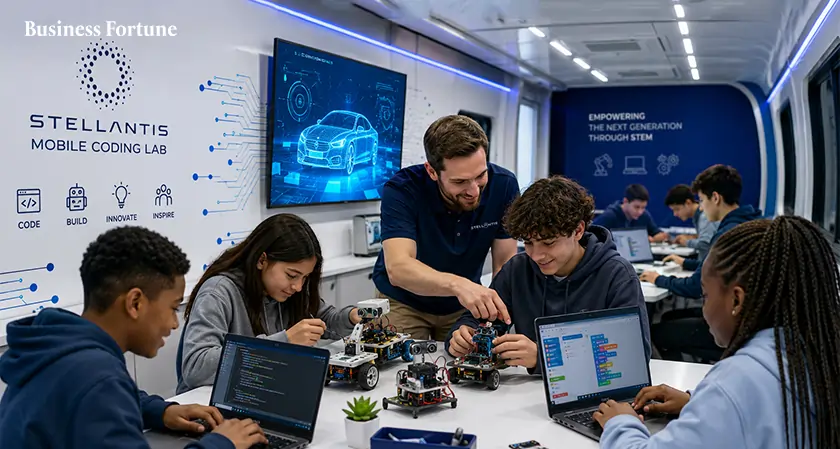
The Stellantis mobile coding lab is bringing digital learning, coding and AI to South African schools. Here's how it could transform students' futures.
The Stellantis mobile coding lab is set to make digital learning more accessible for students and teachers across South Africa, opening new pathways to future careers in technology. Stellantis South Africa has partnered with Social Coding South Africa to deliver coding, robotics and digital education to communities where access to technology is still limited. The initiative is part of Stellantis Philanthropy, the company's global programme that supports education, youth development and equal opportunities.
Taking technology directly to the classroom
At the heart of the partnership is a mobile computer lab that travels to schools and community centres, allowing learners and teachers to gain practical technology skills without needing permanent computer facilities. The programme is designed to reach Grade 8 and Grade 9 learners, giving them hands-on experience in coding, robotics, AI and other Fourth Industrial Revolution (4IR) technologies.
Teachers will also receive training on using digital tools in everyday classroom lessons, while young people will be certified as facilitators. Some participants will also receive paid work opportunities to help expand the programme into more communities.
"At Stellantis, we believe that access to skills and opportunities is key to unlocking long-term social and economic progress" said Sizwekazi Mdingi, Head of Communications and CSR for South Africa and Sub-Saharan Africa at Stellantis.
Why does this partnership matter?
Beyond classroom learning, students will have the chance to participate in national and international robotics competitions, giving them opportunities to apply their knowledge in real-world challenges. The programme also focuses on training local facilitators and empowering teachers so that digital learning continues even after the mobile lab moves to another location.
Thembiso Magajana, founder of Social Coding South Africa, said the partnership helps bridge the gap between talented young people and opportunities they often struggle to access. She noted that bringing the mobile lab directly into communities proves that coding, robotics and AI are achievable skills for every learner.
According to Business Fortune, the initiative reflects Stellantis' wider commitment to digital inclusion and youth empowerment. As technology continues to reshape industries, programmes like this could play a vital role in preparing South Africa's next generation with the skills needed for tomorrow's jobs while building stronger, digitally connected communities.
FAQs
What is the Stellantis mobile coding lab?
It is a travelling computer lab that provides coding, robotics and digital skills training to schools and communities with limited access to technology.
Who will benefit from this programme?
Grade 8 and Grade 9 learners, teachers and young facilitators will receive training and digital learning opportunities.
What subjects will learners study?
Students will learn coding, robotics, digital literacy, artificial intelligence (AI) and Fourth Industrial Revolution (4IR) technologies.
Will learners get opportunities beyond classroom training?
Yes. Participants can compete in national and international robotics competitions to showcase their skills.
What is the long-term goal of the partnership?
The initiative aims to improve digital inclusion, equip communities with lasting technology skills and prepare young people for careers in the growing digital economy.


.webp)





























Comments