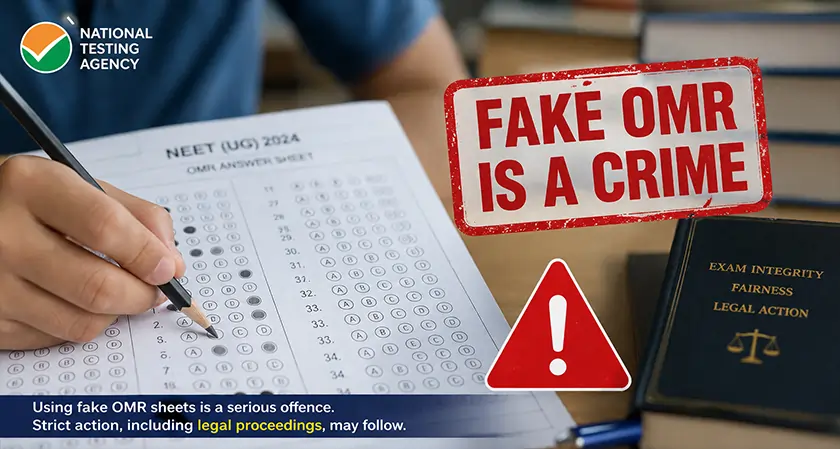
NTA warns NEET aspirants against using fake or AI-generated OMR sheets. Could score disputes now lead to legal action?
For thousands of NEET aspirants and their families, the days following the result announcement have been filled with confusion, frustration and questions. Now, NTA warns that some of the evidence being shared online to challenge NEET UG 2026 scores may not be genuine at all.
The National Testing Agency (NTA) has asked students and parents to be careful while raising complaints about NEET scores. The agency warned that only original OMR sheets and official documents should be used and said that submitting fake or AI-generated documents could lead to legal action.
The advisory comes after the NEET UG 2026 results were announced on July 16, with over 11.21 lakh students qualifying the exam. Soon after the results were released, many students took to social media, saying that the scores they had calculated from their OMR sheets did not match the marks shown in their official results.
Legal Challenge Emerges After the Results
According to the agency, several OMR sheets submitted for verification appeared to be fake and generated using AI tools. Officials stated that incorrect serial numbers, spelling errors and mismatched field labels were among the signs that raised concerns about the authenticity of the documents.
An NTA official said, “Students and parents are advised to submit only original OMRs for scrutiny. Any fake or AI-generated OMR may invite legal action against the complainant.”
The agency also noted that similar cases were reported in previous years and that courts had dismissed some petitions after finding that forged documents had been submitted as evidence.
Are Social Medias Adding to the Confusion?
One of the students raising concerns is Arya Singh, a NEET aspirant from Kanpur. She claimed that when she first checked her result, her score showed 540 marks, but later it was displayed as 167. Her family has reached out to the NTA and the Education Ministry and says it may move to court if the matter is not resolved.
In another case that gained attention online, a parent claimed that the OMR sheet uploaded for their child belonged to someone else. However, NTA officials said the candidate named in the claim had never registered for NEET UG 2026, raising doubts about the authenticity of the document being shared.
Legal Consequences Could Follow
The NTA has emphasized that it is carefully examining every complaint and that genuine grievances will be addressed through official procedures. However, it has also made clear that submitting manipulated or fake AI evidence could lead to legal proceedings.
As Business Fortune sees, the controversy is likely to accelerate discussions on stronger digital verification systems, AI detection mechanisms, and greater transparency in examination processes. As AI tools become more convenient, examination authorities may increasingly need advanced safeguards to protect the integrity of India's largest competitive exams.
FAQs
Why has the NTA issued a warning to NEET 2026 candidates?
The NTA found that some complaints regarding score discrepancies were accompanied by allegedly fake or AI-generated OMR sheets and warned that legal action could be taken against those submitting fabricated documents.
What should candidates do if they believe their NEET score is incorrect?
Candidates should follow the official grievance process and submit only authentic OMR sheets and documents obtained through official NTA channels.
Can AI-generated OMR sheets lead to legal action?
Yes. The NTA has stated that submitting fake or AI-generated OMR sheets as evidence may result in legal consequences.
What concerns have students raised after the NEET 2026 results?
Some students have claimed that the marks they calculated from their OMR sheets do not match the scores declared in the official results.
How many candidates qualified for NEET UG 2026?
According to the NTA, approximately 11.21 lakh candidates qualified the NEET UG 2026 examination.


.webp)




























Comments