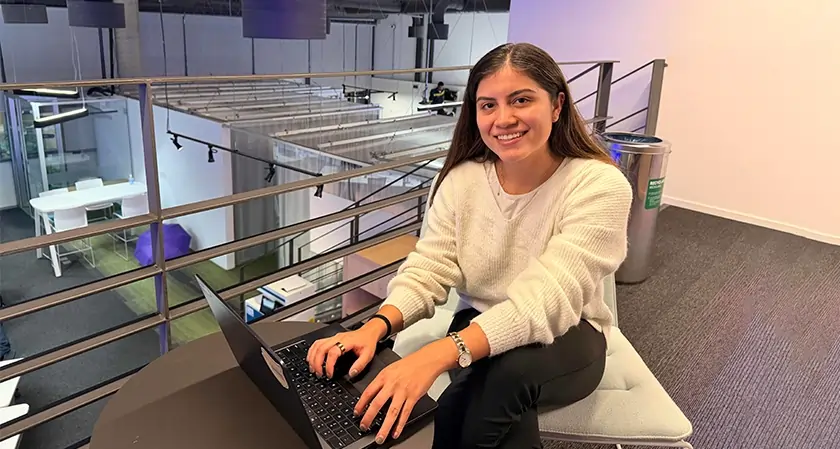
Deploying voice AI agents inside a major Latin American bank is a regulatory problem. Data residency, financial oversight, and local privacy laws can stall a deployment before it begins.
At Domu, Adriana Muñoz Vergara became responsible for clearing that path.
As Chief Growth Officer at the company, a Y Combinator S24 voice AI company serving regulated financial services, she structured the company's Brazilian subsidiary and master service agreements at record speed. Her work unlocked operations with Tier-1 banks and BPOs across loan servicing, debt collection, and customer support.
Muñoz Vergara joined Domu as a founding team member when the company had just three clients and minimal compliance infrastructure. In under 12 months, she helped scale annual recurring revenue from $2 million to nearly $10 million.
She says: "I operate at the intersection of commercial, legal, compliance, and growth. I built foundational systems, strategies, and infrastructure from near-zero, helping convert early traction into durable enterprise revenue."
And she turned regulatory complexity into a competitive advantage. Her work expanded Domu's U.S. licensing footprint from fewer than 3 states to more than 35, established the compliance foundations for LATAM expansion, and helped position the company as a trusted voice AI provider in some of the most heavily regulated environments in financial services.
The speed of that compliance buildout is notable even by fintech standards. Domu held licenses in fewer than three states when she arrived. Within roughly a month, that figure had expanded to nearly 30. Today, the company operates with approximately 35 state licenses.
Rather than treating licensing as a standalone legal exercise, Muñoz Vergara coordinated engineering teams, outside counsel, operational leaders, and enterprise customers simultaneously. She built the compliance architecture as the company scaled its commercial activity.
Muñoz Vergara brings deep cross-border knowledge shaped by her Colombian roots and fluency in Spanish, English, and Catalan. Before Domu, she co-founded BeanBliss
Co. and later led growth and partnerships at Makers Fellowship. She holds a Master's in Strategic Business Analytics from EAE Business School.
That multilingual, multicultural fluency translates directly into her approach to regulation: she argues that regulatory complexity becomes a competitive advantage when companies build the right foundations early. Her approach blends strategic foresight with operational speed, educating internal teams and enterprise clients on AI-specific compliance requirements, including SOC 2, PCI-DSS, ISO 27001, GDPR, and LGPD.
.webp)
The Regulatory Imperative in AI Adoption
As financial institutions operationalize AI, regulatory readiness has become as important as technical performance.
For many buyers, the central question is whether AI performs a task and technology withstands audits, satisfies regulators, and fits within established governance frameworks.
That challenge sits at the center of a rapidly expanding market. Voice AI adoption is accelerating across banking, debt collection, loan servicing, customer support, and payment operations as financial institutions seek to automate high-volume interactions while maintaining compliance.
For many providers, the problem is less about technological efficiency and more about regulatory trust. This is solved by Domu through auditability, compliance, and human escalation integrated into the solution itself.
An excellent case would be the quick start of the Domu Brazilian operation. Muñoz Vergara personally arranged the creation of the subsidiary and negotiated terms that satisfied data residency and financial regulations. The result was the ability to connect to major LATAM financial institutions right away, with immediate benefits.
As call volume increased in Brazil, communication costs rose rapidly and exceeded the initial estimates made during contract negotiations. Within a week, losses amounted to around $20,000 a day and sometimes $7,000 an hour.
Nicolas Diaz, CEO and Co-Founder of Domu, assigned the problem directly to Muñoz Vergara, knowing she had developed a reputation for moving quickly and escalating issues without hesitation.
Muñoz Vergara says: "We had underestimated vendor costs at scale, leading to losses of roughly $20,000 per day in telephony costs. The CEO tasked me with urgent
negotiations across multiple providers and countries because of my sense of urgency and willingness to escalate."
She escalated directly to senior decision-makers across multiple telecom providers while conducting a parallel review of the regulatory framework.
The breakthrough came through regulatory research. Muñoz Vergara identified a Brazilian resolution that allowed per-second billing for Domu's category of engagement, rather than the previously applied 30-second rounding methodology.
Within two days, pricing structures were redesigned across five telecom cost components.
Muñoz Vergara says: "I engaged executives at major providers, uncovered regulatory opportunities in Brazil for per-second billing, and shifted structures within days."
Muñoz Vergara approached those discussions through transparency rather than leverage, openly sharing the economics of the situation and aligning incentives around long-term sustainability. The approach reflected her belief that durable enterprise relationships are built through honest communication, even when conversations involve difficult tradeoffs.
The outcome restored profitability while delivering meaningful savings to customers.
The trust Muñoz Vergara built during that crisis translated directly into client confidence. Mark Sze, Senior Head of Product and Partner at Neon Pagamentos, who worked with her throughout Domu's Brazilian market entry, saw that reliability firsthand: “Her reliability and follow-through set her apart. She built the trust that made our partnership possible, and her professional posture, even when speaking on behalf of the CEO, gave us the confidence to move forward with Domu in Brazil.”
Muñoz Vergara says: "It wasn't enough to find the solution. We also had to convince clients to adopt a completely new pricing structure. That required trust, transparency, and alignment around long-term sustainability."
Tens of thousands of dollars in daily costs were eliminated, improving margins for both Domu and its clients while strengthening trust during a critical phase of expansion.
Navigating Dual Regulatory Regimes: LATAM and the U.S.
Brazil's LGPD, often compared to Europe's GDPR, imposes strict requirements around personal data processing, consent, residency, and cross-border transfers.
However, the United States presents a different challenge. Rather than a single federal framework, companies must navigate a patchwork of state privacy laws, collection licensing requirements, and sector-specific regulations.
In particular, California's privacy regime differs significantly from licensing requirements in other states, while financial services organizations must also address federal oversight expectations.
Muñoz Vergara's role involved mapping these overlapping obligations and designing processes capable of satisfying both LATAM and U.S. regulatory expectations simultaneously.
Muñoz Vergara says: "I built foundational systems, strategies, and infrastructure from near-zero, helping convert early traction into durable enterprise revenue."
The commercial playbook she helped build at Domu demonstrates how regulatory readiness can become revenue acceleration.
That work required translating regulatory requirements into operational systems that enterprise customers could trust.
Aforementioned Co-Founder Diaz says: "Adriana rebuilt our entire contractual and compliance framework from the ground up. The overhaul was way more than just fixing our licensing gaps. She drafted a new Master Service Agreement and built along with our engineering team SOC 2, PCI DSS, and ISO 27001 infrastructure. Adriana even navigated a SOC 2 workaround that closed a million-dollar deal ahead of formal certification. That's the difference between a compliance officer and a growth operator."
Muñoz Vergara led complex contract negotiations with Fortune 500 organizations, including Alorica, Nubank, and Teleperformance. She developed a comprehensive go-to-market strategy for Colombia, including detailed financial models and ROI projections comparing AI agents with traditional collections teams.
These materials targeted Tier-1 financial institutions and translated technical capabilities into operational and financial outcomes executives could evaluate.
The process emphasizes precision at every stage.
Muñoz Vergara often points out that enterprise AI sales have become more difficult, not easier. Industry research shows average B2B win rates hovering near 20%, sales cycles running 38% longer than in 2021, and the typical deal involving six to ten stakeholders, with large enterprise transactions often requiring input from 17 or more decision-makers.
Her approach centers on reducing buyer risk. In regulated industries, buyers evaluate solutions through both operational and regulatory lenses. Many vendors address only the first, stalling deals during legal review.
Muñoz Vergara focuses on surfacing questions around data residency, auditability, liability, and governance early in the process.
She says: “ I am skeptical of poorly designed pilots, and believe that vague success criteria can waste months of effort and erode internal support. In my view, pilots should establish baseline metrics, evaluation criteria, and a clear path to scale before deployment begins.”
The philosophy reflects a broader belief that AI should amplify human relationships rather than replace them.
AI as an Amplifier, Not a Replacement
As automation handles more routine sales and operational tasks, she argues that trust-building, strategic collaboration, and problem-solving become even more valuable. Gartner predicts that by 2030, 75% of B2B buyers will prefer sales experiences that prioritize human interaction at critical decision points.
Results with Alorica, a global Business Process Outsourcing company that specializes in outsourced customer service, technical support, and call center management. illustrate the impact.
Muñoz Vergara says: "From initial contract design through integration, I worked closely with product teams and the client's leadership to ensure success metrics were achieved. Real-time dashboards and rapid feedback loops dramatically shortened iteration cycles."
Alorica, which employs more than 100,000 people across 16 countries, partnered with Domu to deploy Rebecca, a bilingual AI virtual agent operating around the clock in English and Spanish.
In the first 30 days, Rebecca handled 2,565 inbound calls, resolved 48% of inquiries without live-agent intervention, collected nearly $100,000, and achieved an 87% payment success rate. Every interaction remained fully auditable, with automatic escalation protocols for regulated scenarios.
But the deployment extended beyond loan servicing. Jay King, President at Alorica Financial, which handles instant loan origination, flexible repayment schedules, and omnichannel customer support, explains: "Our objective is to apply AI where it creates
the greatest operational value while preserving human expertise for high-trust interactions. The speed of adoption and the outcomes achieved in the first month surpassed our expectations."
Diaz says: "Financial institutions are searching for compliant and practical ways to scale AI. What matters is ensuring every interaction remains auditable and policy-aligned. The early results demonstrated that AI can perform at a human level in many workflows, and we view this as the beginning of a much larger opportunity."
Alorica also implemented Domu's technology for equipment recovery operations, enabling the AI system to manage the return process from identity verification through scheduling and confirmation.
Since launch, that deployment has handled more than 16,000 conversations, with resolution rates exceeding 50% as the program matured. The partnership is now expanding into additional portfolios, outbound engagement, AI-driven quality assurance, and proactive collections programs.
Building a 10x Culture Through Systems and Automation
Muñoz Vergara fosters a team-first culture at Domu. She built automated workflows using tools such as n8n, Windmill, and Slack to streamline vendor processing, candidate evaluation, customer onboarding, and demo pipelines.
Rather than scaling headcount linearly, Muñoz Vergara advocates what she calls 10x thinking: building systems, workflows, and decision-making frameworks that enable small teams to deliver outsized results.
Muñoz Vergara says: "I rarely say 'not my scope' if it impacts the business. I step up across commercial, legal, operations, and growth." The automation infrastructure she introduced multiplies impact while empowering team members to contribute beyond formal job descriptions. Employees routinely step across commercial, compliance, legal, and operational functions when needed, creating a culture built around ownership, adaptability, and execution.
Muñoz Vergara adds: "Extreme humility is essential for learning and growth in early-stage companies. Urgency matters because momentum compounds. I reject artificial limits and encourage 10x thinking, builder mentality, and constant questioning: Are we faster? Better? More ambitious? More scalable?"
That philosophy helped transform a startup with three customers into a company exceeding $10 million in annual recurring revenue.
She says: "Clients should see me as someone deeply committed to their success, not just superficial happiness. I build relationships through honesty, even hard conversations about gaps. Velocity in resolution, transparency, and end-to-end support define my approach."
The philosophy extends to product development as well. One aspect of AI that particularly excites her is the ability to experiment rapidly. Variables such as tone of voice, accent, pacing, and communication style can be tested in minutes. This generates insights that would have required lengthy hiring and training cycles in traditional call center environments.
Muñoz Vergara says: "At Domu, we can test variables like voice tone, accent, and gender in AI calls. Possibilities that would be nearly impossible in traditional call centers. One experiment showed different voices producing dramatically better payment promises from the exact same script."
Founders seeking guidance on fintech expansion will find Muñoz Vergara’s advice invaluable. Her ability to prepare founders for institutional scrutiny was precisely why Omri Even-Tov, an Associate Professor at UC Berkeley Haas, invited her to serve as an industry mentor for the school’s inaugural AI Entrepreneurship course.
Even-Tov highlights her impact as a mentor, saying that she rigorously reviews MVPs, go-to-market plans, and compliance readiness to ensure founders are prepared for institutional buyers long before they face procurement scrutiny.
Sam Tomkins, founder of Hypnos Lab and a Program Manager at Amazon, who has relied on her strategic counsel, says: "Adriana is generous with her time and unfailingly direct in her feedback. Her input has had a tangible effect… and the company's strategy is materially stronger for it."
A Blueprint for Trust-Driven Growth
Compliance should come first, but with great compliance comes strategy, sales, and a competitive advantage. Muñoz Vergara's success provides founders with an outline for navigating regulations and scaling within them. It helps turn legal difficulties into customer trust and business growth.
Combining expertise in legal intricacies, cultural familiarity, an effective sales process, and speed of execution, she demonstrates how a startup can grow internationally and mitigate risks for both its customers and investors.
Muñoz Vergara says: "I hope to be remembered as a person who made others question their beliefs on what is possible. Progress is made by testing assumptions through continuous experimentation and perseverance. Each effort, whether successful or not, opens the door to a future endeavor."
Her journey to Chief Growth Officer at a fast-scaling voice AI company highlights the power of disciplined execution. As Domu continues its trajectory, Muñoz Vergara's regulatory leadership positions the company to capture larger opportunities across Latin America and the United States. It demonstrates that in the age of AI, trust may be the most valuable infrastructure of all.
About the Author
Mahadharani Vijay is a dedicated and highly creative content writer specializing in news writing, blogs, and SEO-focused articles. She is passionate about creating content that is not only informative but also engaging, clear, and easy for readers to connect with. Her ability to simplify complex topics into meaningful and reader-friendly content makes her writing stand out across different audiences, from everyday readers to professional communities.
With a strong focus on understanding the reader’s perspective, Mahadharani carefully develops every piece of content to answer questions, deliver value, and maintain audience interest from beginning to end. Her writing reflects strong research, attention to detail, and a professional approach that helps businesses and readers trust the information she shares. She believes that great content should educate, inspire, and create a lasting impact.
Beyond her writing skills, Mahadharani is known as a positive and approachable professional who values communication, collaboration, and strong networking relationships. Her commitment to quality, consistency, and audience engagement makes her a reliable content writer who brings professionalism, creativity, and purpose into every project she handles.

.webp)






























Comments