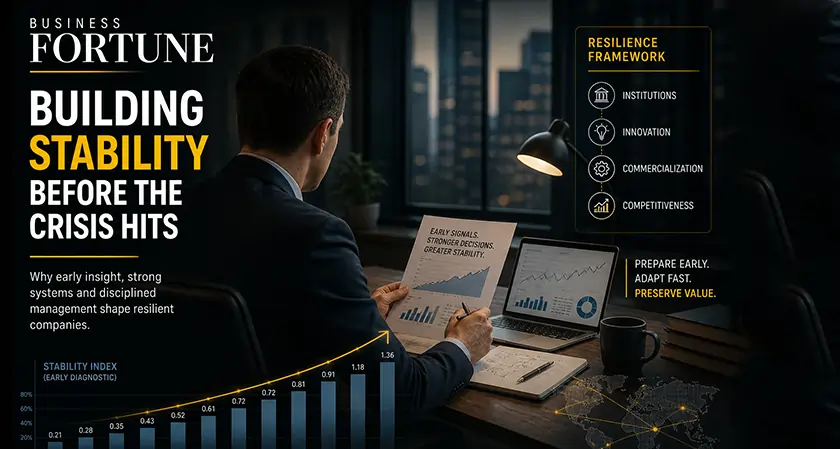
In unstable markets, most companies focus on surviving disruption. The stronger ones focus on building systems that can absorb pressure before it turns into operational failure.
That distinction sits at the center of Oleksandr Likhota’s applied economic work. A Ukrainian economist and Associate Professor, Likhota has focused much of his research on how companies maintain stability under changing external conditions — particularly how businesses detect vulnerability early, preserve continuity under pressure, and prevent external instability from becoming internal disruption.
His work in enterprise financial security points to a broader business reality: companies rarely lose stability because a single shock overwhelms them. More often, they lose it because management systems fail to recognize pressure early, coordinate response fast enough, or adapt before instability begins to spread across the business.
That is a different way to think about resilience.
For many companies, resilience is still treated as a financial outcome — stronger reserves, tighter controls, better reporting. But Likhota’s research suggests stability is usually determined much earlier, at the level of diagnostics, internal coordination, and how effectively management can identify structural weakness before it becomes operational loss.
This is where stronger companies separate themselves.
They are not always the fastest-growing or the most aggressive. Often, they are the ones with better internal visibility, earlier warning signals, and stronger coordination across functions when conditions begin to shift.
That kind of stability is less about caution than preparedness.
One of the more practical contributions in Likhota’s work is his research on assessing the financial security of enterprises in changing external environments. That work argues that resilience is not best understood as a static financial condition. It is a measurable management capability — one shaped by how well a business can diagnose vulnerability, detect destabilizing pressure early, and coordinate response before financial stress becomes structural decline.
Rather than treating financial security as a static outcome, the model evaluates it as an early diagnostic function. Its practical value lies in helping companies identify where instability is beginning to accumulate — before it becomes visible in financial loss. That includes shifts in external conditions, weakening coordination across functions, delayed managerial response, and internal pressure signals that often emerge long before disruption appears in formal reporting. In practical terms, the model is useful not because it explains why companies become unstable after the fact, but because it offers a structured way to recognize instability while it is still manageable.
That has direct implications for how businesses manage volatility.
In unstable conditions, companies often focus on the visible side of risk: margins, liquidity, cost pressure, demand contraction, financing constraints. But many of the failures that later appear as financial problems begin much earlier as management failures — weak coordination, delayed response, fragmented visibility, or slow adaptation under pressure.
By the time instability becomes visible in financial reporting, the business is often already reacting too late.
This is why stronger firms tend to treat resilience less as a reporting function and more as an operating discipline.
They build systems that make instability easier to identify, easier to interpret, and harder to escalate.
That changes how businesses preserve value. It changes how they approach planning, capital discipline, and continuity. It also changes how they approach innovation. Companies that cannot maintain internal stability rarely sustain innovation for long. The ability to adapt, protect value, and scale change depends on the same internal discipline.
That is what makes Likhota’s work especially useful in volatile markets. It reframes resilience not as a defensive reaction to instability, but as a practical business capability — one that determines whether companies remain functional, adaptive, and commercially coherent when external conditions begin to shift.
The firms that navigate instability best are rarely the ones that simply react faster.
They are usually the ones that built stability before they needed it.
About The Author
Mahadharani Vijay is a writer specializing in digital marketing, electric and concept cars, gadgets, and media and entertainment. She focuses on turning emerging trends and innovations into clear, engaging, and accessible stories for both professionals and wider audiences.


.webp)