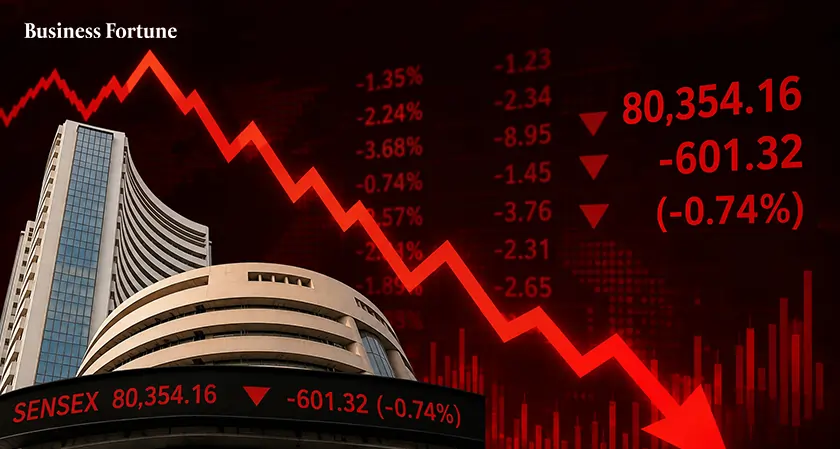
Indian markets fluctuate sharply as foreign selling, currency weakness, and global uncertainty keep investors cautious throughout Wednesday’s trading session.
-
Sensex drops 600 points amid heavy selling pressure
-
Broad market weakness drags investor sentiment sharply lower
-
Financial and IT stocks lead market decline today
-
Global cues and FII outflows intensify market pressure
As Indian stock markets opened and traded under pressure on Wednesday due to persistent withdrawals of foreign funds, currency weakness, and global uncertainty, benchmark indices maintained their recent volatility in Sensex today live updates. Both the Sensex and Nifty 50 saw major swings during the session as investors responded to both sector-specific and mixed worldwide trends. As sentiment on Dalal Street continued to be dominated by larger macroeconomic concerns, market players remained cautious.
Initial trading saw the Nifty50 drop below 23,450 and the BSE Sensex drop by about 600 points, showing a weak start to the day. All heavyweight stocks showed signs of selling pressure, with financials and a few IT services leading the way. According to analysts, was caused by constant concerns about inflationary pressures, high crude oil costs and geopolitical worries that still affect people's will to take on risk. The downward pressure on domestic shares was made worse by the fact that foreign institutional investors (FIIs) continued to be net sellers.
Currency stress and global cues weigh on sentiment
The Indian rupee's current decline, which has been hovering around record lows, was a major factor in today's cautious tone. This has created worries about imported inflation, especially in sectors that depend on worldwide supplies like crude oil. High bond yields, which indicate tighter financial situations and greater borrowing costs for businesses, increased the strain even more.
Due to market swings triggered by Middle East tensions and uncertainties surrounding US economic indicators, investors remained risk-averse on a worldwide scale. Concerns about inflation were also exacerbated by crude oil prices remaining above $110 per barrel, which put energy-sensitive industries under special analysis.
Stock-specific action keeps traders active
There were pockets of activity despite the widespread downturn due to stock-specific changes. Despite earnings-related developments and investor positioning ahead of impending releases, shares of companies like Lenskart and Zee continued to be of interest. There were conflicting sectoral patterns, with losses in cyclical and financial sectors somewhat mitigated by selective purchasing in defensive sectors.
Market analysts noticed that the current phase indicates consolidation rather than a definite trend reversal, as the Nifty met major resistance near the twenty four thousand level and support around the 23,250 to 23,450 zone. For additional clarification, traders monitor company results, statements from global central banks, and incoming economic data.
Inclusive, the session demonstrated a cautious and selective trading environment in which domestic confidence is still outweighed by macro concerns. In the future, analysts predict that volatility will continue to be high, making stock selection more crucial for short-term trading.
Thus, Business Fortune is of the view that markets may remain volatile, with global cues shaping near-term investor sentiment cautiously.


.webp)