Markets usually reward stories long before they reward execution.
RenX Enterprises Corp. (NASDAQ: RENX) just delivered the kind of quarter that forces investors to pay attention to the execution behind the story.
The company delivered a first quarter that did far more than beat expectations. It validated the operating structure that management has spent the past year building beneath the surface. Revenue climbed to $3.96 million. Material sales surged more than 40% quarter over quarter. The Logistics segment returned to profitability. Gross margin expanded by 190 basis points. And operating Adjusted EBITDA improved by approximately $239,000 during the company’s first full quarter operating on its upgraded Myakka City platform.
Those are not the metrics of a business still trying to prove it can operate. They are the metrics of a platform beginning to generate visible leverage.
That distinction matters because infrastructure stories tend to reprice very differently once operational flow starts showing up consistently in the numbers. Early-stage businesses are often valued on projections and possibilities. Industrial platforms earn stronger valuation frameworks when throughput, utilization, logistics efficiency, and margin expansion begin moving together simultaneously.
That operational alignment is now visible at RenX.
And importantly, the quarter did not improve due to a single isolated event. Multiple layers of the system accelerated simultaneously. The upgraded Myakka City processing platform completed its first full operating quarter. Material throughput increased meaningfully. Mulch revenue doubled sequentially. Logistics activity strengthened across Zimmer Equipment’s hauling network. And the company expanded into new land-clearing service lines that began contributing revenue immediately.
That kind of synchronization is rarely accidental.
It usually appears when infrastructure begins stabilizing around repeatable industrial flow rather than conceptual development. And increasingly, that appears to be the larger story surrounding RenX.
For months, the company has largely been viewed through narrow categories. Composting. Sustainability. Biomass recycling. Agricultural inputs. But those descriptions fail to fully capture the operating architecture now forming underneath the business.
Because what RenX is building increasingly resembles a vertically integrated industrial processing network organized around intake, hauling, refinement, engineered substrates, and localized agricultural supply infrastructure.
That shift becomes much more important once investors begin understanding the economics embedded inside the model.
Traditional industrial systems generally begin with raw material expense. RenX frequently begins with inbound material already carrying disposal obligations attached to it. Municipal green waste, woody biomass, and organic byproducts continue accumulating regardless of broader economic conditions. That creates a very different operating foundation than businesses that depend on imported inputs or on volatile commodity sourcing.
And increasingly, the company’s infrastructure is being built specifically to capitalize on that advantage.
The Myakka City platform now integrates hauling, organics intake, industrial-scale grinding and screening, engineered blending, and localized production capability into a centralized operating system. That system continues to scale throughput while positioning the company further upstream in agricultural substrate production.
Importantly, the next phase of that expansion still sits in front of the company.
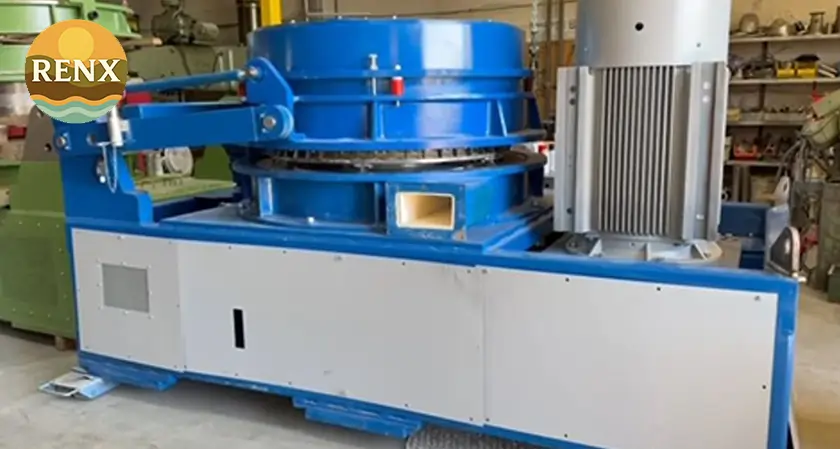
Management continues identifying the Microtec UTM 1200 Turbo Mill as the single largest operational catalyst remaining in 2026. The system, operating under an exclusive U.S. licensing structure, is designed to process woody biomass into highly consistent engineered soil substrates and specialty growing media at industrial scale.
That matters because modern agriculture increasingly depends on consistency rather than commodity sourcing alone.
Greenhouses, nurseries, controlled-environment agriculture operations, and engineered growing systems rely heavily on repeatable input performance. Once production systems begin prioritizing standardization at scale, the infrastructure supporting those inputs becomes significantly more valuable.
And global supply chain pressure continues reinforcing that reality.
Roughly one-third of global fertilizer trade still passes through the Strait of Hormuz, highlighting how exposed agricultural systems remain to concentrated global chokepoints and fragile international logistics corridors. While fertilizer and engineered growing media occupy different layers of the agricultural supply chain, the broader lesson remains the same: localized systems capable of operating with greater control become increasingly valuable when geopolitical pressure rises.
That environment strongly favors domestic processing infrastructure.
RenX appears positioned directly inside that trend.
The company’s multi-year hauling agreements, expanding route utilization, industrial intake relationships, and commercialization efforts tied to the Microtec platform now appear to be converging into something much larger than a traditional small-cap agricultural processing story. Feedstock intake is expanding. Logistics margins are improving. Throughput is scaling. Processing capability is becoming more sophisticated. Commercial validation is advancing.
And for the first time, the leverage inside the operating model is becoming visible in the financial results.
That may ultimately become the most important development investors are still underestimating.
Because, despite the recent strong quarter, RenX still largely trades within the valuation framework of a small-cap environmental processing company. Yet the infrastructure footprint forming beneath the business increasingly resembles a regional industrial network built around repeatable flow, localized processing, and controlled agricultural supply infrastructure.
Markets rarely recognize those transitions immediately. Infrastructure stories tend to reprice gradually, then suddenly, once operational proof begins replacing speculation.
And increasingly, RenX is no longer selling a future concept. It is producing operating evidence.


.webp)