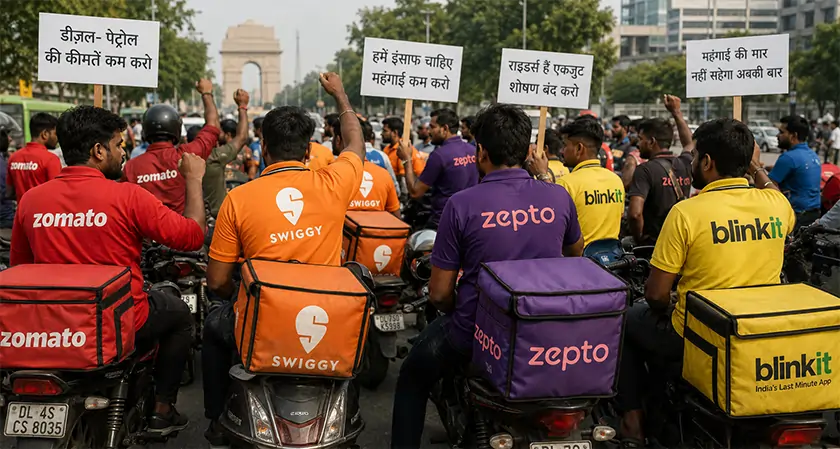
App-based drivers and delivery workers protest low payouts and rising fuel costs, demanding higher per-kilometer service charges nationwide.
-
Gig workers announce nationwide strike over rising fuel prices
-
Delivery and cab services paused from noon to evening
-
Union demands higher per-kilometer payouts for platform workers
-
Rising operational costs intensify pressure on gig economy workers
The Gig & Platform Service Workers Union (GIPSWU) has called for a short-term nationwide strike due to fuel price hike on Saturday in protest of low pay for app-based workers and rising petrol and diesel prices. As part of the protest, the union has called for a nation shutdown due to fuel price hike, asking delivery partners and cab drivers to halt operations from 12 noon to 5 pm.
The strike call follows the centre’s decision to raise petrol and diesel prices by Rs 3 per litre, triggering a fuel price hike strike that impacts gig workers nationwide. In light of the recent unrest in the Middle East, particularly tensions with Iran and worries about possible disruptions in the Strait of Hormuz, the government blamed the revision on increased global crude oil prices.
Nearly 1.2 crore gig and platform workers nationwide, who mostly depend on bikes and other vehicles for their daily lives, are predicted to be severely impacted by the increase, according to GIPSWU.
Union Demands Higher Per-Kilometer Rates
In a statement, the union demanded that the government and app-based companies raise workers' per-kilometer service charges in order to offset rising fuel and maintenance expenses. The rise in fuel, according to union president Seema Singh, is a "direct blow" to gig workers who are already struggling with inflation and rising LPG cylinder costs.
"During the ongoing severe heatwave conditions, delivery workers associated with companies like Swiggy, Zomato, and Blinkit will not be able to bear the impact of rising petrol and diesel prices," Singh stated. A minimum service charge of Rs 20 per kilometer should be declared, she asked the authorities and digital platforms.
The union also cautioned that a large-scale migration of gig workers could result from the absence of immediate financial relief, which would force many workers to leave the industry.
Workers Struggle Amid Rising Expenses
According to National Coordinator Nirmal Gorana, while payout rates from aggregator companies have essentially stayed the same, rising fuel prices have dramatically increased the operational costs for drivers and delivery executives.
He noted that since many gig workers rely solely on motorcycles, scooters and commercial vehicles for their income, they are among the most negatively impacted segments within India's unorganized sector. Gorana claims that despite the intense heat and traffic, workers are working 10 to 14 hours a day.
There were about 77 lakh gig workers in India in 2020 to 2021, according to industry estimates from NITI Aayog; by 2029 to 30, that number is predicted to surpass 2.3 crore. Drivers and delivery executives associated with services like Zomato, Swiggy, Blinkit, Zepto, Ola, Uber, Rapido, Porter and Amazon Flex continue to bear the burden of growing fuel and maintenance costs without receiving corresponding pay increases.
Gig workers may quit platforms if fuel prices and low payouts keep rising, which would result in shortages, service interruptions, and higher delivery costs across the country.
Thus, Business Fortune is of the view that rising fuel costs and stagnant payouts could deepen challenges across India’s gig economy.


.webp)