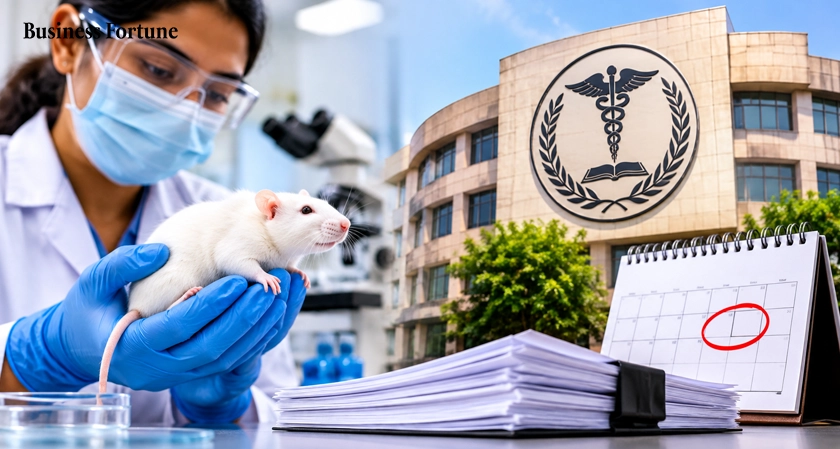
NMC animal experiment rules draft goes to medical colleges for comments, with a 30 day window.
Medical institutions across India have been asked to give feedback on these draft laboratory animal regulations within 30 days.
Summary
A public notice issued by Dr. Raghav Langer, NMC secretary, on November 16, 2026, outlines draft regulations surrounding registration, ethical committees and approvals for animal studies. Feedback on this draft regulation should be submitted to the Committee for Control and Supervision of Experiments on Animals (CCSEA).
What has the NMC asked medical institutions to do?
Medical institutions should consider the draft regulations and provide feedback. Institutions should submit ‘comments/suggestions/objections’ on the draft regulations to the Member Secretary of the CCSEA within 30 days of publication. A copy of this feedback can also be sent to Prof (Dr.) Mahendra Kumar Pant (senior advisor for the NMC). The draft regulations were referred to the NMC by the CCSEA, which operates under the Ministry of Fisheries, Animal Husbandry and Dairying.
What do the regulations propose?
All establishments conducting animal studies or breeding/trading animals for research, will require registration with the CCSEA. All establishments must have an Institutional Animal Ethics Committee (IAEC) consisting of 9 members. Animal studies will be classified as non-recovery, mild, moderate and severe. Mild and moderate animal studies will be approved by IAECs. However, severe and non-recovery animal studies on animals other than rodents and rabbits will be referred to the CCSEA and a decision must be made in 30 working days. All laboratories will require a registry of euthanasia. All studies must be supervised by a designated vet. Studies causing severe extended pain which cannot be minimised are prohibited.
Why are these regulations contentious?
The severity classification for animal studies in this draft regulation and consequently increased decision-making by institutional committees, differs from the 1968 and 1998 regulations. This change may lead to a ‘significant reduction in protection currently provided to animals’, according to PETA and other animal rights groups. However, ETV Bharat states that this package provides stricter regulation, requiring ethical review and humane endpoints. General public feedback was due by November 5.
What do the regulations mean for medical institutions?
Animal studies for teaching in laboratories may be approved by the IAEC for up to 5 years. However, if there is a significant change in animal species, number, severity or type of study, new approval should be obtained. If an institution performs animal studies, or keeps animals for animal studies, then they must be registered with the CCSEA. Registration must be renewed every 3 years as well as reforming their ethics committee.
Further Information
- Notice reference: G.S.R. 864(E), dated September 30, 2026.
- The notice can be found on the NMC website under 16th November, 2026.
- Animals must follow the 3Rs in these experiments. Where possible, animals should be replaced with alternative methods, numbers reduced and methods refined to reduce suffering.
- IAEC members include a biologist, 2 scientists from different areas of biology, a vet and the head scientist of the animal facilities. Representatives from the CCSEA are also included in this committee.
- The IAEC must meet at least twice per year. There must be a quorum of 6 people, including the key representative from the CCSEA and the socially aware representative.
- Animals protected by the Wildlife (Protection) Amendment Act, 2022 cannot be used in these studies. Exceptions to this rule are very limited.
- Certificates of registration last for 3 years.
- If deficiencies are found in laboratories, the CCSEA can notify the establishment and they must make improvements in 15 days. Registration can be suspended or cancelled. If an appeal is made, it must be sent to the secretary of the administrative ministry within 30 days.
- Animal studies in Physiology and Pharmacology have been retained in the NMC’s draft regulations on postgraduate medical education in 2023. However, non-animal alternatives are encouraged wherever possible.
Business Fortune believes, behind every line of these draft rules is a living creature that feels fear, pain and comfort. Medical colleges now have 30 days to tell the CCSEA how animals should be housed, sourced and cared for and their answers will shape how gently or how harshly, those animals are treated. Supporters point to better records and veterinary supervision. Critics worry that handing approvals to institutional committees could thin out protection. Whichever side you stand on, the case for compassion holds: where a kinder method exists, use it and where an animal must be used, treat it with care at every step.
Frequently Asked Questions
1. What are the NMC animal study regulations?
They are draft regulations regarding laboratory animals, published by the centre via the CCSEA and passed to medical institutions for feedback.
2. How long should feedback be sent within?
Feedback should be sent within 30 days of the public notice being published by the NMC on 16th November 2026.
3. Who published the draft Prevention of Cruelty to Animals Regulations, 2026?
They were published by the CCSEA, operating under the Ministry of Fisheries, Animal Husbandry and Dairying on 30th September 2026.
4. Who approves animal studies in this regulation?
Mild and moderate animal studies are approved by IAECs. Severe and non-recovery studies in animals other than rodents and rabbits are referred to the CCSEA.
5. Are these regulations relevant to teaching laboratories in medical institutions?
Yes. Animal studies for teaching and professional training are included. Curriculum based studies may be approved by IAECs for up to 5 years.
Sources
Medical Dialogues · Mongabay India · ETV Bharat · National Medical Commission


























.webp)




.webp)


Comments