
Trump’s remarks on France’s protests, rising prices and immigration spark controversy as his warning about Paris’s future intensifies Europe’s border security debate.
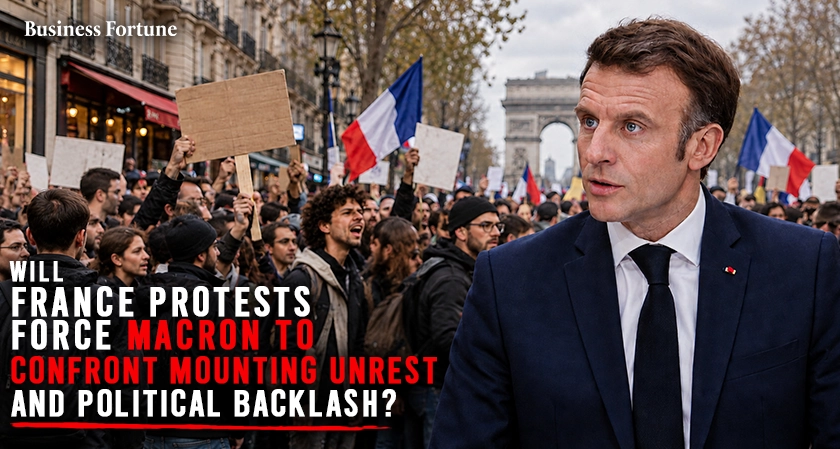
US President Donald Trump has once again blamed France immigration policies for recent protests and violence, urging French President Emmanuel Macron to tighten border controls. On Monday in an interview in Washington, Trump claimed that immigration was the main reason behind the unrest, and ignored any other possibilities. These statements have brought up new concerns regarding immigration, security and the strategy used by Europe for border protection, which includes controversial statements like calling Paris “a Muslim city.”
Trump Blames Immigration for France Unrest
The US President Trump criticized the immigration policy of France following protests in France over price increases. There were reports that some of the protests turned violent, pointing out to the issues facing the country economically and politically.
“What’s happening in France has to do with immigration, not schools, not anything,” Trump told reporters, repeating comments he had made a day earlier.
The US President also referred to his previous discussion with Macron, stating that he had tried to convince the French president not to allow people from all over the world into their country. Trump wanted France to tighten its borders and viewed tighter immigration policies as the solution to the riots.
The protests also had financial concerns attached to them, while Trump’s argument that the root of the problem lay in immigration was not proved by his statements.
‘Paris Muslim City’ Comment Fuels Controversy
Trump escalated his attack on France by declaring “Paris will be a Muslim city very soon.” In this way he tied his issues about immigration to larger concerns about religion and changing demographics in France.
“Paris Muslim City” has emerged as the centerpiece of the controversy in relation to his statements. Nevertheless, the forecast is a product of political rhetoric on the part of Trump.
There are many religious and cultural groups in France, which runs a secular system politically. These statements are expected to generate more debate on the issue of the Muslim community in France, the question of integration, and immigration in Europe.
Also, Trump said that Europe could be finished unless countries closed their borders and eliminated criminals. This statement implied a link between enforcement of immigration laws and public security but failed to prove that the events were related to immigrants.
Macron Faces Pressure Over European Border Security
Immigration enforcement is one of the core promises of Trump’s political agenda even within his 2024 presidential campaign. Immigration rhetoric used by Trump has been criticized on the grounds of exploiting fear of race and culture by his opponents.
For Macron, immigration remains part of a broader political challenge involving border management, financial pressures, public security and social cohesion. European governments must balance immigration enforcement with asylum obligations and domestic concerns.
The most recent statements highlight the distinctions between Trump’s strict immigration policy and the challenges faced by France. As the debate over France immigration unfolds, it is essential to know the proven reasons behind the protests.
Thus, Business Fortune believes that balanced immigration policies and fact-based dialogue are essential to addressing France’s ongoing social and political challenges.
FAQs
Why did Trump blame France immigration policies?
Trump argued that immigration was responsible for the recent unrest, although the demonstrations also involved economic concerns.
What did Trump say about Emmanuel Macron?
He claimed he had previously urged Macron to tighten France’s borders and restrict immigration.
Why did Trump describe Paris as a potential ‘Muslim city’?
He used the phrase to express concerns about immigration and demographic change, without providing evidence for the prediction.
What prompted the protests in France?
Demonstrations included concerns over soaring prices, and some reportedly escalated into street violence.
What does the controversy mean for European immigration policy?
It highlights ongoing disagreements over border security, migration, integration, public safety and national identity.


.webp)




























Comments