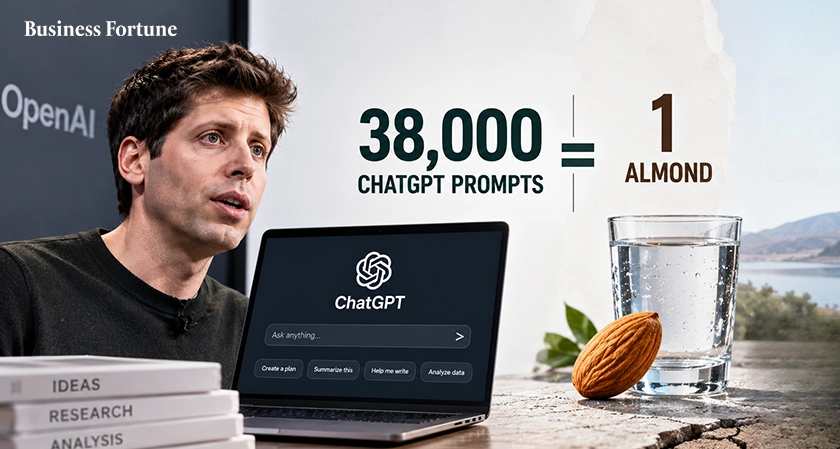
Sam Altman’s claim is fueling a new AI water debate as data centers consume billions of liters of water. But how serious is the problem, and can emerging cooling methods help?
Sam Altman, CEO of OpenAI is challenging the criticism regarding the use of water in AI data centers, arguing that it is not credible. This is after reports that the state of California may soon require data centers to reveal how much water they consume.
In the interview on the Sources Podcast with Alex Heath, Altman stated that 38,000 ChatGPT requests consume the same amount of water as producing an almond in California. He also compared the water use of a modern large data center with that of an office building, mainly referring to everyday use such as sinks and toilets. Experts say the bigger problem is the lack of public information about how much water individual data centers actually consume.
“The information we have is so limited,” said Shaolei Ren, a professor of electrical and computer engineering at the University of California, Riverside.
The issue is important since a 100MW data center uses approximately 2.5 billion liters of water per year, which equals the usage of 5,000 or more homes.
Why Do Data Centers Need So Much Water?
Much of the water is used to remove heat from servers. Direct evaporative cooling is popular due to its ability to eliminate heat in significant amounts at relatively lower costs, and requires lesser electrical power compared to certain other methods.
However, all the water involved in the process gets converted to vapor and escapes from the system. The remaining water may contain minerals that make it unsuitable for further use until treatment.
Could Data Centers Recycle More Water?
Yes, data centers can recycle more water but there are practical challenges. Closed-loop and hybrid cooling systems can reduce water intake by circulating fluids through sealed systems. Operators can also treat wastewater and blowdown using filtration, softening or reverse osmosis. Another option is using treated residual water for purposes such as irrigation or toilet flushing.
For now, these solutions can be expensive and add operational complexity. That could change as water becomes more expensive, shortages increase and governments introduce stricter water rules.
OpenAI Entering the AGI Era
As Business Fortune observes, the water debate comes alongside an even bigger claim from OpenAI president Greg Brockman, who said the company may have entered a new era of Artificial General Intelligence (AGI) following the release of its latest model, Astra.
Brockman said, “I think it’s going to be about this time, and I think it might be about this model.”
OpenAI says Astra can support scientific discovery, mathematics and health, while also handling tasks such as tax returns, game development, architectural visualizations and job searches. Sam Altman, however, has previously called AGI a poorly defined term and questioned its value as a label.
AI technology, which is developing at an increasing speed, will continue to develop but safety and efficiency of resource usage will remain as a major problem. As AI becomes more and more powerful, firms and companies may face an increasing pressure to demonstrate and prove that their technology has the capacity to develop without excessive water usage or reduced safety standards.


.webp)
































Comments