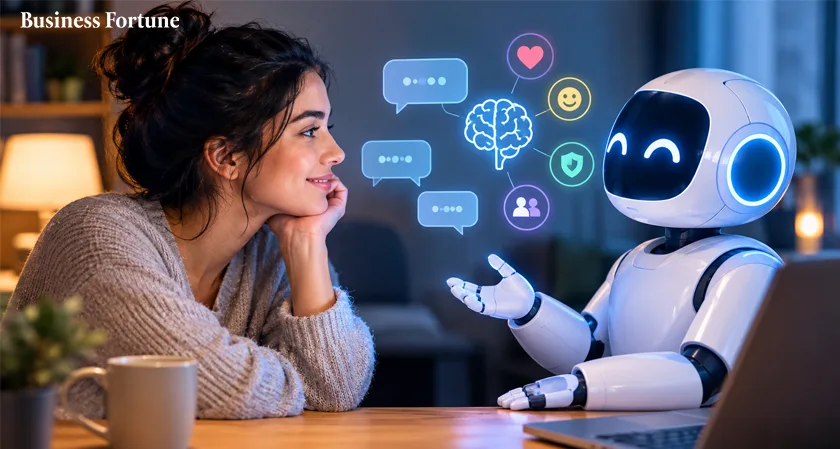
Why do we trust chatbots so easily? Explore Chatbot Trust Psychology and discover the psychology behind the human habits that make AI feel so convincing.
We know Chatbots are machines, yet somehow, we still talk to them every single day. We ask a chatbot to explain an email. Then we ask for dinner ideas. Then, somehow, we are telling it about our terrible Monday. Five minutes later, the chatbot knows more about us than our actual friends do. So, why do we trust chatbots? Chatbot Trust Psychology helps explain why we trust AI more than we should even when we have not checked if it is actually right.
This Business Fortune article explores Chatbot Trust Psychology by understanding the simple human psychological patterns and why we sometimes trust AI so easily.
Psychology of Chatbot Trust
As humans we are naturally programmed to react to any entity that is communicating with us. In this case, when an AI model like ChatGPT, Gemini, Claude and others, understands the background of a conversation and replies with phrases like “I understand” we automatically react in our usual manner and start to trust them.
Psychologists refer to this as anthropomorphism, which means giving human qualities to something that is not human. We already do it with pets, cars and computers. People apologize to their laptops when they freeze and yell their Wi-Fi router as if it intentionally chose the worst possible moment to stop working.
Another study from September 2026 further illustrates how extensive this problem has become. In an analysis carried out by researchers at Frontiers in Psychology, it was discovered that people rely on conversational AI to assist them in tasks, to engage in cognitive offloading, companionship, self-disclosure, and mood regulation. The review also identified links between heavier dependence and factors including anthropomorphic tendencies, loneliness and weaker critical-thinking patterns, although much of the evidence remains correlational.
Then there’s the “ELIZA effect.” This name derives from a computer program known as ELIZA, invented in the 1960s by Joseph Weizenbaum, a computer scientist. ELIZA used very basic forms of conversation that mimicked those used by therapists, but sometimes people would respond as though ELIZA really did understand them. This was a shock to Weizenbaum, as it showed how humans can project understanding onto machines.
This helps explain why people trust Chatbots even when they know perfectly well that the chatbot is software.
Why People Form Emotional Connections with Chatbots
Chatbots are available at almost any hour and it is the easiest to talk to. Chatbots do not roll their eyes, interrupt you, change the subject or say, “Can we talk about something else?” whereas it responds quickly, remembers what you said long ago and never makes you feel embarrassed about asking a silly question. That is part of the appeal and that’s why People are attached to Chatbots. For some users, that can create a sense of companionship. Studies have been conducted on human & chatbot relationships which have revealed that humanlike characteristics, authenticity, and frequent interactions may lead to emotional bonding.
The findings of the study conducted in August 2026, involving 7,027 individuals from Germany, China, South Africa, and the US, revealed that over one-third of the participants showed attachment behaviors towards Chatbots with the emotional support, decrease in loneliness, and freedom from judgment being the most prominent of them all.
The human psychological mechanism is not complicated, it is in fact simple that humans like responsiveness and people often reveal more when they believe they are talking to a non-judgmental listener, it is called disclosure effect. The psychological experience of “someone is listening” can be very powerful, even though the listener is an AI system.
But there is a catch. A chatbot can simulate empathy without experiencing empathy. It can produce the words associated with caring without having a personal life, feelings or human relationship with the person using it, that might be feel like a betrayal for the deeply attached ones.
That does not mean everyone who chats with an AI becomes emotionally attached. Plenty of people use ChatGPT exactly like a calculator with better grammar. But the possibility of attachment is real and scary.
AI and Human Behavior
People only trust other people when they sound confident. We may also engage socially with the technology that appears friendly, helpful, or knowledgeable and this is exactly why people believe chatbot responses. This concept is called the Computers as Social Actors (CASA). The CASA theory suggests that users treat their computers as social beings even when they know the technology is something non-human.
If something is spoken in a way which seems confident, knowledgeable and helpful, our brain starts considering it as a reliable source without even verifying. This creates a simple psychological shortcut. When a chatbot sounds smart and certain, we may believe it without checking the information first. It is a bit like Google Maps. We usually follow its directions without questioning every turn. But with Chatbots, confident words can feel like they come from a confident person, but they do not.
How AI Chatbots Affect Human Decision Making
This is where trust in AI Chatbots becomes more complicated. People are using AI to choose products or understand complicated topics which can sometimes be genuinely useful. They are also asking it about their health, uploading medical reports, and asking what their test results might mean, almost as if they were speaking to a doctor.
A 2026 Washington Post report found that nearly one in three Americans had used Chatbots for health information. Some users were uploading medical records and asking AI to explain test results or symptoms.
There have also been worrying cases. In July 2026, a man in Florida filed a lawsuit against OpenAI due to the medical advice provided by ChatGPT which had kept him away from receiving any treatment that ultimately resulted in a life-threatening pulmonary embolism.
Similar incident happened back in 2024 when a Florida mom, Megan Garcia, filed a case against Character.AI and Google because her 14-year-old boy had died due to some interactions with a Character.AI chatbot.
Confirmation Bias and Cognitive Offloading
Suppose a chatbot confirms something you already believe. You may feel even more confident because the answer arrived instantly and sounded logical. That is the psychological trap called confirmation bias. People naturally pay more attention to information that supports what they already think. A chatbot can accidentally become an extremely polite yes-machine if someone keeps asking questions until they get an answer they like. This is where AI chatbot psychology moves beyond curiosity and into everyday life.
But people can also fall into cognitive offloading, where they allow a technology to handle part of the thinking process instead of doing it themselves. There is nothing automatically wrong with offloading. Nobody wants to calculate every percentage manually when a calculator exists. The concern appears when people stop checking the answer because the machine sounds convincing.
Very recent 2026 reporting also shows that Chatbot trust is becoming a practical issue, not just a psychological curiosity. A Financial Times test published found major AI Chatbots gave incorrect answers to financial questions 57% of the time in its test set, highlighting the gap between sounding convincing and being correct.
An AI that constantly tells you that you are right can feel wonderful, but that can stop you from thinking.
The Funny Little Trick Our Brains Play
Psychology behind AI trust is that we are social creatures, and our brains are extremely good at finding meaning in things that communicate with us. Chatbots happen to be very good at giving our brains the signals they are looking for. The psychology behind AI trust comes down to several familiar human tendencies working together.
-
We respond to human-like language.
-
We trust systems that appear competent and sound confident
-
We become comfortable with familiar tools.
-
We disclose more when we feel less judged.
-
And we naturally look for confirmation of what we already believe.
Chatbots can trigger several of these behaviors at once. That is why a conversation with AI can feel surprisingly different from typing a question into a search engine. A search engine gives you pages. A Chatbot gives you a conversation and humans are built for conversations.
Use a Chatbot to brainstorm a birthday party? Fine.
Use it to explain a complicated concept? Helpful.
Use it to challenge your assumptions? Even better.
When it is about your health, money, legal matters, or something personal, a smooth AI answer should not make any final decision. No matter how intelligent the bot sounds, there will always be some possibility that it may get something wrong. Sometimes, it might be wise to just stop and verify the information, realizing that an AI tool is not an individual that always knows the truth.
FAQs
What is Chatbot Trust Psychology?
Chatbot Trust Psychology examines why people develop confidence in conversational AI and how factors such as anthropomorphism, perceived competence, familiarity and emotional responsiveness influence that trust.
What is the ELIZA effect?
The ELIZA effect describes people's tendency to attribute human understanding, emotions or intentions to computer systems that use human-like conversation.
Can people become emotionally attached to AI Chatbots?
Yes. Research has documented emotional attachment to social Chatbots, particularly when users interact frequently and perceive the chatbot as human-like, responsive and accepting.
Why do people believe chatbot responses?
Fluent language, confident wording and the appearance of expertise can make information feel credible. This can sometimes lead people to overlook the need to verify an answer.
Are Chatbots actually trustworthy?
Their usefulness depends on the task. They can be valuable for brainstorming, learning and everyday assistance, but important information should be checked against reliable sources or qualified human experts.


.webp)



























Comments