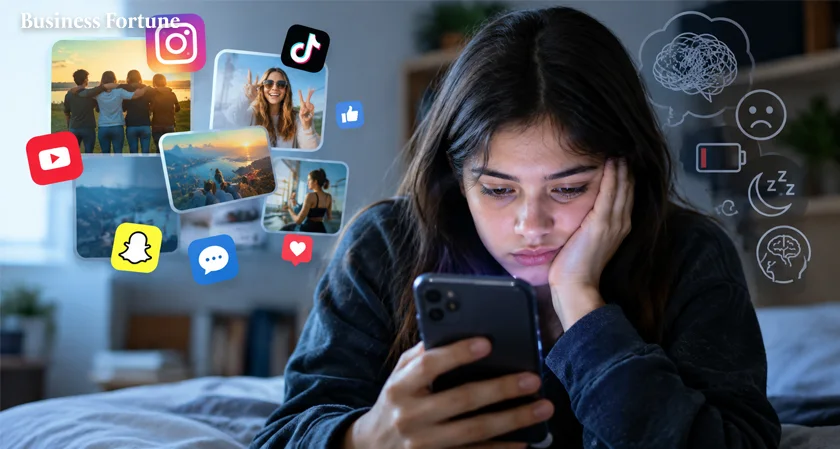
What happens when a five-minute scroll quietly becomes an everyday habit? Explore how social media can influence sleep, focus, emotions, and daily life.
You pick up your phone for five minutes. You open Instagram, watch one Reel, then another. Someone is travelling, someone has started a business, someone looks unbelievably happy and someone else seems to have the perfect body, friends and perfect life. You keep scrolling. Suddenly, thirty minutes have disappeared. Sound familiar? Now imagine doing this every day without really noticing how much time is passing.
This is where the discussion about the negative effects of social media on youth becomes particularly relevant. Social media is not the evil itself. Rather, it can be used by adolescents to communicate, study, create, find opportunities, pursue their interests and remain connected with those who matter to them. What is harmful in it is the development of a scrolling habit, which becomes impossible to control and online validation impacting how adolescents perceive themselves.
Many youths find themselves engaging in social media usage without realizing the amount of time they are spending on these applications. Social media usage can have negative effects on an adolescent’s sleeping patterns, concentration levels, academic performance, interactions and even regular activities. The solution lies in proper social media usage. Business Fortune analyzes the problem and possible methods of achieving maintain a healthier balance.
What are the negative effects of social media on youth?
The use of social media may affect the lives of young people in their habits, relations, emotions, focus and attention. This influence is different for each individual, but difficulties may arise in cases where online use starts to replace sleep, studying, exercise, leisure, talking or privacy.
The problem is not really about one specific application. The question is how much time, what kind of content is being viewed and the emotion associated with scrolling through the screens.
The youth may open Instagram because they are bored. They might have scrolled through Instagram due to feeling lonely. The youth might be checking the mobile continuously just for the sake of receiving some sort of affirmation from friends.
Some common concerns include:
-
Reduced concentration during school or study time
-
Delayed sleep caused by late-night scrolling
-
Increased comparison with other people's lives
-
Pressure to receive likes, comments or followers
-
Exposure to unrealistic lifestyles and beauty standards
-
Less time for offline relationships and activities
-
Difficulty staying away from the phone even when there is no real reason to use it
The crucial point is that social media does not necessarily cause harm to individuals. This is an alarm bell when social media becomes something that controls your life rather than something you can just do.
Why is the hidden cost of infinite scroll so powerful?
The Hidden Cost of Infinite Scroll is not simply the amount of time spent on a phone. This can be seen from how easily people get lost track because there is new content at all times. Unlike television shows or films where there is a natural end to them, there is no clear end when it comes to a social media feed.
The Cost of the Infinite Scroll goes beyond the time you spend on your cell phone. The thing is that it gets easier for a person to lose track of time since there will always be something new to look at. Unlike watching a TV show or a movie, where there is an ending, there isn’t any in social media.
This will be the case for younger people who will make this habit a part of their daily routine. For instance, a few minutes taken for browsing during a break can increase to half an hour, whereas browsing on social networking sites before going to sleep will result in staying up late at night.
Another issue that exists is that people might keep on watching even if they are not really interested anymore. A teenager may get into Instagram out of boredom but will start watching Reels and continue scrolling through the app because new content keeps popping up.
The real issue is whether social media remains a choice or starts becoming an automatic habit. Recognising that difference can help young people set healthier limits and develop better digital habits.
What are the signs of social media dependency?
Identifying signs of social media dependency early on makes it easier to kick the addiction. Addiction is not just about using social media often. One can use the Internet without being addicted to it. It is only when one repeatedly tries to cut down the use of social media but fails to do so that things become worrying.
Possible signs include:
-
Checking the phone immediately after waking up
-
Feeling uncomfortable or restless when unable to access social media
-
Repeatedly checking notifications without a clear reason
-
Using social media during study, meals, conversations or other activities
-
Choosing scrolling over sleep
-
Feeling upset after comparing personal life with online content
-
Continuing to use social media despite noticing negative effects
Use of social media is considered problematic when it impacts your sleep, concentration, relationships or daily activities. Not being able to stop using social media or constantly checking your phone are some warning signs.
How does smartphone addiction affect mental health?
There is a relationship between smartphone addiction and mental well-being because phones offer endless entertainment, connection, information and interaction. Addiction or excessive usage of smartphones is linked to such a pattern: one gets bored or stressed, uses a phone to receive some stimulation, gets distracted for a little while and again reaches for a phone whenever an unpleasant feeling arises.
That does not solve the original problem. It simply postpones it.
This could become especially significant in the case where social media is used as a means to cope with feelings of loneliness, stress, insecurity and boredom among young people. This is because whenever there is an uncomfortable feeling, the first thing that happens is the engagement of a screen.
It is important to note that the use of social networking sites does not automatically lead to the development of mental health. There are numerous things which affect an individual’s mental state such as the family life, education, sleep, exercise, personality type and other issues.
How does teen social media addiction affect mental health?
Teen social media addiction mental health have become an important concern as social media plays a bigger role in how young people communicate and spend their free time. Teenagers become more preoccupied with their friends, their looks, their popularity and what others think about them naturally in their development process. This constant social media exposure may exacerbate such worries.
The teenager will look at pictures on Instagram and see that their peers are having fun, that some influencers are traveling, spending money, accomplishing things or posting filtered pictures. The life of this teenager can become boring after some time if nothing is wrong with it.
This is when the distinction between real life and social media life makes all the difference. One will not share everything that happens to them but rather select events. This is because influencers invest a lot of time in planning, shooting and preparing their content for sharing.
For teens, constant comparison can bring about unneeded stress in regards to looks, lifestyle, relationships and success. Instead, it is better to understand that social media presents only a certain segment of the life of the other individual. This way, the teens can use social media for entertainment without letting it affect their perception of life.
What does social media do to adolescent brain development?
There are a number of things to consider regarding the effects that social media impact on adolescent brain development. During this developmental period, the brain is undergoing significant changes in terms of its ability to make decisions and regulate attention, emotions and reward-based behavior.
This is not to suggest that social media will harm all teens permanently. Instead, what is more important is for them to cultivate good digital habits by taking breaks, sleeping well, concentrating on studies and staying off screens.
How can young people break social media addiction?
Understanding how to break social media addiction does not involve removing all your accounts. Most of today's youth cannot do without social media when it comes to communicating and entertaining themselves, thus they need to learn how to manage their technology use better.
Start by making small changes. Try having phone-free times when you eat, study, talk with your family and at bedtime. Not receiving unnecessary notifications is one way to stop the temptation of constantly checking your phone.
It can also be made harder to scroll through apps by removing social media apps from the home screen, logging out or setting up time limits for screen use. The importance of getting enough sleep cannot be overstated, as scrolling at night could easily become a habit.
It may also be helpful to replace the habit. If boredom makes you turn to Instagram, do something else like reading, walking, drawing, listening to music, playing sports or socializing with your friends. It is important to cultivate your feed by unfollowing accounts that cause unnecessary stress and comparisons.
Before opening an app, stop and ask yourself what you are going to do with it. If there isn’t a clear reason to do so, wait a couple of minutes. Such decisions will slowly create better practices for yourself.
Why do Instagram Reels feel impossible to stop watching?
Instagram Reels may quickly transform an intermittent break into a prolonged period of scrolling. Each video ends right away with the next one beginning, so there is no motivation to cease unless the person decides to do so. This is particularly likely to happen if the person opens up the app for reasons of boredom or habit.
Reels are not always a source of trouble. They can actually be fun, engaging and innovative. However, the trouble begins when scrolling turns into an unconscious act that consumes valuable time meant for sleeping, studying or doing something else. Setting a time limit and making a break is useful in keeping Reels entertaining.
What will the future of social media look like for young people?
Social media is set to evolve further in light of newer platforms, short form content and artificial intelligence becoming an integral part of digital life. This makes it all the more necessary for youth to learn the skill of managing attention.
While screen time reduction is one of the major considerations, it is also important to pay attention to social media use itself. The latter may serve as a source of fun, knowledge, creation and communication; however, it must not substitute for sleep, studying, relationships with friends and family and hobbies.
Thus, Business Fortune believes the future will call for a healthier relationship between online and offline activities. Youth should be able to participate in social media activities and not be compelled by the need to check and compare themselves with the virtual world they get to see. The principle is straightforward; participate in social media activities if it adds any value and allow yourself sufficient time offline.
FAQs
Can social media affect a young person’s academic performance?
Yes. Frequent notifications, constant scrolling and difficulty putting the phone away can interrupt concentration, reduce study time and contribute to poor sleep, which may affect learning and academic performance.
Is all social media use harmful for teenagers?
No. Social media can help teenagers communicate, learn, express creativity and discover opportunities. The potential problem arises when excessive or uncontrolled use begins interfering with sleep, studies, relationships or everyday activities.
How can parents help teenagers develop healthier social media habits?
Parents can encourage phone-free family time, discuss online experiences without judgment, establish reasonable boundaries and help teenagers find enjoyable offline activities rather than focusing only on restricting screen time.
Why do teenagers compare themselves with people they see online?
Social media often shows carefully selected moments rather than someone’s complete life. Repeated exposure to polished images of appearance, success, travel and relationships can make online lives seem more perfect than they actually are.
What is the simplest way for young people to reduce unnecessary scrolling?
A useful starting point is to pause before opening an app and identify a clear reason for using it. Turning off unnecessary notifications, setting time limits and keeping phones away during study and bedtime can also help.


.webp)
































Comments