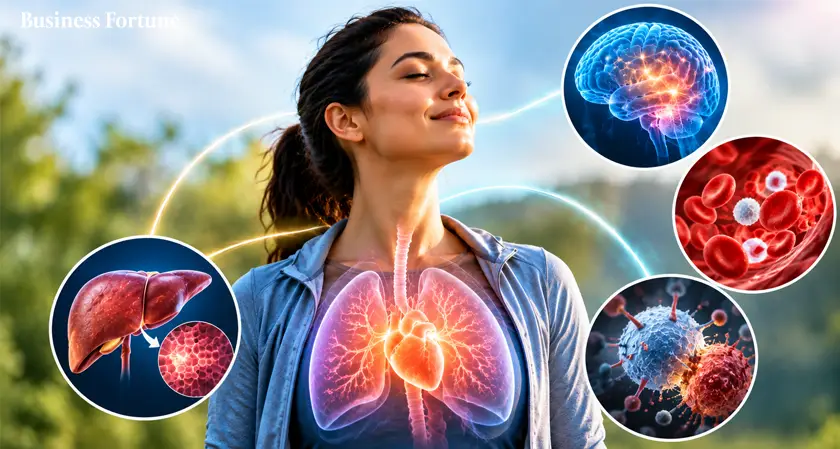
The body's natural healing process is much more complicated than just closing a wound. Everything from repairing DNA in individual cells to rebuilding a fingertip, renewing the lining of the intestines and remodeling microscopic damage in the bone consists a host of repair processes that happen frequently, often below our awareness.
The body is capable of repairing much more than you might expect. When most people think of the body's ability to heal itself, they think of the common processes: a cut healing, a bruise fading or a broken bone knitting itself back together. While true, those are only some of the most common examples. Some of the most remarkable body’s natural healing process examples happen at a microscopic or unexpected level.
Natural healing mechanisms say something important about how the body recovers naturally. Sometimes your body is repairing damaged cells. Sometimes it is remodeling. Sometimes it is compensating for damage by rearranging its function. And on rare occasions, it can regenerate structures previously thought impossible for humans to regrow.
That is where human body repair mechanisms become genuinely fascinating. It takes place on all levels from individual molecules to entire organs and systems.
- Your cells constantly repair damaged DNA
One of the most astonishing examples of natural healing mechanisms doesn't actually involve a visible wound. It takes place inside your cells.
DNA is exposed to damage on a regular basis, both from internal processes like normal metabolism and from external factors like ultraviolet light. The National Cancer Institute (NCI) lists several repair pathways that cells use to detect and respond to various forms of DNA damage, either repairing the genetic code or stopping the cell from dividing further. These include base-excision repair, nucleotide-excision repair, mismatch repair and pathways for repairing broken DNA strands.
Think of it as molecular maintenance. A cell doesn't just ignore all errors that take place in its genetic code. It has surveillance mechanisms that detect problems and trigger appropriate responses. Some damage can be repaired. More serious damage can trigger checkpoints or programmed cell death.
Of course, DNA repair isn't always effective. Persistent or incorrectly repaired DNA damage can lead to a variety of diseases, including cancer. The very existence of powerful repair mechanisms should therefore be considered protective, not an unlimited defense.
- Your intestinal lining practically rebuilds itself
The inside of your intestine is exposed to an uncommonly challenging environment. It has to withstand food, digestive chemicals, mechanical friction and an immense population of microorganisms.
The protective lining of the intestine is replaced frequently.
"The intestinal epithelium is a highly renewed tissue that turns over every five days or so," notes the U.S. National Institute of Diabetes and Digestive and Kidney Diseases (NIDDK). The intestinal epithelium is a layer of cells that lines the inside of the intestines. Intestinal stem cells located in specialized pockets called crypts, create new epithelial cells that replace older cells.
This makes the intestine one of the most striking examples of the body's natural ability to recover from minor injuries, except that much of that repair takes place as regular maintenance and not because of a dramatic injury.
The process is remarkably dynamic. Cells are created, moved into position, perform specialized functions and are then shed.
This is the body's natural recovery on an almost industrial scale. It also shows an important difference: the body doesn't always repair tissue by forming a scar. Some tissues have evolved to be able to efficiently replace their cells, allowing for normal structure and function to be retained.
- The stomach repeats the process while surrounded by acid
The stomach presents a kind of paradox. It needs powerful acid and digestive chemicals to function, while it also needs to protect itself from them.
One solution is a constantly maintained mucosal defense system. The lining of the stomach employs a series of measures, including mucus, bicarbonate, blood flow, cellular defenses and rapid replacement or movement of epithelial cells, to maintain protection. When superficial damage occurs, surviving epithelial cells can migrate across the injured site to a process called restitution.
In other words, the stomach doesn't simply build a wall and leave it alone. It constantly monitors, protects and repairs that barrier.
This is an unusual example of natural healing mechanisms because the tissue is repairing itself while simultaneously performing the function that can contribute to the potential threat.
Studies of gastroduodenal mucosal repair have identified superficial injuries that can be repaired rapidly, while deeper injuries require more extensive regeneration.
- Some human fingertips can actually regenerate
This is perhaps the most surprising example of the lot.
Humans are comparatively limited in their regenerative capacity compared to animals such as salamanders. But the very end of a human finger is an exception.
Distal fingertip injuries can actually regenerate substantial amounts of tissue under the right circumstances. Clinical literature has documented regrowth of skin, nail structures and even bone following particular distal fingertip amputations, especially when the injury is far enough towards the fingertip.
A particularly interesting recent primary study published in npj Regenerative Medicine in 2025 followed 22 people with fingertip amputations treated using a protective silicone finger cap. Researchers identified four recognizable phases of regeneration - coagulation, hypergranulation, proliferation and epithelialization - and reported regeneration of subcutaneous tissue, nail bed and skin and excellent outcomes within the study group.
That finding makes fingertip regeneration one of the most intriguing examples of natural healing in humans.
But there is an important caveat. This isn't evidence that humans can regenerate arms or legs. Regeneration depends heavily on the location and nature of the injury. More proximal amputations tend to heal through conventional repair and scar formation rather than true regeneration.
- Your bones repair microscopic cracks you never notice
You don't need to break a bone for your skeleton to experience damage.
Normal daily activity puts mechanical stress on the bones. As a result, microscopic cracks can develop. Rather than allowing this damage to occur indefinitely, the bone constantly remodels itself.
Specialized cells called osteoclasts remove old or damaged bone, while osteoblasts build new bone. Osteocytes, which reside in the bone, assist in coordinating the remodeling. Studies of the bone's repair mechanisms have also demonstrated that bone has an ability to detect and respond to microdamage, preventing small defects from accumulating into serious structural problems.
This is one of the clearest human body repair mechanisms that most people never think about.
You could walk, climb stairs or exercise for years without knowing that tiny bits of your skeleton are being repaired and remodeled.
- The brain can recover function by rewiring.
The brain has a more unusual healing challenge. When neurons are lost following a severe injury such as a stroke, the adult human brain generally cannot regenerate large areas of destroyed neural tissue. Yet some individuals can recover functions after surviving neural circuits reorganize themselves.
This is termed neuroplasticity.
NINDS notes that the brain can reorganize its circuits and that rehabilitation can help survivors relearn lost abilities following a stroke. Scientific research has demonstrated changes in neural networks associated with recovery, including remodeling and a shift in contribution of surviving brain regions to tasks.
This distinction underlines a difference between structural regeneration and functional regeneration. The brain may not necessarily regenerate the cells that were lost, but surviving networks can adapt, grow new patterns of activity and learn alternative methods of carrying out tasks.
This makes neuroplasticity one of the most sophisticated natural healing mechanisms in the human body.
Importantly, neuroplasticity isn't a reason to think serious neurological injuries will resolve on their own.
- The liver can restore substantial amounts of tissue.
The liver is one of the body's most regeneration-capable organs.
Unlike many tissues that respond to major damage primarily by forming scar tissue, the liver can restore lost mass under appropriate conditions. NIDDK highlights that the liver is unusual in its capacity to regenerate and adjust its size based on the body's needs.
Scientists are still understanding exactly how different populations of liver cells contribute to maintenance and regeneration. Research has demonstrated that the location of a cell in the liver can affect its function and contribution to regeneration.
This illustrates how the liver is an exceptional example of how the body can recover from minor injuries naturally, albeit is not guaranteed to provide immunity from permanent damage.
Repeated injury, chronic disease and extensive fibrosis can impact the normal architecture and function of the liver. Regeneration does have biological limits.
Healing Isn't Always The Same As Regeneration.
One of the biggest misconceptions about healing without medicine is that all healing means damaged tissue is regenerated to be precisely as it was before.
It isn't.
There are at least three kinds of outcomes: repair, regeneration and compensation.
Repair restores structural integrity – often with scar tissue. Regeneration replaces lost tissue with tissue that more closely resembles the original. Compensation allows a system to recover despite the original structure not being completely recovered.
A fingertip can exhibit regeneration. A scarred wound exemplifies repair. Brain recovery after a stroke can involve functional compensation and neuroplasticity.
Knowing the difference adds interest and scientific accuracy.
What Fuels The Body's Natural Repair Systems?
The body doesn't require a "detox" program to activate these mechanisms – most of them are already running.
Appropriate nutrition provides the materials needed for cellular activity. Sleep supports numerous physiological processes and appropriate physical activity provides mechanical signals that can influence tissues such as bone and muscle.
But there isn't any universal lifestyle trick that can guarantee how the body recovers from minor injuries naturally.
Some injuries require wound care. Some fractures require stabilization. Some infections require antimicrobial treatment. Serious neurological injuries require urgent medical attention and rehabilitation.
Business Fortune concludes that the most useful understanding of how the body recovers naturally is therefore not that medicine is unnecessary, it is that medical treatment often works in conjunction with biological repair rather than in place of it.
FAQs
- What is the most unusual example of the body healing itself?
Human fingertip regeneration is among the most unusual documented examples. Certain distal fingertip amputations can recover skin, nail structures and bone especially when the injury is sufficiently close to the fingertip.
- Can the human body repair DNA naturally?
Yes. Cells naturally have multiple DNA-repair pathways that detect and address different forms of genetic damage. These systems run constantly because DNA can be damaged by normal cellular metabolism and environmental exposures.
- Does the intestine actually replace its entire lining?
The intestinal epithelium is very regenerative. NIDDK reports that the inner lining of the gastrointestinal tract completely renews itself every five days, largely driven by intestinal stem cells.
- Can the brain heal itself after damage?
The brain is limited in its ability to regenerate lost tissue, but it can reorganize its surviving neural networks. This neuroplasticity can contribute to functional regeneration after injuries such as a stroke, especially with rehabilitation.
- Does natural healing mean you don't need medical treatment?
No. The body’s natural recovery and medical treatment are not mutually exclusive. The body's repair systems carry out many biological steps and medical care could take away obstacles to healing, control infection, stabilize injuries or assist recovery. Serious injuries and unexplained symptoms should be medically evaluated instead of being left to "heal naturally."


.webp)






























Comments