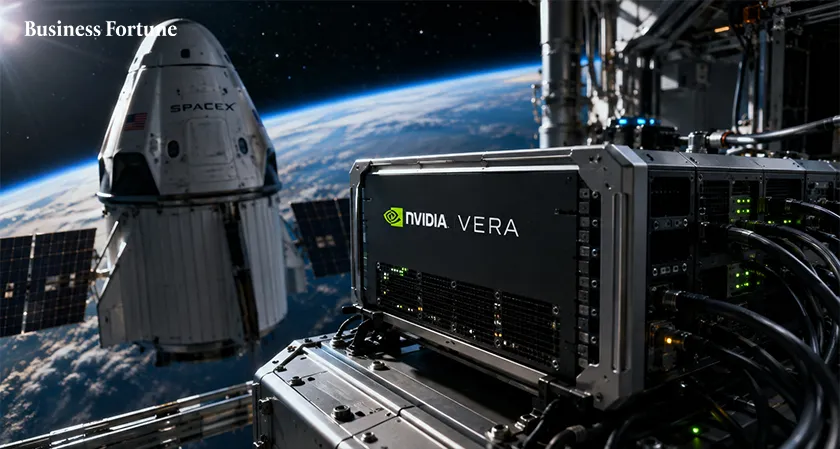
SpaceXAI adopts NVIDIA Vera to handle the growing data demands of AI agents, improve Grok and take AI computing from Earth into space.
SpaceXAI adopts NVIDIA Vera CPUs to increase its next generation of agentic AI applications, by introducing NVIDIA’s CPU architecture for AI agents into one of the company’s most ambitious computing projects. The move is also important for data analytics because AI agents increasingly depend on fast data processing, code execution, simulations, and orchestration between model calls.
AI Agents Need More Than Powerful GPUs
As AI systems become more capable, processing a model’s response is only one part of the workload. Agents need to collect and process data, use external tools, execute code, and coordinate several tasks before reaching an outcome.
NVIDIA says its Vera CPU is designed specifically for this work. It features 88 NVIDIA-designed Olympus cores and high-bandwidth LPDDR5X memory capable of delivering up to 1.2TB/s of bandwidth. NVIDIA claims Vera can deliver up to 1.8x faster task completion than x86 CPUs across workloads including agentic AI, strengthen learning and data processing.
“Agentic AI requires a new kind of computing system, one built not only to generate answers, but to take action,” said Ian Buck, vice president of hyperscale and high-performance computing at NVIDIA.
What Does Vera Mean for Data Processing?
For SpaceXAI, the CPU will handle large amounts of orchestration, code execution and data processing while GPUs focus on the workloads they are best suited for. And the approach could become important as AI systems process increasingly large and complex datasets. Faster movement and processing of information can help reduce delays between different stages of an AI workflow.
Mike Nicolls, president of SpaceXAI, said, “Vera gives us the CPU performance and memory bandwidth to run enormous amounts of orchestration, code and data processing while keeping GPUs doing what they do best.”
SpaceXAI Is Scaling Its AI Infrastructure
SpaceXAI also plans to expand the infrastructure supporting Grok using the NVIDIA Vera Rubin platform as it moves toward gigawatts of computing capacity. Vera Rubin combines accelerated computing, NVLink interconnect technology, Spectrum-X Ethernet networking, BlueField data processing and NVIDIA software in a single architecture.
The company is also taking the technology beyond traditional data centers. Its planned first-generation Starmind AI satellite will use an optimized NVIDIA Vera Rubin NVL72 system.
The Future of Data Analytics Could Move Beyond Earth
As Business Fortune observes, space based computing brings new challenges involving power, thermal management, bandwidth, reliability and physical integration. If SpaceXAI can successfully adapt AI infrastructure for orbital environments, data processing and analytics could eventually happen closer to where information is generated in space.
That points toward a future where AI infrastructure is not limited to terrestrial data centers. From large AI factories on Earth to computing systems in orbit, faster CPUs and data processing could become an increasingly important part of how intelligent systems operate.
FAQs
What is NVIDIA Vera?
NVIDIA Vera is a CPU designed to handle AI agent workloads such as data processing, code execution, tool use, orchestration, and simulations.
Why is Vera relevant to data analytics?
AI agents must process and coordinate large amounts of information. Vera is designed to speed up these CPU-intensive data processing tasks.
How fast is NVIDIA Vera?
NVIDIA claims Vera can deliver up to 1.8x faster task completion than x86 CPUs across selected workloads, including data processing.
What is SpaceXAI using Vera for?
SpaceXAI plans to use Vera for agentic AI applications and to support infrastructure behind Grok on the Vera Rubin platform.
Will NVIDIA technology be used in space?
Yes. SpaceXAI plans to use an optimized Vera Rubin NVL72 system for its first-generation Starmind AI satellite, extending AI computing infrastructure toward orbital applications.


.webp)































Comments