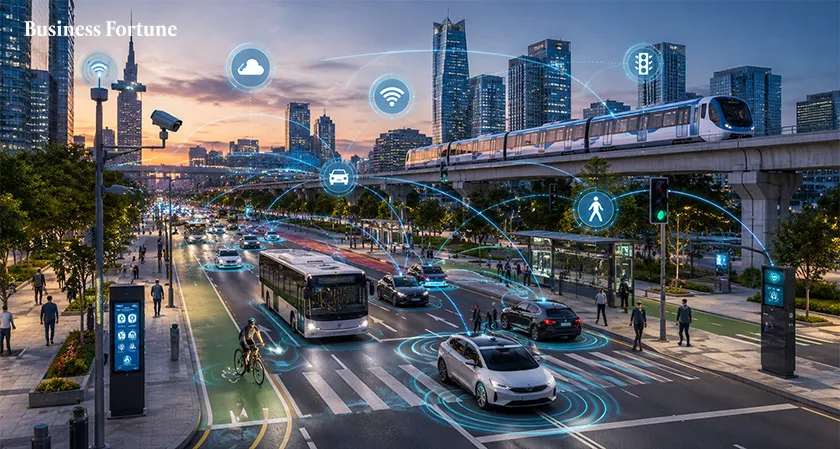
Smart Transportation Systems are transforming urban travel by connecting technology, infrastructure and services to address congestion, safety, efficiency and mobility challenges.
Traffic congestion, road accidents, population growth and the increased burden on infrastructure have led to a rethinking of urban movement. Road expansion may work, but it cannot solve all transportation challenges. The solution lies in a smart and integrated transportation strategy. This is where the importance of Smart Transportation Systems comes in, where all these elements will be incorporated to ensure that transportation becomes more efficient and effective.
For decades, the transport networks relied mainly on schedules, traffic lights, human decisions and infrastructure. Today, due to advances in technology, this process is taking a new turn. Contemporary transport networks are capable of gathering data from cars and roads, analyzing situations and providing solutions accordingly. The outcome is that this kind of transport network is not limited to just the movement of people from one place to another. It is capable of forecasting events, facilitating emergency operations and assisting cities in making sound infrastructural decisions.
The Main Benefits of Smart Transportation Technology
The value of smart transportation goes well beyond reducing traffic jams. If infrastructure, technology and transport services work together, there are benefits to be had in areas such as safety, efficiency, security, sustainability and supply chain resilience.
Improved Safety
Road safety continues to be one of the greatest concerns that all transportation systems need to address. The concept of intelligent transportation can be used to deal with the issue through the integration of connected cars, sensors, cameras, artificial intelligence and communications.
Connected systems can do is minimize the dangers that result from human mistakes. There could be alerts for the driver on the possible dangers, while the cars equipped with sensing technology will be able to better comprehend their environment. As for the pedestrians and cyclists, smart intersections could increase safety.
Better Traffic Management
Traffic management becomes more and more complex with increasing size of cities. Traditional systems tend to have fixed timing plans and use little information about the current situation on the road network. Smart transport provides city planners with up-to-date information on traffic volume, vehicle movement, road condition, accidents and infrastructural performance.
Based on this information, it will be easier for traffic management centers to detect traffic congestion and react to the situation accordingly. The traffic lights can be regulated, incidents can be notified to motorists and the route can be changed depending on the situation. Visibility also assists city authorities to identify recurring issues and design better infrastructure by using transportation data.
Greater Efficiency and Lower Costs
Efficiency is yet another big benefit. Transportation system which knows about the demands can use roads, vehicles, energy and public transit services in a more efficient manner. Information can allow the authority to check if a particular bus route needs any change or if train schedule matches passenger demand or if traffic lights cause unnecessary delays.
Smart transport technology may also aid in preventive maintenance. Rather than repairing the infrastructure or equipment only after its failure, the smart system can detect any signs of deterioration much before that. It will lead to fewer downtimes, reduced maintenance cost and lesser use of resources.
The Technology Connecting Modern Transportation
Connectivity plays a crucial role in smart mobility. The transportation of a smart city combines vehicles, traffic signals, cameras, sensors, parking facilities, control rooms and communication systems such that information exchange can take place between various components of the transportation system.
Consider a busy urban intersection. The regular traffic signal system may function on the basis of preset timers, pressure systems, or pedestrian buttons. However, in a smart intersection, the system can be based on cameras and sensors that keep track of vehicles and pedestrians.
The vehicles can even be used to provide information. The sensors, cameras, Bluetooth and LiDAR can assist the vehicle to sense its environment and recognize other road users or obstacles around it. Where the vehicle and the infrastructure are able to communicate, then the transportation will be coordinated. The vehicle will receive information about the traffic light from the infrastructure and vice versa.
It is the constant exchange of information that enables today’s transportation systems to become more proactive than reactive.
How AI, IoT and 5G Are Shaping Smart Transportation
Artificial Intelligence, the Internet of Things and 5G technology have become among the most essential technologies that underpin connected mobility. AI is able to process large amounts of transportation data, find traffic patterns, predict congestion, optimize routes and enable quick decision making by transportation authorities. The difference is that while reporting events, artificial intelligence can predict what will happen next.
Internet of Things connects physical devices that are connected in the transportation system. Devices placed in roads, traffic lights, vehicles, parking and other infrastructures have the ability to continuously provide data on traffic flow, positions of vehicles, state of the road and any disruption in the system.
5G reinforces this connected world by providing fast communication without any delay. When time becomes critical for applications, fast communication through vehicles, roadsides and control systems is possible with 5G technology.
In combination, AI, IoT and 5G form the digital basis of smarter mobility. This technology is not restricted to self-driving cars. It can be used for traffic management, public transport, emergencies, routing and many other applications in the field of connected transportation.
Smart Parking and Traffic Management in Modern Cities
Parking constitutes only a minor segment of the transportation network, yet it can have a surprisingly significant effect on city traffic. The drivers seeking out parking spaces can create extra driving, delays and traffic.
The smart parking system makes use of sensors that identify open spots and send information to the driver. Meanwhile, the smart traffic management system monitors traffic and regulates the traffic lights based on current conditions. These innovations can minimize unnecessary movement and allow cities to maximize their current infrastructure for road and parking.
Smart Public Transportation and Connected Mobility
Smart transportation technology can also be applied to the realm of public transportation. The position of buses and trains can be tracked in real time, making it possible for passengers to obtain precise data about arrival times and delays. Transporters can use the gathered data to analyse the performance of their vehicles.
Public transit that is connected could also give cities insight into how people travel around the city. Patterns in passenger demand could point out areas that might need additional services or where there are areas of underutilized routes. This could make public transit more efficient and effective while giving commuters another viable option other than using private transportation.
Environmental and Security Benefits
The transportation industry affects the environment in many ways, especially when there is congestion that results in wastage of fuel and increases travel distance. Smart transportation can help enhance the flow of traffic, provide good public transportation systems and assist cars to find efficient routes.
Security is equally important. With the increased integration of transport, there is improved visibility into what is going on in their transport systems. The integrated system will facilitate improved communications between the different bodies involved in transport.
However, connectivity introduces cybersecurity concerns. The smart transportation systems must be secured from any unauthorized access, information breach, or interference. Good security measures, software updates, communication security and data handling are critical.
Stronger Supply Chains
The advantages of connectivity in transportation go beyond simply moving people. The logistics and transport of goods also require dependable roadways, vehicles and information. In the case of disruption, the use of tracking and connectivity can help logistics operators detect delays and adapt routes or scheduling.
Automation, AI and connectivity can also increase visibility within the supply chain. This can be especially advantageous in cases of emergencies or disruptions when it becomes crucial to transport food, medicine, fuel and other necessities.
What Makes Smart City Transport Difficult to Implement?
Building an smart transportation system involves much more than merely installing additional sensors. There are several difficulties that municipalities will have to overcome while trying to integrate technologies, infrastructure and public utilities.
One of them is the problem of technological compatibility since devices and programs produced by various vendors might not communicate seamlessly. Another obstacle is related to cybersecurity concerns inasmuch as each connected device can present an additional source of vulnerability.
Another factor that can hamper implementation is regulation, which is needed for autonomous cars, smart infrastructure, data sharing platforms and new mobility solutions.
Public acceptance is important as well. There must be trust in the safety and reliability of transport systems as well as respect for privacy. Communication and tangible benefits can aid in this process.
Data, Privacy and Responsible Mobility
However, since data forms the base of connected transport, concerns about privacy and ethical use have been raised due to the increasing significance of data. Data can be gathered by the smart systems through traffic movement, vehicle movements, travel behavior and performance of infrastructure.
The cities will thus need to develop policies with regard to data collection, storage, sharing and protection of transportation data. The aim would be to realize the advantages of connected transportation without compromising on trust issues.
Smart Transportation in a Growing Urban World
The need for smart mobility is especially apparent in regions where there is a fast pace of urbanization. This situation is common in Asian, African countries and other emerging markets where there is an increasing population coupled with rising needs for mobility and pressure on infrastructure.
Transportation systems in these regions are already quite multimodal where people use buses, trains, motorbikes, bicycles, walking and cars. The issue is not just about incorporating technologies but to integrate these modes of transport into a seamless transportation network for more people.
This is where the whole concept of smart city transportation comes into play. Technologies can be used to enable coordination in different modes of transport.
The Future of Urban Mobility
The future of urban mobility will not be shaped by just one single automobile or technological advancement. The key will lie in how well all of these components are brought together into an integrated mobility ecosystem.
The impact of AI, Internet of Things, 5G, connected vehicles, smart parking, traffic management and even digital public transport is being felt already. However, it takes more than technology to make a smart city.
From the Business Fortune view, the true opportunity lies in the ability to apply innovation to practical urban challenges. The most sophisticated transport systems will not necessarily be the best transport systems; rather, they will be the ones that enhance safety, reliability, affordability and efficiency of daily travel.
As cities keep growing, intelligent transport systems will play an increasingly significant role in urban life. Ultimately, the success of a city transport system will depend on one simple thing – whether technologies help build more efficient transport networks that are safer, more eco-friendly and capable of handling future demands.


.webp)






























Comments