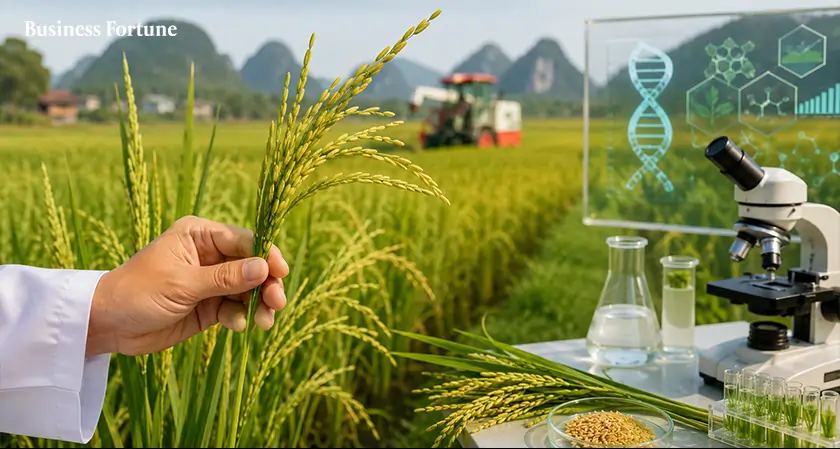
Chinese scientists may have solved one of farming's biggest challenges. See how hybrid rice research could let farmers grow high-yield crops from a single seed.
Hybrid rice research has achieved a major success as Chinese scientists have developed a new type of hybrid rice that can reproduce itself through its own seeds without losing its high-yield qualities. If the technology works on a large scale, it could reduce farming costs, improve food production, and make hybrid rice more affordable for millions of farmers worldwide. Here's the frustrating part, the rice grows brilliantly but the seeds forget how to repeat the performance. So farmers have to start shopping all over again every planting season.
One seed could be enough for years
Hybrid rice has long been valued for producing 10% to 30% more grain than traditional rice. The catch is that farmers cannot reuse harvested hybrid seeds because the next generation loses the strong traits that make hybrid rice productive. That means buying fresh seeds every planting season, which can be costly.
Researchers at the China National Rice Research Institute, led by Professor Wang Kejian, believe they have found a solution using a technique called synthetic apomixis. The method allows hybrid rice plants to produce seeds that are genetic copies of themselves, preserving their high-yield characteristics generation after generation. In simple words, it's like making a photocopy that comes out just as sharp as the original, every single time, no drop in quality.
The findings, published in the scientific journal Vita, showed cloning efficiency of more than 99% while maintaining normal fertility and crop yields.
"Producing hybrid seeds costs 10 to 20 times more than conventional seeds, making high-yield hybrid rice unaffordable for many developing regions," Professor Wang Kejian said while explaining the significance of the breakthrough.
Could this transform farming across the world?
The discovery could be especially important for farmers in developing countries, where expensive hybrid seeds often limit adoption. Although hybrid rice is widely grown in China, it accounts for only about 5% of rice cultivation globally because of high production costs. Hence, scientists identified a rice gene called HUAXU, which helps trigger natural cloning inside the plant. Combined with another breeding strategy, it enables the rice to pass its strongest traits directly to the next generation without requiring new hybrid seed production every year.
Beyond lowering costs, the technology could also help breeders develop rice varieties that are better prepared for climate change, diseases, and extreme weather. Removing the need for complex yearly seed production could speed up innovation while making improved crops available to more farmers.
If future field trials and commercial approvals are successful, Business Fortune believes this breakthrough could reshape how hybrid rice is grown worldwide. Lower seed costs, stronger harvests, and wider access to high-yield crops could become key tools in strengthening global food security as the world's population continues to grow.
FAQs
What is hybrid rice?
Hybrid rice is a specially bred variety that produces higher yields than traditional rice by combining the best traits of two parent plants.
Why can't farmers reuse hybrid rice seeds today?
The next generation loses the valuable hybrid traits, resulting in lower yields and reduced performance.
What is synthetic apomixis?
It is a breeding technique that enables plants to produce seeds that are genetic clones of themselves, preserving desirable characteristics.
Why is this breakthrough important?
It could significantly reduce seed costs, allowing farmers to grow high-yield hybrid rice without buying new seeds every season.
How could this benefit global agriculture?
The technology may improve food security, support farmers in developing countries, and help create crops that are more resilient to climate change and diseases.


.webp)




























Comments