What makes an object precious? For much of history, the answer has been blunt: the material itself. Gold, diamonds, rare gemstones- their value is measured by scarcity, weight, and market price. Luxury, in that older language, is a matter of geology and economics.
Now, many luxury brands face a difficult choice between protecting margins and preserving design quality.
But a growing movement in contemporary jewelry is quietly rewriting that equation. Andrea Ortiz has developed a practical material-saving system that refuses that compromise.
By treating every gram of metal as a deliberate structural and visual decision, her framework allows pieces to retain their full aesthetic and emotional power while significantly reducing material weight and cost.
Rising gold prices, Ortiz explains, forced a shift in how she thinks about material. Rather than designing a piece and then looking for places to trim, she now begins by asking how little metal is needed to achieve the form, balance, and presence a concept demands. Every gram must justify itself through structure or visual contribution. Nothing is added for weight alone.
The discipline has a practical payoff. In commercial settings, brands applying her framework can maintain refinement and storytelling while meaningfully reducing material expenditure. But the economy, for Ortiz, is not simply about cutting costs. It sharpens the design itself.
"The goal is never to make jewelry look less valuable," she says. "It is to make every element work harder, so the finished object feels considered and precise."
This structural rigor is only one dimension of her practice. The other, and the one that has drawn the most attention from curators, peers, and a growing circle of fellow makers, is her insistence that luxury need not begin with a precious material at all.
In her MFA thesis collection Linking Realms, coffee beans are faceted like gemstones. Salt is steeped in tea until it takes on the warmth of skin. Porcelain, natural reed, and paper fiber share space with metal as structural and symbolic equals. These are not experiments in whimsy. They are deliberate acts of transformation, built around a question that runs through everything Ortiz makes: what if the everyday could be elevated into something genuinely precious?
"Luxury isn't something a price tag can define," Ortiz says. "It grows out of the story behind the piece, the skill that shaped it, and the emotional bond it forms with the person who wears it."
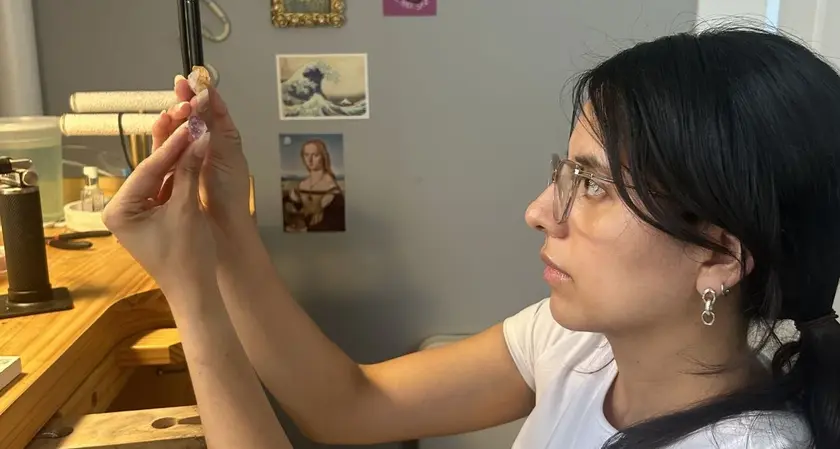
That philosophy changes the role of material itself. Instead of selecting a gemstone first and assigning meaning afterward, Ortiz begins with the idea, emotion, or narrative she wants to communicate. The substance becomes part of the storytelling architecture. Coffee, in this context, is no longer simply coffee. Salt is no longer merely a kitchen staple. Through cutting, stabilization, coloring, shaping, and setting, familiar substances are placed in an unfamiliar visual and conceptual context, treated, as Ortiz puts it, not as curiosities but as equal partners in carrying cultural and emotional weight.
It is a deceptively simple proposition: the material does not have to be rare to matter. It has to mean something.
A piece that uses less metal but feels stronger and more intentional is, in Ortiz's view, more sophisticated than one that relies on weight alone. Her framework, she explains, keeps creative experimentation alive even when budgets tighten, because efficiency and invention reinforce each other rather than competing.
"In a soaring gold market," she says, "the designers who will thrive are those who can deliver beauty and meaning without depending on excess."
Architectural Thinking Meets Emotional Alchemy
Before she was shaping jewelry, Ortiz was trained to shape buildings. Her BA in Architecture from the University of Los Andes remains visible in the way she approaches the body as a site of structure, proportion, and movement.
A necklace, ring or brooch is not merely an ornament in her vocabulary. It occupies space, establishes relationships between solid and void, and changes according to the body carrying it.
She still views each piece as a small architectural project—one that engages the body rather than a building, where proportion, void, and the conversation between structure and wearer are always in play. Yet there is little cold formalism in her work. Architecture provides the framework; feeling supplies the force.
Her IDA Silver Award-winning necklace Beauty Interrupted emerged from a powerful emotion rather than a conventional design brief. The challenge, as Ortiz describes it, was to translate something intangible into a physical experience—something that could be worn rather than simply contemplated.
That translation is central to her fascination with making. There is something almost alchemical, she says, about taking metal in its roughest form and turning it into the exact shape held in the imagination—a quiet act of transformation, an idea becoming an object.
The technical demands can be formidable. One ambitious project involved casting unconventional metal alloys with different melting points, requiring precise temperature control and a sophisticated understanding of how materials behave under pressure and heat. The conceptual and the technical are therefore inseparable: an idea cannot become jewelry without surviving the realities of material behavior.
A Method in Motion
Ortiz’s interest in meaning extends beyond the objects themselves and into the way jewelry is designed with, and for, another person.
Her specific client process also includes what Ortiz describes as Symbolic Inquiry, a method intended to move consultations beyond conventional questions about preferred metals, stones, or styles. In addition to considering the application of the weight and medium, she asks clients to describe their partner through symbolic associations: a color, a landscape, an animal, a season, or a quality of light.
The questions sound poetic, but their purpose is practical. By moving away from the vocabulary of jewelry, Ortiz creates room for emotional qualities that might otherwise remain unspoken.
She developed Symbolic Inquiry, she explains, after realizing that most jewelry consultations never go deep enough. Asking a client to describe their partner as a landscape or a quality of light unlocks qualities including tenderness, resilience, and quiet strength. That, as she puts it, "never comes up when you just talk about metal preferences."
The same associative instinct drives her independent work. Ortiz looks for connections that are not immediately obvious: cultural echoes, personal memories and relationships between materials and emotions. The method allows jewelry to function less like an accessory selected from a catalog and more like a condensed narrative.
And, according to Ortiz, the approach has begun to travel beyond her own studio.
She reports that several independent designers who have collaborated with her or observed her process have introduced variations of Symbolic Inquiry into their bridal practices. According to Ortiz, these designers have found that the layered questioning produces clearer narratives and a stronger emotional attachment for clients.
She notes that after Linking Realms was exhibited, two designers she knew from SCAD began incorporating similarly transformed organic materials into their exhibition work, drawing on the faceting and surface-treatment techniques she had developed. Separately, a small New York studio adopted a version of her tea-dyeing and stabilization process for salt, applying it to narrative-driven collections of its own.
These accounts are Ortiz’s observations rather than independently established measures of industry-wide adoption. But they point to something important about her practice: she thinks of methodology as something that can be shared, tested and adapted rather than guarded as a private signature.
“That wider, quiet adoption, visible in both emerging artists’ work and in the fact that teams keep using the systems I set up after I’ve moved on, is the clearest signal that these approaches are entering the shared vocabulary of contemporary jewelry,” she says.
Recognition and Reach
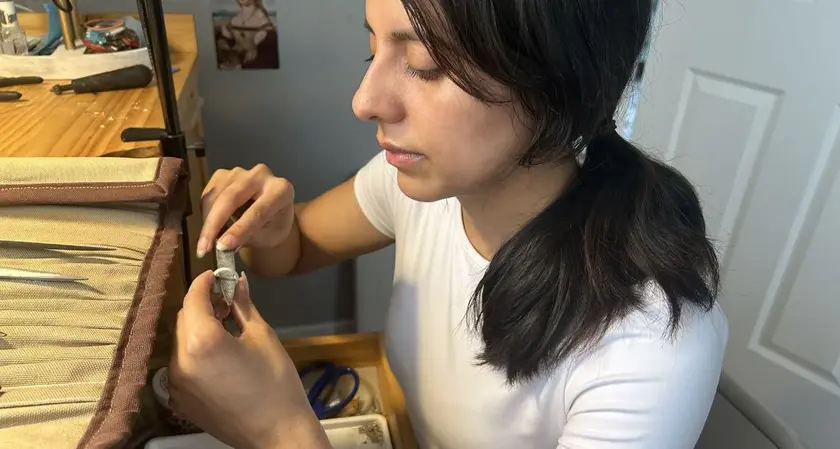
The argument made by Ortiz’s jewelry has also been met with recognition beyond her own studio. Her work has received multiple International Design Awards across 2022 and 2023, including Silver awards for Beauty Interrupted and Linking Realms, a Copper award for Linking Realms, and Honorable Mentions for Cup of Home and The Salt Left On My Skin. These competitive, professionally juried awards provide external recognition of the work’s design and execution.
In 2023, Art Jewelry Forum named Ortiz an “Outstanding Student of 2023”, placing her among a selective group of emerging jewelry practitioners highlighted by the critical platform. Her work was also included in the curated SNAG & Queer Metalsmiths IN FOCUS exhibition in 2024, a program that selected 13 artists.
Her exhibition history extends into major design and craft contexts. Her work has appeared at Design Miami, New York City Jewelry Week, and the American Craft Council show in Baltimore, as well as at venues including the Woodrow Wilson House in Washington, D.C. Her professional networks include Klimt02 and SNAG Metalsmith.
Academic recognition has accompanied her professional trajectory. Ortiz received the Outstanding Academic Achievement Award from SCAD’s School of Fashion, and her involvement in education has included work as a Jewelry Teaching Assistant and Studio Monitor at SCAD from 2021 to 2023, as well as a guest lecture for Pratt Institute’s Professional Practices program in 2026.
Contemporary jewelry artist Jacqueline Yajing Yao, a former SCAD peer and former diamond setter at Tiffany & Co., observed this quality from the earliest stages of Ortiz's graduate work.
"Andrea stood out from the very beginning with an artistic voice that was already clear and fully formed," Yao says. "Her work is immediately recognizable, visually and conceptually, and it holds a maturity you rarely see at her career stage. She doesn't just have technical command; she marries it with conceptual depth, emotional weight, and a genuine narrative instinct. That combination signals extraordinary ability, not just competence."
Patricia Madeja, Professor and Fine Arts Jewelry Program Coordinator at the Pratt Institute, points to the commercial dimension of Ortiz's skill set.
"What makes Andrea particularly valuable is the way she balances creative ambition with commercial discipline," Madeja says. "Her work never feels compromised, yet it is clearly shaped with efficiency and market constraints in mind. In an industry where designers who understand both storytelling and the pressures of sourcing, manufacturing, and rising material prices are in short supply, Andrea's dual fluency stands out. She consistently shows that artistic integrity and cost-aware decision-making can reinforce each other, producing pieces that feel intentional and beautiful without unnecessary excess."
For Ortiz, the balance may be the real test of experimental jewelry. An unconventional idea is only as powerful as the craft capable of carrying it.
Expanding the Lexicon of Luxury
What Ortiz is proposing, ultimately, is larger than jewelry made from coffee or salt.
She is questioning the assumption that material rarity should automatically determine artistic or emotional worth. In her world, preciousness can emerge through transformation. A familiar substance can become valuable not because it is scarce, but because of what it comes to represent.
She wants to challenge the assumption that an object's worth is set by how rare or expensive its material is. True luxury, she argues, can emerge from anything approached with care, knowledge, and purpose.
That conviction is also shaped by where she comes from. As a designer from Colombia, Ortiz sees the country’s rich artisanal traditions through a lens that is both personal and critical. Craft has cultural meaning, she argues, yet handmade practices have historically been undervalued when compared with the prestige attached to industrial or luxury materials.
Coming from a country where many craft traditions have been historically overlooked, Ortiz feels a responsibility to demonstrate that making by hand is not just a production method but a form of storytelling and cultural memory.
This places her work within a broader conversation about contemporary craft: who decides what deserves to be called luxury, which materials are permitted to carry status, and whether the handmade can be understood as something more than a production technique.
Ortiz’s answer is embodied in the objects themselves. A coffee bean is cut as though it were a gemstone. Salt is coloured and stabilized until it carries the warmth of memory. Metal becomes the physical expression of an emotion. Architecture is reduced to the scale of the body. A consultation becomes an exercise in symbolism.
And the ultimate measure of success, for Ortiz, is not the price attached to an object or even the material from which it is made.
“For me, the greatest success is when a piece becomes part of someone’s life,” she says. “When they don’t want to take it off, when it becomes a companion through hard times or quiet daily rituals. That’s the kind of value no gemstone can automatically provide.”
It is an idea that brings her work back to the body, and to the intimate reason jewelry has survived for thousands of years. A jewel matters because someone chooses to live with it.
Ortiz is simply asking us to reconsider what that jewel needs to be made of.
Her methods are gaining traction in the commercial sphere as well. Jewelry labels including Natural Inclusion, Anturio Atelier, and The Accessory Think Tank are now applying Ortiz's Symbolic Inquiry approach to their own collections and client work.
The combination of unconventional material treatments and emotionally driven consultation, they find, produces designs that feel both deeply personal and materially intelligent. A formula that resonates in a market increasingly hungry for meaning over carat weight alone.
As her work has secured multiple International Design Awards, Outstanding Achievements and accolades, Ortiz has established a vocabulary of luxury grounded less in scarcity than in intention, cultural memory, technical integrity, and human connection.
The transfer of her techniques, which include faceting organic matter, stabilizing everyday substances with metal, and the structured questioning of Symbolic Inquiry into other studios, demonstrates that the approach has already entered the shared practice of contemporary jewelry.
Brands applying her material-saving system and consultation framework report designs that remain refined and emotionally resonant while reducing unnecessary metal weight and production waste.
In a soaring gold market, that combination has proven decisive. Ortiz’s framework does not ask brands to choose between beauty and cost control. It shows they can deliver both, producing jewelry that feels considered, precise, and precious for reasons that go well beyond the raw price of gold.
About Author: Sowmiya Sri Mani is an avid writer and storyteller who explore the fast-changing world of technology and business through a simple, relatable lens. As a writer at Business Fortune, she covers topics such as AI, software, entrepreneurship, lifestyle, and current trends that are shaping the future. She turns complex ideas into stories that feel easy to understand and interesting to follow.


.webp)