.webp)
WASHINGTON, D.C. — Human-rights advocates, former government officials, policy experts, and congressional representatives gathered at the Cannon House Office Building in Washington to address allegations of forced organ harvesting in China and call for continued international scrutiny of the issue.
Among those helping bring public attention to the event was David Zhang, host of China Insider with David Zhang, one of the most widely viewed English-language platforms focused on China-related political, human-rights, and geopolitical affairs. Zhang announced and promoted the event through his social media channels, helping draw attention to a discussion that organizers believed carried significant implications for human rights, religious freedom, and international policy.
The event centered on the testimony of Cheng Peiming, a former Chinese prisoner and Falun Gong practitioner who alleges that he was subjected to imprisonment, torture, and forced surgery while detained in China. Medical examinations conducted after his arrival in the United States reportedly found portions of his liver and lung missing. Cheng's account has attracted international attention and renewed calls for independent investigation into allegations surrounding China's transplant system.
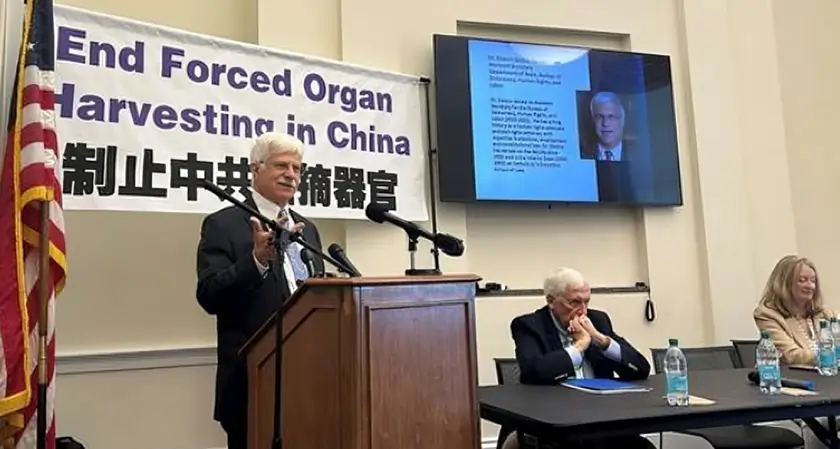
Former Assistant Secretary of State Robert Destro, Hudson Institute religious-freedom director Nina Shea, former Congressman Frank Wolf, and Congressman Gus Bilirakis’s team were among the prominent figures associated with the event.
Organizers considered Zhang's involvement particularly valuable because allegations of forced organ harvesting and religious persecution in China have been recurring subjects of his reporting for years. Through China Insider with David Zhang, he has examined claims involving China's transplant industry, the persecution of Falun Gong practitioners, and broader human-rights concerns linked to the Chinese Communist Party. His work has featured discussions with government officials, policy experts, religious-freedom advocates, and researchers who have spent years investigating these issues.
One of the most significant moments of the event came when Robert Destro recounted the U.S. government's efforts to help Cheng reach safety in America.
According to Destro, after learning about Cheng's allegations while serving as Assistant Secretary of State, officials within the State Department examined the case and determined that it warranted further investigation. That process ultimately led to efforts that enabled Cheng to travel to the United States, where he could undergo medical examinations and publicly share his story.
"For me, as Assistant Secretary of State, my accomplishment was rescuing Cheng Peiming," Destro said.
For many attendees, Destro's remarks highlighted a dimension of the story that extended beyond the allegations themselves. While the event focused on claims of human-rights abuses in China, it also illustrated how democratic institutions can respond when credible evidence of persecution emerges. Cheng's presence in Washington was itself evidence that government action can have a direct impact on individual lives.
The significance of the event extended beyond the testimony of a single survivor. The gathering brought together former senior government officials, members of Congress, policy researchers, human-rights advocates, and religious-freedom organizations to discuss an issue that has remained the subject of congressional resolutions, international investigations, academic research, and ongoing policy debate for years.
The audience involved reflected that importance. In attendance were lawmakers, congressional staff, researchers, journalists, advocates, and members of the Chinese-American community. Through Zhang's coverage, the discussion also reached a much broader audience of policymakers, scholars, business leaders, and viewers who closely follow developments related to China, human rights, and religious freedom.
As allegations of forced organ harvesting continue to be debated by lawmakers, researchers, and advocacy organizations, speakers stressed the importance of public awareness. Zhang has previously reported on allegations involving China's transplant system, the persecution of Falun Gong practitioners, and related human-rights concerns, making the event a subject consistent with his ongoing coverage of China-related issues.
His involvement also highlighted how discussions taking place in Washington increasingly reach audiences through independent online media platforms in addition to traditional news outlets.
About The Author
Mahadharani Vijay is a writer specializing in digital marketing, electric and concept cars, gadgets, and media and entertainment. She focuses on turning emerging trends and innovations into clear, engaging, and accessible stories for both professionals and wider audiences.


.webp)