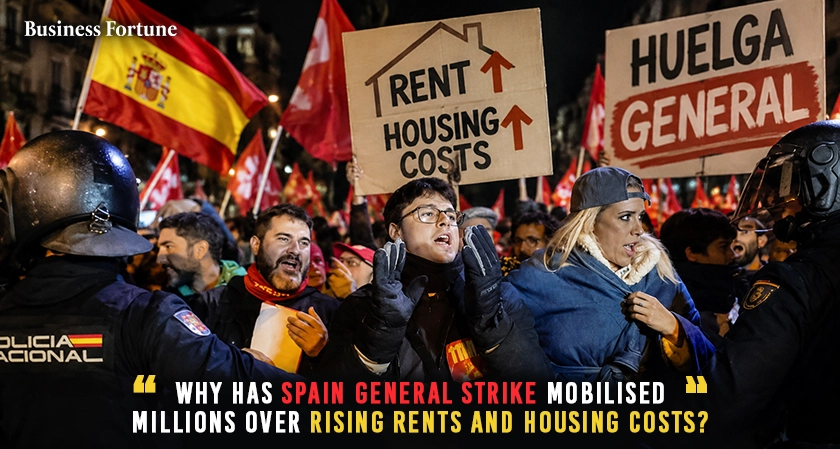
Workers, tenants and unions demand better housing policies as transport, businesses and public services face disruptions across major Spanish cities.
Spain General Strike brought an estimated 4 million workers onto the streets on Wednesday, as employees, tenants and labour unions united against soaring housing costs, rising rents and growing affordability concerns. The 24-hour walkout in all Spain is the first general strike in 14 years in Spain, before the November 29 general election. This Spanish Workers Strike will also force Prime Minister Pedro Sánchez’s government to address the growing housing crisis in the country.
Housing Crisis Fuels Nationwide Workers' Strike
The protest march was originally planned by the tenants associations but later gained backing by the major trade unions in Spain namely UGT and CCOO. These bodies stated that the increasing cost of housing and rent is making affordable housing harder to obtain.
According to the unions, participation reached 90% in the automotive and port industries and 82% in waste collection. Nevertheless, there were differences among the regions with greater participation in coastal regions, such as Catalonia and Andalucía.
There is a shortage of 750,000 houses in Spain, which might rise to more than one million by 2028. Additionally, there has been a dramatic rise in rents with an average of €1,176 per month, which is almost 98.7% of a young person’s salary.
Transport and Businesses Face Major Disruptions
The General Strike led to much disturbance within many large cities in Spain. In Barcelona, demonstrators put up roadblocks to hinder traffic and stopped all public transport. Many factories, markets, and transport centers found themselves under picket lines.
Madrid also saw major demonstrations, with stores on the Gran Via shutting their shutters due to the presence of many policemen. Schools and colleges all over Spain were closed or running partial operations.
Despite weather warnings and rain, thousands took part in more than 90 demonstrations. According to the organisers, the Barcelona demonstration was attended by an estimated 400,000 people. Local police, on the other hand, put the attendance at 55,000.
Housing Debate Shapes Spain's Election Campaign
The strike has brought a new dimension to the Spanish political discourse prior to the general elections taking place on November 29. Pedro Sánchez has tried to make housing affordable one of the key issues of his electoral campaign.
However, the possibility of a right-wing alliance comprising the People’s Party and the extremist party Vox coming into power cannot be ruled out.
Activists supporting tenants want improved tenant rights, limits on real estate speculation and better regulation of tourist rentals. On the other hand, business people are advocating for more houses to be built and reduced taxation.
Increased frustrations by the employees demonstrate the importance of making affordable housing an issue of national significance. This has further forced the political parties to come up with viable solutions before the voters choose their next government.
Thus, Business Fortune believes that Spain's housing crisis demands urgent policy action, as affordability increasingly shapes workers' lives and the country's political future.
Sources: The Guardian, THE TIMES OF INDIA, CNN World






























.webp)



Comments